

日本語 | 繁體中文 | English | 한국어 | Tiếng Việt
Two days until August 14 and 15.
At the venue, POOL LABO, the cloth is being replaced right now.

What it means to replace the cloth
The cloth is the fabric stretched across the top of a pool table.
The more it is played on, the more it fuzzes, and the roll of the balls slowly changes.
A change so slight you wouldn’t notice it in everyday play.
But on a stage where top-level players compete, that “slight change” can decide the result.
That is why, on the 12th and 13th, just before the tournament, the cloth on six tables is being replaced.
This time, the cloth is the competition-grade “CPBA Competition.”
The old cloth is stripped away, and the new cloth laid carefully, one table at a time.
Finishing a single table takes no small amount of time.
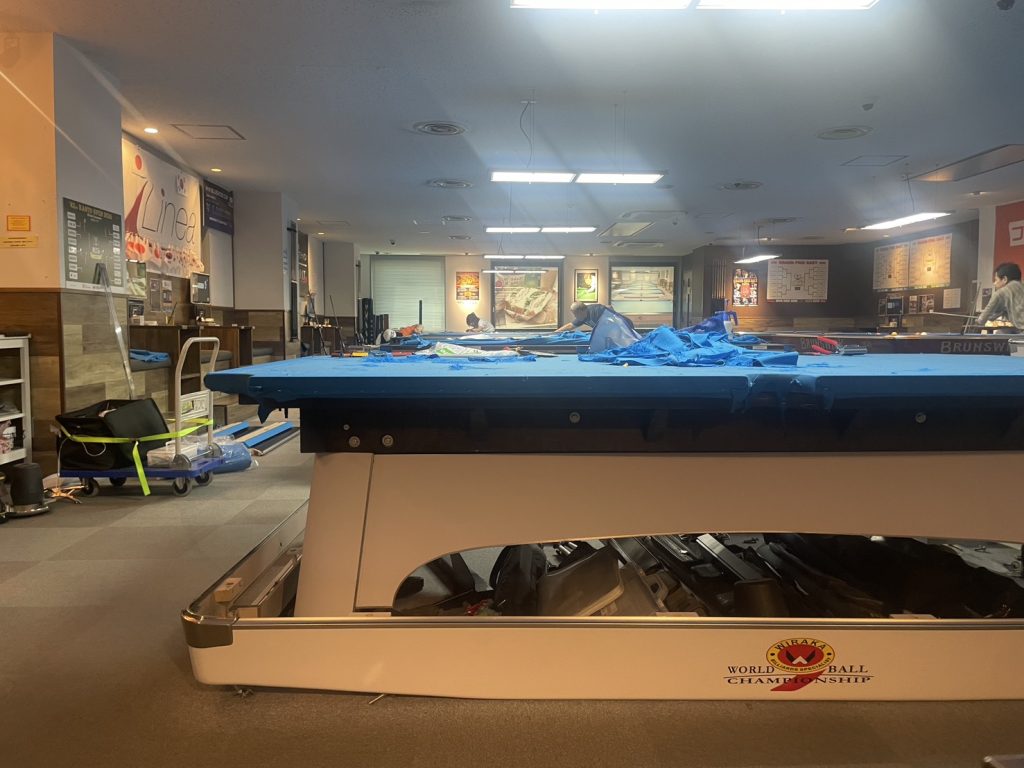
In truth, these are not easy tables
It isn’t only the new cloth.
The tables at POOL LABO have relatively lively cushions and relatively tight pockets.
For 14.1 (straight pool), these are by no means gentle conditions.
To string together big runs, position play must be all the more precise.
Fast cushions call for a more delicate touch on speed.
Tight pockets leave no room for even the slightest error in the cut.
Add to that freshly laid cloth.
How quickly can you adapt to conditions unlike your usual home table?
That, too, is one of the abilities asked of the players.
One more variable for the players
As we’ve shared in earlier posts, the preliminaries of this tournament layer unique rules on top of one another: a race to 50, a 40-minute time allowance, and both players losing at 75 minutes.
Add to that fast cushions, tight pockets, freshly laid cloth.
On conditions alone, this is by no means an easy tournament.
But that is exactly why something comes into view.
In these demanding conditions, who will play what kind of 14.1?
Will they hold to their usual game?
Or change their style to suit the conditions?
That judgment itself is what makes this tournament worth watching.
14.1 is played with the mind
14.1 is not simply a game of striking balls.
You look at the balls scattered across the table and build the run in your head.
In what order will you take them?
Where is there a “cluster,” balls packed tight together?
When, and how, will you break it up?
With every ball, you play while reading what comes next.
It is a game that tests not just stamina but the power of thought.
Clusters, one by one
In 14.1, balls gather into tight clumps — clusters.
Play on without breaking them, and sooner or later you run out of shots.
That is why players notice clusters early and judge the moment to break them open.
Break one cluster, then on to the next.
That accumulation leads to long runs.
Behind the flashy shots lies quiet, meticulous calculation.
And this time: fast cushions, tight pockets, freshly laid cloth.
Precisely because the conditions are not the usual ones, that calculation demands even greater precision.
Thought becomes numbers
As we mentioned in an earlier post, this tournament publishes stats for every player.
Average, high run, innings.
These numbers are results, and at the same time a record of how each player thought.
A player who keeps a high average may have handled clusters and built their racks well.
A player whose high run keeps climbing may have their timing for breaking clusters and their planning in sync.
Behind every number, there is always a player’s decision.
You can enjoy it without knowing
You don’t need to know the rules of 14.1 in detail.
“Why stop the ball there?”
“Why choose that spot?”
Watch with questions like these, and the meaning of each shot gradually comes into view.
Even for players who don’t usually play 14.1, this tournament may hold new discoveries.
And there is a sensation we’d love even people who rarely touch pool to experience.
It is the pleasure of tracing someone else’s thinking from the outside.
It may be a little like watching shogi or go.
The pleasure of following not the moves themselves, but the thinking behind them.
14.1 has that same pleasure.
These two days, in the best possible condition
There are people preparing the venue for the tournament.
Table by table, they lay the cloth with care, getting ready to welcome the players.
Beyond all that effort lies each shot the players will play.
The vivid blue of freshly laid cloth.
And the ones who will witness those shots are all of you who come to the venue.
Admission is free.
Fast cushions.
Tight pockets.
And freshly laid cloth.
In conditions that are anything but gentle, what will the players think, and how will they play?
Come to the venue and spend a little time tracing that thinking.
It doesn’t matter if you don’t know the rules, or if pool is unfamiliar to you.
Following the judgment behind each shot — please savor that intellectual experience over these two days.
Watching is free.
Two days to the tournament.
👉 Tournament details & draw
👉 Player stats