

Game Rules 04 Billiards Guide
What is 14.1?
The rules, and how to play.
14.1 (straight pool) is one of the most traditional games in pocket billiards. You need not shoot the balls in order; any object ball you pocket is worth one point, and the first player to reach the agreed score wins. Beneath its simple rules lies real depth, a test of every part of your game.
At a glance
Key points
- Balls
- One cue ball and fifteen object balls numbered 1 to 15. Sixteen balls in all
- How to win
- One point per ball. First to the agreed score (100, say) wins
- Continuing play
- When 14 balls are down, rerack those 14, leaving the last ball (the break ball) on the table, and keep shooting
- Rack
- Triangle (five rows). 15-ball at the apex (on the foot spot), 1-ball and 5-ball at the back corners
- Call shot
- Yes. On every shot, including the break, you call the ball and the pocket
This page follows the Nippon Billiard Association (NBA) “Pocket Billiards Competition Rules” (June 2026 revision, in Japanese). Where the World Standardized Rules (WPA Rules of Play, in effect since September 2025) differ, we have added a note each time, under “Under the World Rules (WPA).” At a tournament, that event’s own regulations take precedence.
01Balls used
- 1 cue ball (white)
- 15 object balls, numbered 1 to 15
A ball’s number makes no difference to scoring: every ball counts as one point. Nor do you need to shoot them in order.
02Object of the game
The object is to reach the agreed score before your opponent. Each called ball pocketed legally adds one point.
The name “14-1” (fourteen-one) comes from the way play continues: once 14 of the 15 balls are down, those 14 are reracked with the last ball left on the table, and play goes on. In English it is called “14.1 Continuous Pool,” and in Japan it is also known as “straight pool.”
Example target scores
Races to 50, 75, 100 or 150 points, chosen to suit the format and the time available. Pocketing all 15 balls of a rack earns 15 points.
03Racking
Fifteen balls are racked in a triangle. From the second rack on, the rack has 14 balls (see below).
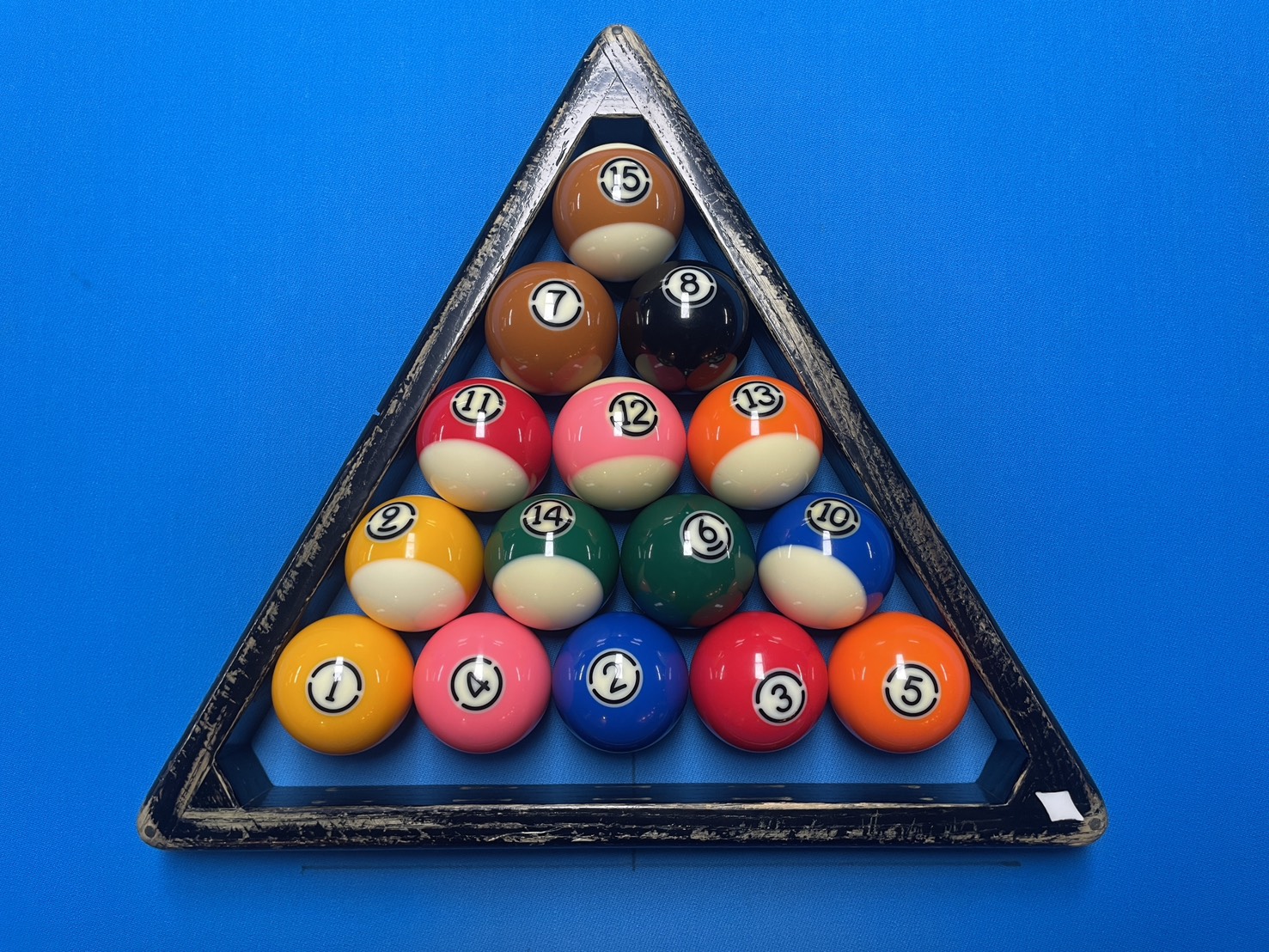
| Position | Ball | Notes |
|---|---|---|
| Apex (foot spot) | 15-ball | Always fixed |
| Corners of the 5th row | 1-ball and 5-ball | Either side is fine |
| Others | Remaining balls | Placed freely |
From the second rack on, 14 balls are racked with the apex (foot spot) position left empty. [NBA Ch. 13, Art. 3]
04Call shot
Every shot, including the break, is a called shot. You declare the ball and the pocket before shooting, and score one point when it goes in as called. [NBA Ch. 13, Art. 7]
If you do not intend to pocket a ball, call “safety” before you shoot. Any object ball pocketed on a safety does not score; it is spotted on the foot spot and the turn passes to the opponent. [WPA 7.5]
05Break shot
The starting player breaks from anywhere in the kitchen (behind the head string). The called-shot rule applies to the break as well.
Break requirements and the break foul
On the opening break, you must either pocket the called ball or, after the cue ball contacts an object ball, drive the cue ball and at least two object balls to a cushion (if the cue ball scratches, it is treated as having reached a cushion). [NBA Ch. 13, Art. 4, Para. 1]
Failing that, it is a break foul: a two-point deduction. The opponent may choose either to rerack and have the offender break again, or to play on from the position as it lies. Either way, the deduction is two points. [NBA Ch. 13, Art. 9, Para. 4]
If a break that meets these requirements involves a foul such as a scratch or touching a ball, it is a one-point deduction, and the opponent plays from the position as it lies (after a scratch, with the cue ball behind the head string). [Ibid.]
Fouls on the opening break do not count toward three consecutive fouls. [NBA Ch. 13, Art. 8, Para. 2]
06How the game flows
- Lag to decide who shoots first
- The starting player breaks (usually calling safety)
- One point for each successful called shot; keep shooting
- A miss, a safety or a foul passes the turn
- Once 14 balls are pocketed, rerack (see next section)
- The first player to reach the target score wins
07Reracking and the break ball
When 14 of the 15 balls have been pocketed and only one remains on the table, the other 14 are reracked. That last remaining ball is called the “break ball.”
- 14 of the 15 balls are pocketed
- The last ball (the break ball) stays where it is
- The 14 balls are reracked (with the apex position empty)
- With the cue ball where it lies, call and shoot the break ball. Usually the player pockets the break ball while sending the cue ball into the new rack to spread the balls, and play continues
All the rules require is that the called ball goes in. Breaks from the second rack on carry no cushion requirement like that of the opening break. [NBA Ch. 13, Art. 4, Para. 3]
When the balls get in the way of the rack
If the break ball or the cue ball lies within the triangle where the 14 balls go, they are re-spotted as follows. [NBA Ch. 13, Arts. 5-6]
| Situation | How to re-spot |
|---|---|
| Only the cue ball is in the rack area | The cue ball goes behind the head string. If the break ball is also behind the head string, the cue ball goes on the head spot (or the center spot if that is occupied) |
| Only the break ball is in the rack area | The break ball goes on the head spot (or the center spot if the cue ball is in the way) |
| Both are in the rack area | All 15 balls, break ball included, are reracked; the cue ball is played from behind the head string |
| The 14th ball and the break ball drop on the same shot | Rerack all 15 and continue (the break ball scores too). If the cue ball is in the rack area, it goes behind the head string |
08Main fouls
A foul brings a one-point deduction and passes the turn to the opponent. Deductions can take a score below zero. [NBA Ch. 13, Art. 9, Para. 2]
| Foul | What happens |
|---|---|
| Bad hit | The cue ball hit no object ball |
| No rail | After contact with an object ball, neither the cue ball nor any object ball reached a cushion, and no object ball was pocketed |
| Scratch | The cue ball goes into a pocket |
| Touching a ball | Touched the cue ball or an object ball with the body or cue, other than in a stroke |
| Ball off the table | The cue ball or an object ball left the table |
| Double hit | Struck the cue ball twice with the cue |
| Both feet off the floor | Both feet were off the floor during the shot |
For definitions of fouls and how each game treats them, see the List of Fouls.
09Three-foul penalty
If the same player fouls three times in a row, a heavy penalty is added on top of the usual foul deduction.
When three consecutive fouls occur
1 point for the third foul + a 15-point three-foul penalty = 16 points deducted in all. [NBA Ch. 13, Art. 9, Para. 3]
After three consecutive fouls, the opponent may choose either to play on from the position as it lies, or to rerack and have the offending player break again. [NBA Ch. 13, Art. 8, Para. 2]
Once three consecutive fouls are called, the foul count resets, and the next shot starts with no fouls on record. Fouls on the opening break are not counted.
10What is a high run?
A high run is the number of points scored in succession in one inning (one turn at the table). Pocket 30 balls in a row in a single turn, for example, and that is a high run of 30.
11Match format and point handicaps
14.1 is decided not by a race to racks but by a race to points. A target score is set before the match, and the first player to reach it wins.
| Target score | What happens |
|---|---|
| Race to 50 | Quick to play. Good for a first match |
| Race to 100 | The standard setting. Room to test your skill properly |
| Race to 150 | A full-scale match format. Demands sustained concentration |
When the players differ in strength, a points handicap is used. For example, “advanced player 100, beginner 50”: giving each player a different target score makes for a match close to even.
12Frequently asked questions
Where does the name “14-1” come from?
From the way play continues: once 14 of the 15 balls are in, those 14 are reracked with the last ball (the break ball) left on the table, and you keep shooting.
How is it pronounced, and what else is it called?
It is said “fourteen-one.” It is sometimes written 14.1, and it is also called straight pool, or continuous pool (14.1 Continuous Pool).
Does a ball’s number change its value?
No. Every ball is worth one point. If the called ball goes in, any others that drop with it add one point each.
After a foul, what happens to the cue ball?
One point is deducted and the turn passes to the opponent, who plays the cue ball from where it lies. Only after a scratch is it placed behind the head string.
How many points do three consecutive fouls cost?
One point for the third foul plus a 15-point penalty: 16 points in all.
What is the break ball?
The last ball left on the table after 14 have been pocketed. You call and pocket it while sending the cue ball into the reracked balls, and keep shooting.
👉 Once you know the rules: lessons and match streams in Billiards in Depth