

Game Rules 05 Billiards Guide
What is Rotation?
The rules, and how to play.
Rotation grew out of a game called “61,” played in mid-19th-century America, and is a traditional pocket billiards game long loved in Japan. As in 9-Ball, you must first hit the lowest-numbered ball, but it is a points game: the number of each ball you pocket is its score. Every ball carries a different weight, and great comebacks happen.
At a glance
Key points
- Balls
- One cue ball and fifteen object balls numbered 1 to 15. Sixteen balls in all
- How to win
- The number of each ball pocketed is its score. First to the agreed total (a race to 120, a race to 150 and so on) wins. A rack totals 120 points
- Which ball first
- Always hit the lowest-numbered ball on the table first
- Rack
- Triangle (five rows). The positions of all 15 balls are fixed
- Call shot
- Depends on the event or pool hall (if used, on all shots except the break)
This page follows the Nippon Billiard Association (NBA) “Pocket Billiards Competition Rules” (June 2026 revision), Chapter 11, “Rotation Rules.” The World Standardized Rules (WPA) have no provisions for Rotation, so there are no notes on differences from the WPA. In tournaments, the event’s own regulations take precedence.
01Balls used
- 1 cue ball (white)
- 15 object balls, numbered 1 to 15
On every shot, the cue ball must first strike the lowest-numbered ball on the table.
02How scoring works
Each ball you pocket scores its own number. [NBA Ch. 11, Art. 8]
03Object of the game
The object is to reach the agreed score before your opponent.
Example target scores
Races to 120 and 150 are the most common; depending on the format and the time available, matches may also be played as races to 180 or 240.
A rack totals 120 points, so even a race to 120 usually runs to two racks or more.
04Racking
Fifteen balls are racked in a triangle. Every ball has a fixed position, arranged so that high-numbered balls are hard to pocket on the break.
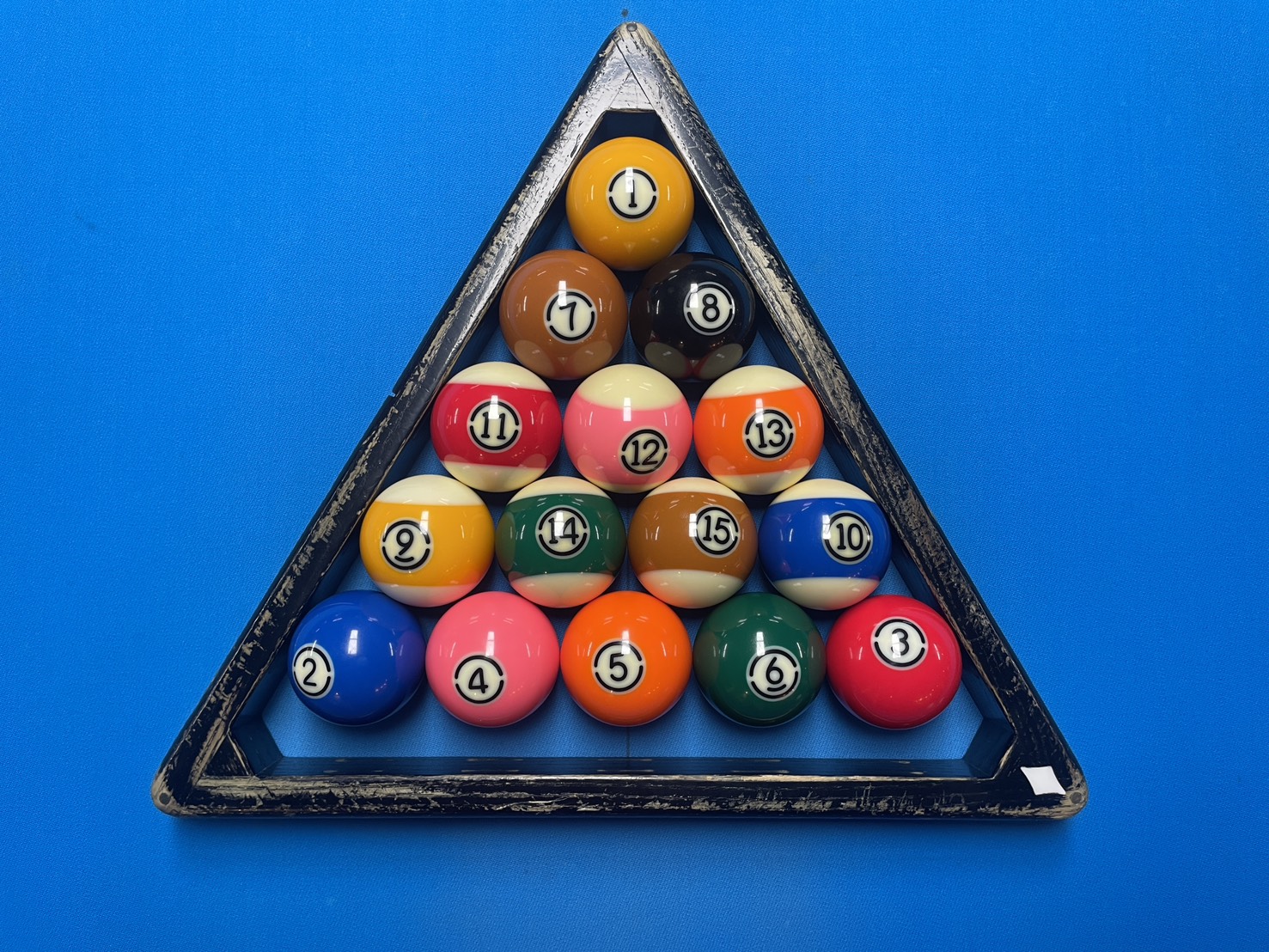
| Row | Balls (left to right) |
|---|---|
| Row 1 (apex, on the foot spot) | 1 |
| Row 2 | 7, 8 |
| Row 3 | 11, 12, 13 |
| Row 4 | 9, 14, 15, 10 |
| Row 5 (back) | 2, 4, 5, 6, 3 |
In the back row, the 2-ball and 3-ball sit at the corners and the 5-ball in the middle. Rack so that the line joining the 1-ball and the 5-ball lies on the table’s long center line (the long string). [NBA Ch. 11, Art. 3, Fig. 11-1]
05Call shot
Under the NBA rules, called shots in Rotation “may be adopted,” so depending on the event or pool hall, some play with calls and some without. [NBA Ch. 11, Art. 1, Para. 4; Art. 5] Without calls, every ball pocketed on a shot without a foul scores.
With calls, on every shot except the break you declare the ball and the pocket before shooting.
- Shot made as called → points scored, keep shooting
- Safety played as called → turn passes
- Safety called but an object ball drops → no score; the object ball is spotted on the foot spot and the turn passes (spotted as set out in Ch. 4, Art. 8, “Spotting Object Balls”)
06How the game flows
- Lag to decide who shoots first
- The starting player breaks from the kitchen (no call required)
- If an object ball drops without a foul, keep shooting
- Each pocketed object ball (as called, if calls are used) adds its number to your score
- A miss, a safety or a foul passes the turn
- The first player to reach the target score wins
07Break shot
The starting player breaks from anywhere in the kitchen (behind the head string). The cue ball must hit the 1-ball first, and the break must either pocket at least one object ball or drive at least four object balls (not counting the cue ball) to a cushion. Object balls pocketed on the break score. [NBA Ch. 11, Art. 4, Paras. 1 and 4]
08Push out
Only on the shot right after the break (or, if a ball dropped on the break, the shot that follows) may a player declare a “push out.” Whether push outs are used is decided by each event. [NBA Ch. 11, Art. 1, Para. 5]
Push out rules
The usual requirements (hitting the lowest-numbered ball first, reaching a cushion) are waived, and you may send the cue ball anywhere you like.
After a push out, the opponent chooses. They may play the next shot themselves or hand it back to the player who pushed out.
If an object ball is pocketed during a push out, it does not score and is spotted on the foot spot. [NBA Ch. 11, Art. 6, Para. 2]
On a push out, only three things are fouls: a scratch, a double hit, and touching a ball. [ibid., Para. 1]
09Who breaks the next rack
In a race to 120 or 150, play usually goes on to a second rack and beyond. To break the next rack themselves, the player who pockets the last object ball must, after pocketing it, bring the cue ball to a stop in the kitchen (behind the head string). [NBA Ch. 11, Art. 4, Paras. 5-6]
If the cue ball stops in the kitchen, and if it does not
If it does: break from wherever the cue ball lies.
If it does not: the turn passes to the opponent, who breaks the next rack from anywhere in the kitchen.
10Main fouls
A foul passes the turn to the opponent. Rather than placing the cue ball anywhere on the table as in 9-Ball, the opponent chooses the position of the cue ball and of the lowest-numbered object ball from the options below, declaring the choice once. [NBA Ch. 11, Art. 7, Para. 3]
| Cue ball | Where the lowest-numbered object ball may go |
|---|---|
| As it lies | As it lies, the center spot or the foot spot |
| Moved behind the head string (lowest-numbered ball outside the head string) | As it lies, the center spot or the foot spot |
| Moved behind the head string (lowest-numbered ball inside the head string) | The center spot or the foot spot |
Object balls pocketed on a foul
They do not score and go back on the table. If it was the lowest-numbered ball, choose the foot spot or the center spot. Other object balls are spotted on the foot spot after the lowest-numbered ball’s position is decided (in numerical order if there are several). [NBA Ch. 11, Art. 7, Para. 4]
| Foul | What happens |
|---|---|
| Bad hit | The cue ball did not hit the lowest-numbered ball first |
| No rail | After the cue ball hit the lowest-numbered ball, no ball reached a cushion and no object ball was pocketed |
| Scratch | The cue ball goes into a pocket |
| Touching a ball | Touched the cue ball or an object ball with the body or cue, other than in a stroke |
| Ball off the table | The cue ball or an object ball left the table |
| Double hit | Struck the cue ball twice with the cue |
| Both feet off the floor | Both feet were off the floor during the shot |
For definitions of fouls and how each game treats them, see the List of Fouls.
11Three-foul penalty
If the same player fouls three times in a row, a penalty applies. Unlike 9-Ball, it does not cost the rack.
When three consecutive fouls occur
The opponent resumes with ball in hand (the cue ball placed anywhere on the table). The opponent may also choose where the lowest-numbered ball, the next to be hit, is placed: as it lies, on the center spot, or on the foot spot. [NBA Ch. 11, Art. 7, Para. 6]
Once three consecutive fouls are called, the foul count resets, and the next shot starts with no fouls on record.
12Match format and point handicaps
Rotation is decided by a race to points. A full rack totals 120 points.
| Target score | What happens |
|---|---|
| Race to 120 | The standard setting. A rack totals 120 points, so a match usually runs to two racks or more |
| Race to 150 | A slightly longer test of skill |
| Race to 180 or 240 | For when you want a long, thorough test of skill |
When the players differ in strength, a points handicap is used. For example, “advanced player 120, beginner 60”: changing the target scores makes for a match close to even.
13Frequently asked questions
Where did Rotation come from?
Its forerunner was a 15-ball game called “61,” played in mid-19th-century America. In Japan it has long been enjoyed as a points game, and the Nippon Billiard Association’s competition rules include a set of “Rotation Rules.”
How is the score counted?
The number on each ball you pocket is its score. The 1-ball is worth 1 point, the 15-ball 15 points. A full rack totals 120.
How do you settle a match in a single rack?
Whoever reaches 61 first has won that rack (a majority of 120). In Japan, though, tournaments and pool halls usually play races to 120 or 150.
How are the 15 balls racked?
From the apex: 1 / 7, 8 / 11, 12, 13 / 9, 14, 15, 10 / 2, 4, 5, 6, 3 (NBA Figure 11-1).
After a foul, where can the cue ball go?
The opponent chooses “as it lies” or “behind the head string.” They also choose whether the lowest-numbered object ball stays as it lies or goes on the center spot or the foot spot.
Which pool games use 15 balls?
Three: 8-Ball, Rotation and 14.1 (15 object balls plus the cue ball).
👉 Once you know the rules: lessons and match streams in Billiards in Depth