

Game Rules 01 Billiards Guide
What is 9-Ball?
The rules, and how to play.
9-Ball is one of the best-loved pocket billiards games in the world. It is played with balls numbered 1 to 9, and the player who legally pockets the 9-ball wins the rack.
At a glance
Key points
- Balls
- One cue ball and nine object balls numbered 1 to 9. Ten balls in all
- How to win
- Whoever legally pockets the 9 wins the rack. There is no need to pocket all of balls 1 to 8
- Which ball first
- Always hit the lowest-numbered ball on the table first
- Rack
- Diamond. The 1 at the front (on the foot spot), the 9 in the center
- Call shot
- None. Any ball in any pocket counts
This page follows the Nippon Billiard Association (NBA) “Pocket Billiards Competition Rules” (June 2026 revision, in Japanese). Where the World Standardized Rules (WPA Rules of Play, in effect since September 2025) differ, we have added a note each time, under “Under the World Rules (WPA).” At a tournament, that event’s own regulations take precedence.
01Balls used
- 1 cue ball (white)
- Nine object balls, numbered 1 to 9
Counting the cue ball, the game uses 10 balls.
On every shot, the cue ball must first hit the lowest-numbered ball on the table.
02Object of the game
The object is to pocket the 9-ball within the rules. You need not pocket all of balls 1 to 8: if the 9 goes in as the result of a legal shot, you win the rack then and there.
There is no “call shot,” no naming of a ball or a pocket. Any ball in any pocket counts.
03Racking
The nine balls are set in a diamond. The 1 goes at the front, on the foot spot, and the 9 in the center. The object balls should be packed as tightly together as possible.
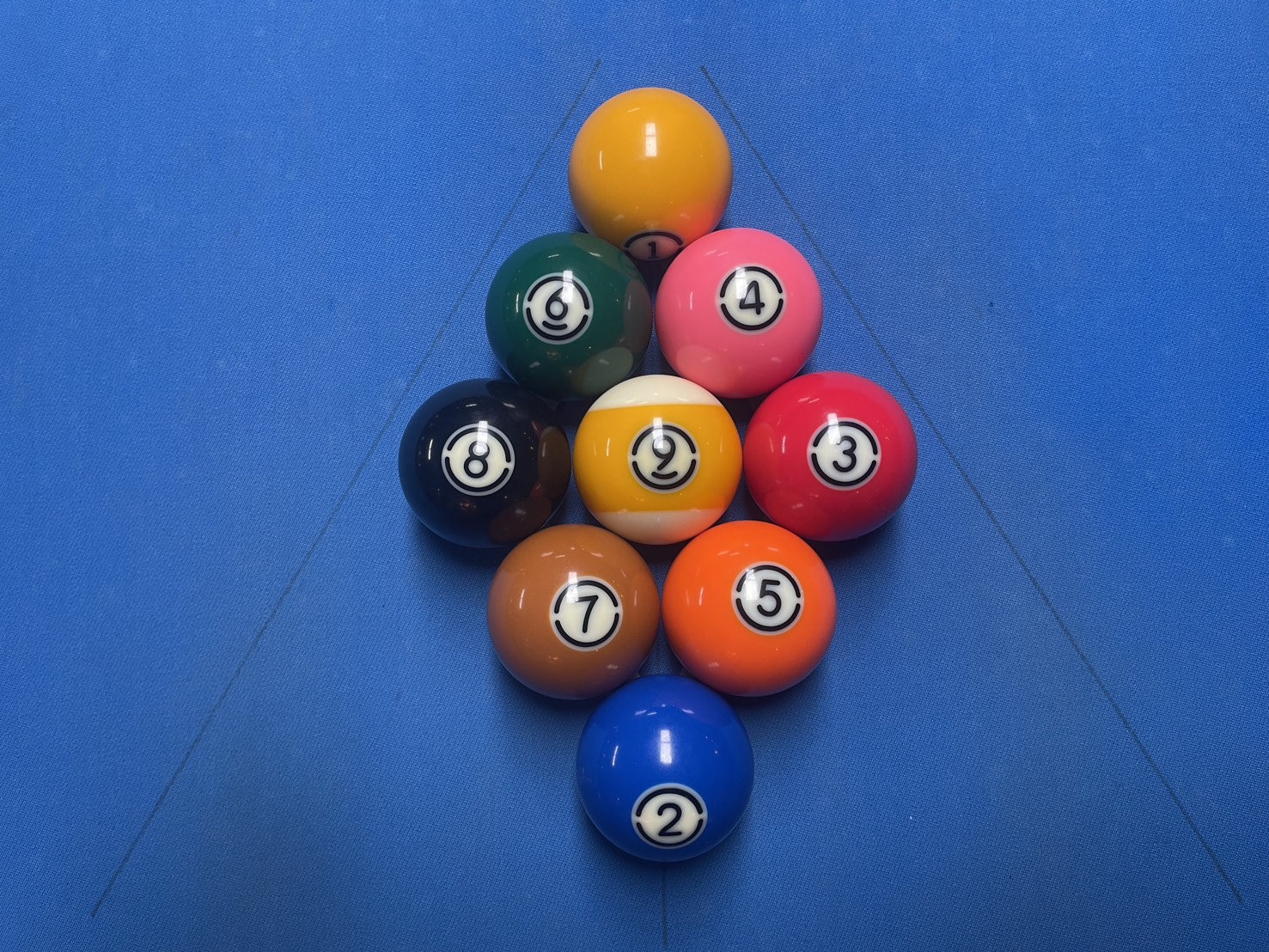
| Position | Ball | Notes |
|---|---|---|
| Apex (foot spot) | The 1 | Always fixed |
| Center (middle of the third row) | The 9 | Always fixed |
| Back | The 2 | Pattern rack only |
| Others | Remaining balls | Placed at random |
Under the NBA rules, each tournament adopts either a “random rack” (every ball other than the 1 and the 9 placed at random) or a “pattern rack” (the 2 also placed at the back). [NBA Ch. 9, Art. 3, Para. 5]
04Break shot
The game begins with the break shot, the opening stroke. The cue ball may be placed anywhere behind the head string (in the kitchen). On the break, the cue ball must hit the 1-ball first, and at least one of the following must happen.
- At least one object ball is pocketed
- At least four object balls, not counting the cue ball, reach a cushion (the edge of the table)
Three-point rule
Tournaments often adopt the “three-point rule,” which makes the break requirement stricter. Unless the object balls pocketed on the break and the object balls that cross the head string add up to at least three, it is an “illegal break,” and the turn passes to the opponent. The opponent may either play from the position as it lies, or pass and let the breaker shoot. If no object ball is pocketed, the turn passes to the opponent however many balls crossed the head string. [NBA Ch. 9, Art. 4, Para. 7]
Since the June 2026 revision, whether a ball has crossed the head string is judged by the center of the object ball, not its edge.
Who breaks
There are two ways: “winner breaks,” where the winner of the previous rack breaks, and “alternate break,” where the players take turns. Each tournament decides which to use. [NBA Ch. 9, Art. 4, Para. 6]
05Basic rules of the shot
What each turn requires.
- The cue ball must first hit the lowest-numbered ball on the table
- After that contact, an object ball must be pocketed or some ball must reach a cushion
- If an object ball is pocketed without a foul, you keep shooting
- If no object ball is pocketed, the turn passes to your opponent (who shoots with the cue ball where it lies)
06How to win
You win the rack in any of the following ways.
- You legally pocket the 9-ball
- The 9-ball goes in on the break shot (with no foul)
- The 9-ball is legally pocketed on a combination or similar shot
- Your opponent loses on three fouls
07Main fouls
After a foul, your opponent receives Ball in hand (they may place the cue ball anywhere on the table and play). [NBA Ch. 9, Art. 6]
| Foul | What happens |
|---|---|
| Bad hit | The cue ball did not hit the lowest-numbered ball first |
| No rail | After the cue ball hit the lowest-numbered ball, no ball reached a cushion and no object ball was pocketed |
| Scratch | The cue ball goes into a pocket |
| Touching a ball | Touched the cue ball or an object ball with the body or cue, other than in a stroke |
| Ball off the table | The cue ball or an object ball left the table |
| Double hit | Struck the cue ball twice with the cue |
| Both feet off the floor | Both feet were off the floor during the shot |
For definitions of fouls and how each game treats them, see the List of Fouls.
08Push out
Only on the shot right after the break (or, if a ball was pocketed on the break, the next shot), the player may declare a “push out.” Saying “push” is enough.
Push out rules
The usual requirements (hitting the lowest-numbered ball first, reaching a cushion) are waived, and you may send the cue ball anywhere you like.
After a push out, the opponent chooses who plays: they may shoot from there themselves, or hand the shot back to the player who pushed.
Even if an object ball goes in on a push out, you cannot keep shooting. A 9 that goes in is spotted on the foot spot; other object balls stay down. [NBA Ch. 9, Art. 5, Para. 2; WPA 5.6]
On a push out, only three things are fouls: a scratch, a double hit, and touching a ball. [NBA Ch. 9, Art. 5, Para. 1]
09Three-foul rule
If the same player fouls three times in a row, they lose the rack.
How it applies
Fouls are counted only within the same rack. Your opponent taking a turn in between does not, by itself, reset the count. A single shot of your own without a foul brings it back to zero.
After the second foul, before the next shot, the referee or the opponent announces that the player is “on two fouls”. If the player fouls a third time without that warning, it does not count as three fouls; they remain on two. [NBA Ch. 9, Art. 6, Para. 3]
A break that fails the requirements (a breaking foul) is not counted.
10Match format and rack handicaps
A 9-Ball match is played until one player wins an agreed number of racks. In a “5-saki” match, whoever wins five racks first takes the match; in English this is written “Race to 5.”
| Notation | What happens |
|---|---|
| Race to 5 (5-saki) | First to five racks wins. Common for casual games and practice matches |
| Race to 7 (7-saki) | A standard length for tournament qualifiers and main draws |
| Race to 9 (9-saki) | Set when a longer match is wanted, such as a final |
When the players differ in strength, a rack handicap is used. When a stronger player meets a newer one, giving each a different number of racks to win makes for a closer contest: for example, “Race to 7 for the stronger player, Race to 4 for the newer one.”
11Frequently asked questions
How many balls are used in 9-Ball?
One cue ball and nine object balls numbered 1 to 9. Counting the cue ball, that makes 10 balls in all.
If the 9 goes in partway through, do I win?
Yes. If it goes in on a shot without a foul, such as one that hits the lowest-numbered ball first, you win the rack then and there. A 9 pocketed on a foul is spotted on the foot spot, and your opponent continues with ball in hand.
Do I need to call my shots (name the ball)?
No. In 9-Ball, no call is needed under either the NBA or the WPA rules.
Do I have to pocket all of balls 1 to 8?
No. Whoever legally pockets the 9 wins the rack.
Where do I break from?
From behind the head string (the kitchen). As long as the center of the cue ball is behind the head string, you may place it anywhere. [NBA Ch. 4, Art. 3, Para. 2]
What if nothing goes in on the break?
If the requirement is met (at least four object balls, not counting the cue ball, reach a cushion), the turn passes to your opponent, who plays from the position as it lies. Your opponent may also choose to push out.
👉 Once you know the rules: lessons and match streams in Billiards in Depth