

Practice Game 06 Billiards Guide
What is Bowlliards?
The rules, and how to enjoy it.
Bowlliards (written ボーラード or ボウラード in Japanese) is a practice game that brings bowling’s scoring to pool. You play ten frames for score, and a perfect game is 300. It is also one of the skill tests in the JPBA (Japan Professional Pocket Billiard Association) pro exam, and many players, alone or with friends, use it as a measure of their progress.
At a glance
Key points
- Balls
- One cue ball and ten object balls numbered 1 to 10. No need to shoot them in order
- Scoring
- One point per ball. Ten frames, up to two innings each. Strikes and spares are scored as in bowling; a perfect game is 300
- Rack
- Triangle (four rows). The apex ball matches the frame number
- Call shot
- Yes (except on the break)
- 10th frame
- Two extra innings after a strike, one after a spare
This page follows the Nippon Billiard Association (NBA) “Pocket Billiards Competition Rules” (June 2026 revision), Chapter 14, “Bowlliards Rules.” The World Standardized Rules (WPA) have no provisions for Bowlliards, so where the rules commonly played in English-speaking countries differ, we note it under “In English-speaking countries.”
01Balls used
- 1 cue ball (white)
- 10 object balls, numbered 1 to 10
You do not need to shoot the balls in numerical order: any ball will do (this is called “any ball”). Every shot except the break, however, is a called shot. [NBA Ch. 14, Art. 5]
02Object of the game
Play ten frames and aim for as high a score as you can. A perfect game is 300. It is not a contest of winning and losing but a matter of building up your own score: a practice game.
03Racking
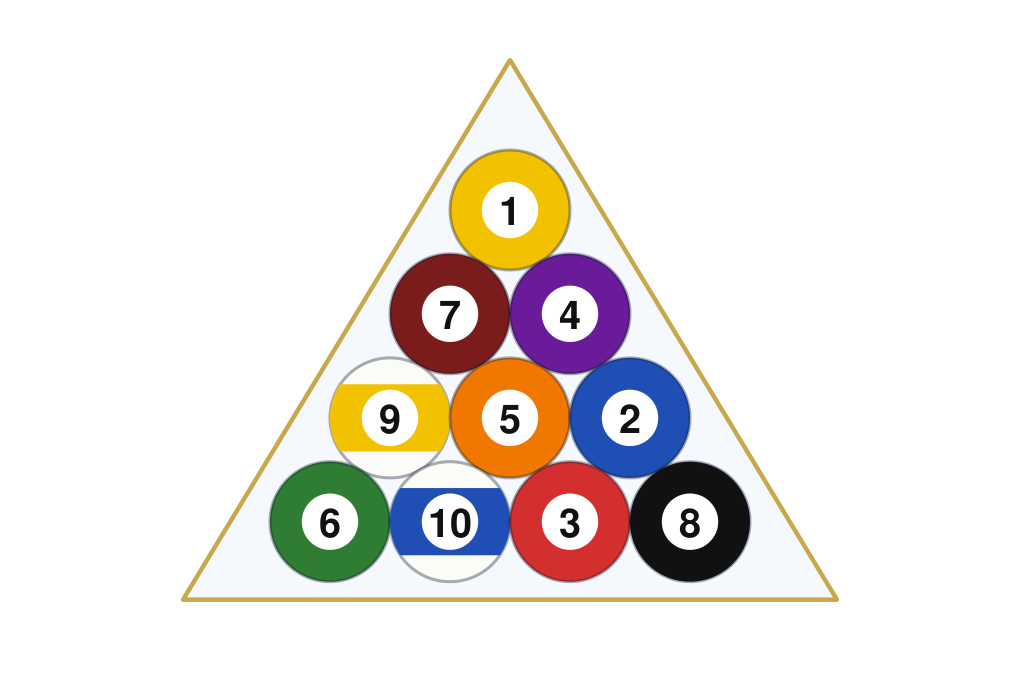
Ten balls are racked in a triangle. At the apex of the rack (the foot spot), place the ball whose number matches the frame. The other balls may go anywhere. Rack so that the line from the apex ball to the middle ball of the third row lies on the table’s long center line. [NBA Ch. 14, Art. 2]
↑ Breaking end (head)
↓ Foot rail end
| Frame | Apex ball |
|---|---|
| Frame 1 | 1-ball |
| Frame 2 | 2-ball |
| Frame 3 onward | The ball matching the frame number (and so on) |
| 10th frame | 10-ball |
04How frames work
As in bowling, a frame consists of up to two innings. An inning is one turn at the table: you keep shooting until you miss or foul.
05How a frame unfolds
- Break from anywhere in the kitchen (no call required). The cue ball must first hit the apex ball (on the foot spot) [NBA Ch. 14, Art. 4, Para. 3(a)]
- Balls pocketed on a break without a foul score. Even if none drop, the first inning continues [Ibid., (b)]
- From then on, keep pocketing object balls as called shots
- A miss or a foul ends the first inning; move on to the second (pocket all ten in the first inning and it is a strike)
- The second inning starts from the position as it lies. The frame ends at the first miss or foul [Ibid., Para. 4]
- When the frame ends, record the score, rerack, and move on to the next frame
06Scoring
Scoring works exactly as in bowling.
| Result | Calculation |
|---|---|
| Strike | 10 points + the points from the next two innings |
| Spare | 10 points + the points from the next inning |
| Open frame | Only the total number of balls pocketed in the two innings |
Bonus innings in the 10th frame
A strike in the 10th frame earns two more innings, and a spare one more, shot straight on. [NBA Ch. 14, Art. 4, Paras. 6-7] Those points are added to the 10th frame.
Strike in every frame and pocket ten balls in each of the two bonus innings, and you reach a perfect score: 30 points × 10 frames = 300.
Scoring example
| Frame | 1st inning | 2nd inning | Frame score | Total |
|---|---|---|---|---|
| 1 | 10 (strike) | — | 10 + 7 + 3 = 20 | 20 |
| 2 | 7 | 3 (spare) | 10 + 6 = 16 | 36 |
| 3 | 6 | 2 | 6 + 2 = 8 | 44 |
The strike in frame 1 adds the next two innings (7 and 3); the spare in frame 2 adds the next inning (6). Every single ball feeds straight into the score, and that is where the game’s depth lies.
07Fouls and what follows
The standard pocket billiards fouls apply, and a foul ends the inning. [NBA Ch. 14, Art. 7] Balls pocketed on a foul do not score.
| Foul | What happens |
|---|---|
| Scratch | The cue ball goes into a pocket |
| No rail | After contact with an object ball, no ball reached a cushion and no object ball was pocketed |
| Touching a ball | Touched the cue ball or an object ball with the body or cue, other than in a stroke |
| Ball off the table | The cue ball or an object ball left the table (the object ball is returned to the foot spot) |
| Double hit | Struck the cue ball twice with the cue |
| Both feet off the floor | Both feet were off the floor during the shot |
After a foul
Foul in the first inning: After a scratch, or with the cue ball off the table, the second inning starts with the cue ball in the kitchen, and you must call an object ball outside the head string (if every object ball is inside the head string, the one nearest the head string may be re-spotted on the foot spot). [NBA Ch. 14, Art. 7, Para. 1] Otherwise, the second inning starts with the cue ball where it lies.
Foul in the second inning: The frame ends there. Move on to the break for the next frame.
For definitions of fouls and how each game treats them, see the List of Fouls.
08Head-to-head Bowlliards (recommended by the Organizing Committee)
Bowlliards is, at heart, a practice game for polishing your score on your own, but the Yokohama Open Organizing Committee also recommends playing it head-to-head.
Player A plays one frame, then Player B plays one. Alternate like this through ten frames, and the higher total after ten frames wins.
Because you are chasing your opponent’s score as you go, it brings a tension that ordinary Bowlliards does not have. A run of strikes can open a wide gap; a run of misses can turn the match around. It is easy for spectators to follow, too, and a wonderful fit for events and social gatherings.
For more, see the Organizing Committee’s article “Play alone, see your score, get better: An Invitation to Bowlliards” (in Japanese).
09Frequently asked questions
Are ボーラード, ボウラード and ボラード the same game?
Yes. As a billiards game they all mean the same thing; only the Japanese spelling differs. The Nippon Billiard Association’s rules write it ボウラード, and in English it is Bowlliards.
What is a perfect score?
300. That is the score for a strike in all ten frames, plus ten balls in each of the two bonus innings of the 10th frame.
How does the 10th-frame bonus work?
After a strike you shoot two more innings, after a spare one more, and those points are added to the 10th frame.
How are strikes and spares scored?
A strike scores 10 plus the next two innings; a spare scores 10 plus the next inning. It is the same count as in bowling.
Is there a set ball to hit first on the break?
Yes. Under the NBA rules, the cue ball must first hit the apex ball (on the foot spot).
Can I play on my own?
Yes. It began as a practice game for keeping your own score and checking your progress.
👉 Once you know the rules: lessons and match streams in Billiards in Depth