
日本語 | 繁體中文 | English | 한국어 | Tiếng Việt
I took up billiards in the first place because I thought it looked cool.
Autumn of my second year at university.
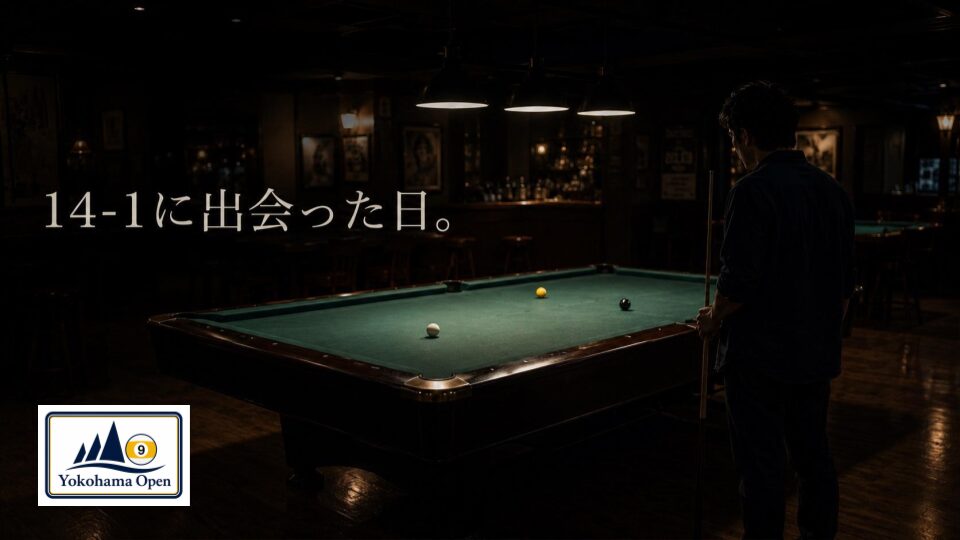
A dim place a friend took me to.
The lights fell only on the tables.
The sound of the white ball running.
The sound of a ball dropping into a pocket.
That alone was enough.
I started going a few times a week.
9-ball.
Nine balls, sunk in order.
Simple, easy to follow, fast.
But after a few months, I noticed something.
On the nights I won and the nights I lost, something felt missing.
It was by chance that I started talking to him.
There was a man who always played alone, at the table in the corner.
In his forties, maybe.
He did not look especially good, but something about him was different.
Before each shot, he would look at the table for a long time.
As if he were reading something.
The music in the hall changed.
Quiet jazz began to play.
The man did not seem to notice. He settled slowly into his stance.
One night, I found myself speaking to him.
“What are you looking at?”
The man smiled a little.
“What comes after the ball.”
That was how it began.
“You play 9-ball?” he asked.
“Yeah. Only 9-ball.”
“And 14.1?”
I had never heard of it.
Before answering, the man slowly wiped his shaft with a hand towel.
“In 14.1, the balls have no order. You can sink any of them first. And as long as you don’t miss, you keep shooting.”
“Forever?”
“As long as you don’t miss.”
After that, the man was quiet for a while.
Looking at the table, he slowly chalked his tip.
Scritch. Scritch.
The small sound dissolved into the quiet of the room.
“In 9-ball, the next ball is decided for you. In 14.1, you decide the next one yourself. Which ball to start from. How to move the cue ball. You decide all of it.”
“And that’s what makes it fun?”
The man let a moment pass.
“Freedom weighs more than you think.”
What he taught me was not how to sink balls.
“Sink fourteen, and only the last one is left.”
Pointing at the table, he went on.
“You pocket that one, and with the cue ball you break open the rack. Fourteen balls spread out again. And you keep shooting.”
“So it just goes on.”
“As long as you don’t miss.”
He said the same words again.
“That last ball is the break ball. But what matters is the one before it.”
“The one before?”
“They call it the key ball. Where you sink it decides where you can shoot the break ball from. Where the break ball is decides how the rack opens. How it opens decides the next layout.”
“So you’re always thinking way ahead while you shoot?”
The man leaned his cue against the wall and looked at the table once more.
“It’s a bit like life.”
One night, the man began to play without a word.
I watched: one ball, two, three—he did not stop.
Each time a rack was set, he looked over the table and began to walk again.
The small sound of his soles on the floor.
A ball running, and dropping into a pocket.
Ten balls. Twenty. Thirty.
Somewhere along the way, I stopped counting.
I only watched.
I could feel something building, ball upon ball.
In the end, he missed.
The cue ball rolled farther than he meant.
His face did not change.
He only closed his eyes a little, the cue still in his hand.
“That’s it for tonight, then.”
“How many was that?”
The man looked at the score sheet.
“Forty-seven. Going by the average, not a bad night.”
“The average?”
“How many balls you sink per inning, on average. The high run is the most you’ve sunk in a row. The average is how steady you were, every time.”
The man was quiet for a little while.
“The high run is brilliance. The average is integrity.”
Those words stayed with me for a long time.
The high run is brilliance.
The average, integrity.
“14.1 is hard, isn’t it?”
One night, when I said that, he shook his head.
“It’s not hard. It’s honest. You can’t fake it. How much you’re thinking, how careful you are, it all shows, just as it is. That’s why you can’t quit.”
Slowly wiping his shaft, the man went on.
“There’s luck in 9-ball. But in 14.1, the longer you play, the more your real game comes out. There’s nowhere to run. That’s what makes it frightening. And fun.”
From that night on, I felt I saw the balls a little differently.
Even playing 9-ball, I began to think not only of the next ball, but of the one after that.
It was a long time before I realized that this was what 14.1 had taught me.
August 14 and 15. Kannai, Yokohama.
Thirty-two people like that man will gather.
Those with a high run to their name.
Those who have built up their average.
Those who have polished their key balls.
Those who have staked their lives on the break.
Stats for every player, updated and published throughout the tournament.
Beyond the numbers, you can see a person’s integrity.
Watching in person is free.
We look forward to seeing you in Yokohama.
👉 Tournament details, streams and players
👉 Yokohama Open player stats
👉 Billiards resources from Japan and around the world, organized by purpose: Billiards in Depth (latest updated hourly)