
日本語 | 繁體中文 | English | 한국어 | Tiếng Việt
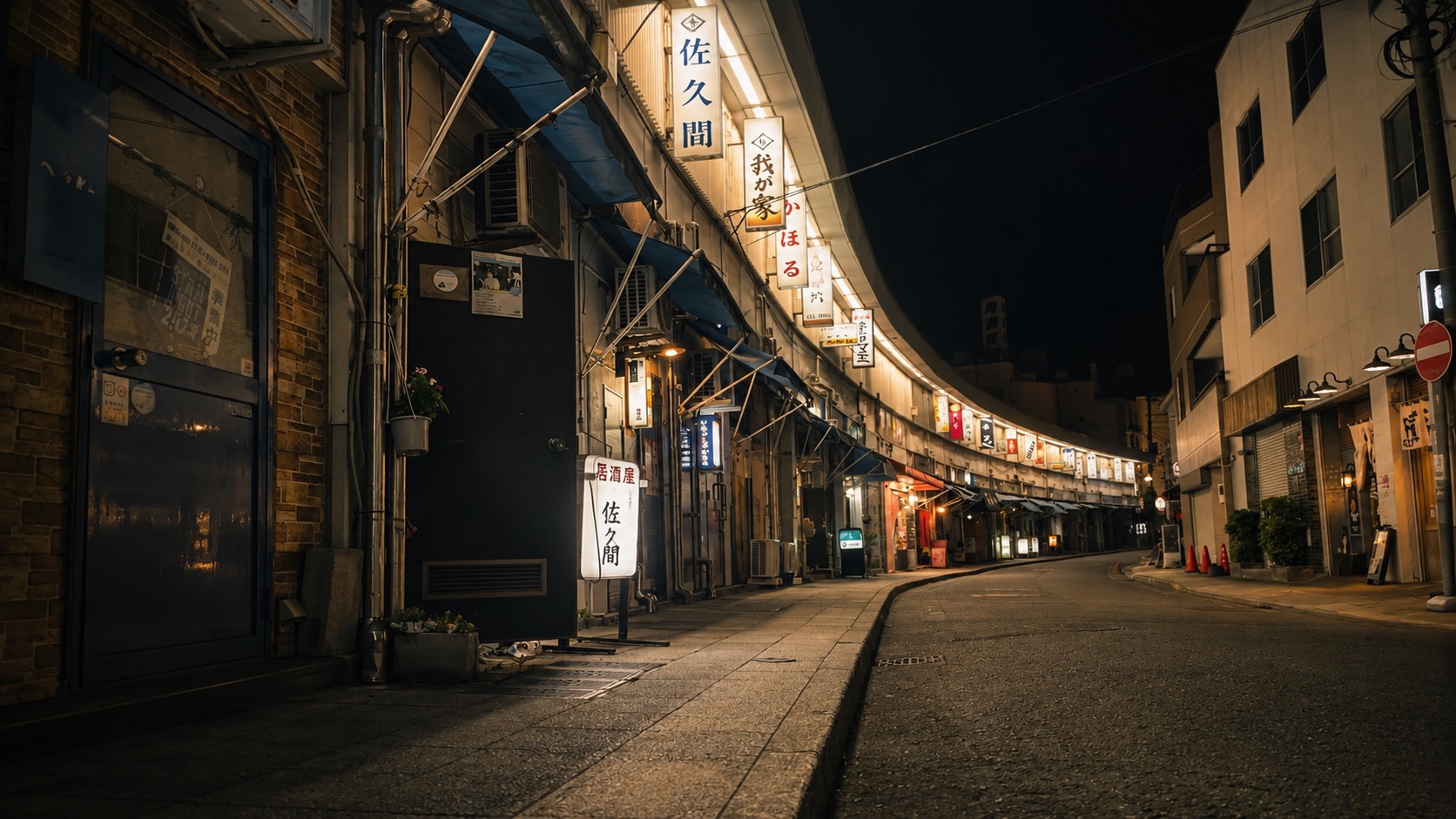
On Miyakobashi Shopping Street at night, time runs a little slower.
Laughter spills from the small shops lined along the river.
Smoke from the yakitori rode the breeze, and the clink of ice carried all the way under the bridge.
Among them is a small bar with only eight seats at the counter.
The lights were low; only the glasses shone softly.
The bartender says nothing.
Only the glass he keeps polishing marks the time, quietly.
“Heard you haven’t closed a single deal this month.”
Tanaka said it as he took his glass.
We had started together.
Joined the company the same year.
Same age.
Only our sales numbers were always far apart.
“It’s not like I’m sitting still.”
“Moving isn’t enough.”
“But I’m doing the showings, I’m making the calls.”
“That’s the thing.”
Tanaka laughed.
“You put in a lot of work. But your expected value is low.”
Even in our company, Tanaka was an unusual salesman.
He would spend hours talking with a customer everyone else had written off as “never going to buy.”
And then he would casually hand a deal everyone could see “closing today” over to a junior colleague.
People around him would tilt their heads.
“What is that guy thinking when he sells?”
I heard it said, many times.
“You know what expected value is?”
“The math thing?”
“Yeah. The idea’s similar.”
Tanaka swirled his glass.
“Say there’s a deal with a 30% chance of closing.”
“Okay.”
“But it takes you a whole week.”
“……”
“Then there’s one with only a 10% chance. But it’s just an hour of talking. And that person might introduce you to another customer.”
“So the 10% one is better?”
“No.”
Tanaka shook his head.
“You go wrong because you only look at the odds.”
“Look at what lies beyond them.”
“The time it costs.”
“What you might gain.”
“Relationships that lead somewhere later.”
“The risk if you lose it.”
“Take all of it together, and ask how much that choice is worth.”
Tanaka smiled a little.
“That’s what I call expected value.”
“So that’s why you see customers who’ll never buy?”
“I don’t think they’ll never buy.”
Tanaka answered quietly.
“They may not buy now, but in three years things might be different.”
“They might get transferred.”
“Their family might grow.”
“They might send someone else my way.”
“What you have with people isn’t decided by today’s result alone.”
“You think it through, future and all. That’s what I think the job is.”
“And the other way round — even with a deal that looks set to close today, if you focus on it so hard you lose every other possibility, in the end it’s worth less.”
Without a word, the bartender set down a second glass.
The ice made a small sound.
After a long silence, Tanaka spoke.
“You know pool?”
“I’ve been once, with my girlfriend.”
“There’s a game called 14.1 — straight pool.”
“Never heard of it.”
“There’s a tournament in Kannai, the week after next.”
“Pot a ball, score a point.”
“Simple enough.”
“Except it’s not simple at all.”
Tanaka traced the rim of his glass with a finger.
“The really strong players never stop attacking.”
“But don’t they play defense too?”
“They do.”
Tanaka nodded.
“But they don’t defend for the sake of defending.”
“Say there’s a shot with an 80% chance of going in.”
“That’s high.”
“But the moment you miss, it leaves a layout where your opponent runs a hundred.”
“……”
“Then you don’t shoot it.”
“Even at 80%?”
“Because it’s 80%.”
Tanaka laughed.
“The 20% that loses you the game is just too big.”
“So you play a safety.”
“You don’t score.”
“But you don’t let your opponent attack either.”
“Buying time?”
“No.”
Tanaka shook his head.
“You build a table where, next time, you can attack and keep on attacking without worry.”
“……”
“You’re not giving up on a ball.”
“You’re choosing a future where a hundred balls follow.”
“That’s why the better the player, the stranger it looks.”
“What does?”
“They’re attacking, but they never force it.”
Tanaka looked at the ice in his glass.
“Because they’re not looking only at the ball in front of them.”
“The next ball.”
“The one after that.”
“And the flow of dozens of balls that follows.”
“They think it all through, and make the choice that’s worth the most.”
“When it gets dangerous, they stop.”
“But they don’t stop for the sake of stopping.”
“They choose this moment so they can run again.”
It was quiet inside the bar.
Outside, the laughter of drinkers sounds far away.
“Sales is the same.”
Tanaka went on.
“Keep chasing only the contract in front of you, and one day it gets hard to breathe.”
“What matters isn’t winning this moment.”
“It’s making the future’s possibilities as large as they can be.”
“Once you decide it’s time to go for it, you attack.”
“When it feels wrong, you step back for a moment.”
“Those calls, added up, become the final result.”
“In the end, work is a game too.”
The glass was empty.
“Sounds interesting.”
“It is.”
Tanaka stood up.
“When the balls are still, that’s when the most is moving.”
He took the bill, paid, and left the bar.
The moment the door opened, the lively air outside slipped in, and then the quiet returned.
In the glass left behind, the half-melted ice shifted with a small clink.
(The tournament in Kannai — week after next, wasn’t it.)
On that table, what are the players seeing?
The one ball in front of them?
Or the future that runs on beyond it?
I thought I would go and see for myself, just once.
SANSIAS presents Yokohama 14-1 Summit 2026
That night, perhaps the word Tanaka used — “expected value” — was not only about work.
What the players see on the table must lie in the same place.
Not only the ball in front of them, but a future of dozens of balls that runs on beyond it.
The moment to attack.
The moment to stop, by choice.
A move thought through all the way to the shape you hand your opponent.
In 14.1, even while the balls are still, the players are calculating the future.
Why did they choose that shot?
Why did they choose not to shoot?
There is not only technique there, but each player’s own judgment.
The thinking behind the numbers.
Decisions, stacked one ball at a time.
Watched that way, 14.1 shows you a slightly different landscape.
👉 Tournament details, streams and players
👉 Yokohama Open player stats