
日本語 | 繁體中文 | English | 한국어 | Tiếng Việt
I heard a colleague was playing.
“It’s a pool tournament. The event’s called 14.1—straight pool.”
When I was told this in a meeting room, I didn’t think much of it.
But I had nothing on that weekend.
When I walked into the venue, it wasn’t what I’d pictured.
I had imagined somewhere livelier.
The lights fell only on the table.
The spectators watched that one table in silence.
Someone was writing something on a score sheet.
Someone sat with arms folded, following the player’s hands without a sound.
There was a feeling in the air that something was about to happen.
The match began.
Fifteen balls sat in a neat triangle.
The opponent got down on the shot.
I thought there would be a hard break.
Instead, only the cue ball moved, softly.
“That’s a safety,” said the man beside me.
“They don’t break?”
“14.1 is call shot. You have to say which ball is going in which pocket before you shoot. At the start all fifteen are packed together, right? You can’t tell where anything would go. So you don’t force the break. You play safe first.”
I see, I thought.
So thirteen balls stayed together in a clump, with just two lying a little apart.
Then it was my colleague’s turn.
Of the two loose balls, my colleague went for the far one.
It was a long shot.
But there was a clean click, and the ball dropped.
A small breath escaped the room.
From there, my colleague stayed at the table.
Bit by bit, my colleague worked into the clump of thirteen, opening it as the run went on.
Sinking a ball, sending the white cue ball toward the clump.
The cue ball grazed the clump, and the packed balls began to loosen.
Sinking another ball, opening the clump a little more with the cue ball.
Scoring points, and solving the problem as it came.
With every ball, the table became a different landscape.
Partway through clearing the fourteen, my colleague suddenly played differently.
With only a few balls left, the last one—the ball that would become the break ball—wasn’t sitting in a good spot near the rack.
While sinking another ball, my colleague sent the white cue ball toward that break ball.
The cue ball gave the break ball a gentle nudge.
The ball moved, just a little.
“That was moving the break ball,” said the man beside me.
“With the white ball? You can move the ball you’re going to shoot?”
“When there’s no good break ball, you use the cue ball to make one yourself.”
When the fourteen were cleared, my colleague stood still for a while in front of that last ball.
Then, slowly, the cue went through.
A crash spread through the room.
Fourteen balls scattered all at once.
“Good break,” someone murmured.
Several balls were already open for the next shot.
My colleague started walking without hesitation.
The second break went beautifully, too.
The balls spread across the table, and my colleague’s rhythm carried on.
Forty balls, forty-one, forty-two—
Somewhere along the way, I felt the air in the room begin to change.
Everyone was leaning forward.
It was the third break.
Sinking the last ball, my colleague split the rack with the cue ball.
But this time, the balls didn’t spread well.
“That one didn’t open up enough,” the man beside me murmured.
What was left was an awkward layout.
The flow that had carried on until then paused there, a little.
My colleague looked over the table for a while.
A long while.
And then didn’t pocket a ball.
Instead, my colleague touched an object ball and left the cue ball where the opponent would have a hard time shooting.
From there, it became a different match.
The opponent played safe.
My colleague played safe.
The balls moved, and nobody scored.
“It’s a safety battle,” said the man beside me.
No points.
The balls move.
But an unseen contest went on.
Defending is attacking, too, I thought.
The room stayed quiet.
But it was a different quiet from before.
Before, it had been the quiet of expectation: how far will this go?
Now it was the quiet of tension: who will miss first?
Both were fascinating.
After the match, I asked my colleague about it.
“For a while there, nobody was scoring at all, huh.”
“It turned into a safety battle, didn’t it,” my colleague said.
“I got to forty-three, and my position got sloppy. Better to play safe there than force it and miss.”
“But pulling off three breaks was amazing.”
My colleague smiled a little.
“When I got the key ball right, the breaks were easy.”
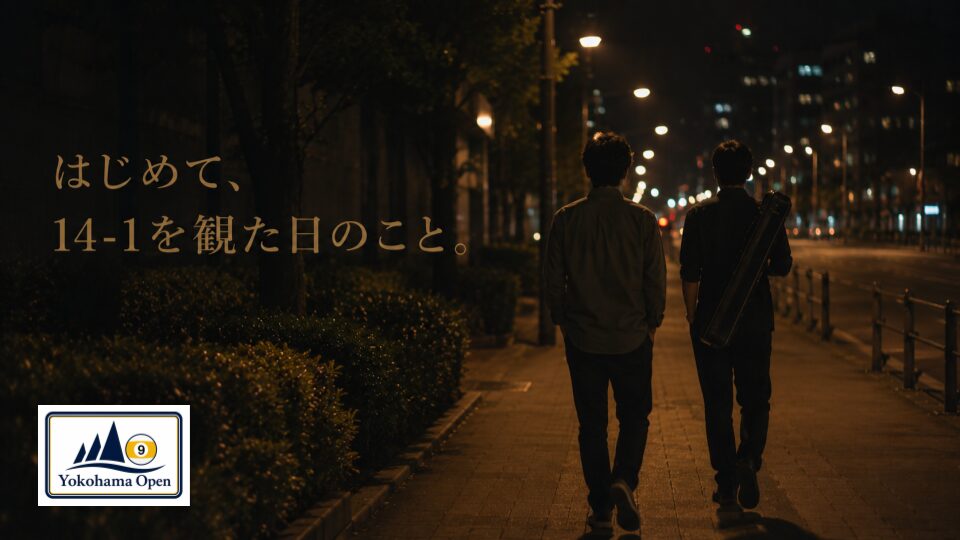
On the way home, I wanted to see it again.
Watching once isn’t enough to understand what that quiet meant.
And so you want to watch again.
August 14 and 15. Kannai, Yokohama.
If you are watching for the first time, you will feel it too, I’m sure.
Stats for every player, updated and published throughout the tournament.
Watch alongside the high runs and averages, and the meaning of that one shot comes into deeper view.
Watching in person is free.
We look forward to seeing you in Yokohama.
👉 Tournament details, streams and players
👉 Yokohama Open player stats
👉 Billiards resources from Japan and around the world, organized by purpose: Billiards in Depth (latest updated hourly)