
日本語 | 繁體中文 | English | 한국어 | Tiếng Việt
Have you ever watched a pool match?
“Isn’t pool something you play yourself?”
“I don’t really know the rules. I doubt I’d enjoy watching.”
If that’s what you think, let us be honest.
You are missing out on a lot.
As a sport to watch, pool is astonishingly well made.
And you can enjoy it without understanding every rule.
It’s exactly like baseball: you can enjoy a game without being able to explain the infield fly rule.
Here are three ways to enjoy watching pool.
Point 1: Know that it is a sport you listen to
The first thing that surprises people watching pool is the quiet.
There is no stadium roar.
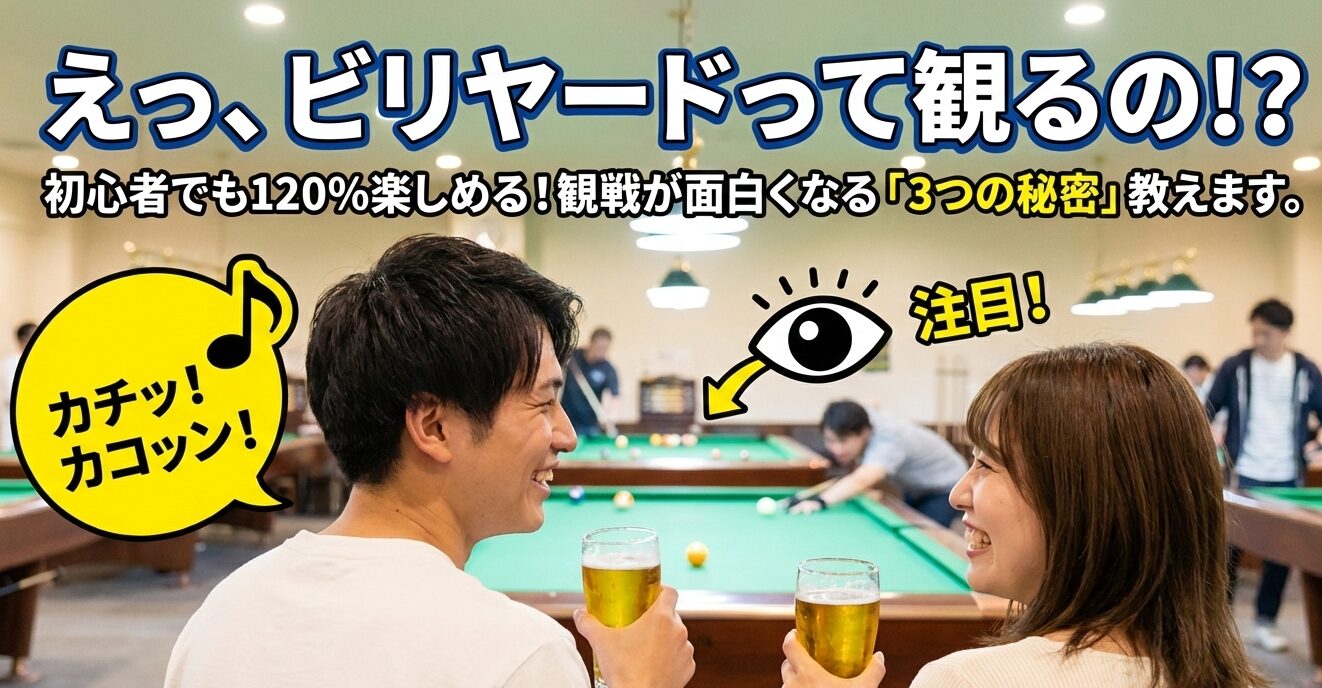
In that silence: the dry “click” of ball meeting ball, and the hollow “clock” of an object ball swallowed by the pocket.
That sound is hard to carry on video.
Hear it in the room, and you find yourself sitting up straighter.
Not light, not too heavy. A precise sound.
When a player lines up a difficult shot, the whole room goes still, as if holding its breath.
And then—
the moment it drops.
“Ohh…”
A hushed voice, and restrained applause.
That swing between stillness and release is the greatest pleasure of watching pool.
If you can come to the Yokohama Open, please take your earphones out.
The sound of the balls, the players’ breathing, the sharp intake of breath from the crowd.
All of it is part of watching pool.
Point 2: Watch the pros’ bearing, and the white ball
Pool is a sport where you can enjoy not only skill but beauty.
The fingertips as they settle into the cue.
A stance with nothing wasted.
An arm that draws back straight and swings through straight, like a pendulum.
A sequence of movements, carried out in silence.
“I can’t tell what’s so impressive.”
That’s fine.
You can’t tell, and yet somehow you can’t look away.
That is a pro’s bearing.
The beauty of the bridge (the shape of the hand)
When they shoot, players rest a hand on the table.
The shape of that hand is called the “bridge.”
A pro’s bridge is a finished form in itself.
Its steadiness, its looseness, the angle of the fingers.
All of it calculated, all of it honed.
Look closely, and the distance between bridge and cue ball differs from player to player.
Some set up close; others deliberately keep their distance.
There, too, a player’s way of thinking and rhythm come through.
And there is one more thing we’d like you to watch: the arm that holds the cue.
The backswing.
Drawn back quietly, then, after the briefest pause, released into impact.
And from there, the follow-through flowing on naturally.
No sign of force, and yet never off center.
The more beautiful a player’s stroke, the less wasted motion there is in the balls.
Watch how the white ball moves
From here, we go a little deeper into what to watch for.
When the cue ball strikes an object ball with no spin, the cue ball (the white ball) basically splits off at 90 degrees, to the side opposite the object ball’s path.
But—
the moment draw (backspin), follow (topspin) or sidespin comes in, that rule falls apart easily.
It cuts in at a sharp angle,
or drifts off far wider than you expected.
“Wait, it can move like that?”
The white ball does things like that again and again.
The stronger the player,
“It should go off at 90 degrees.” “It should stay right here.”
the more firmly they hold expectations like these.
And that is exactly why,
when the white ball defies that expectation, they can’t help but groan in admiration.
Beginners say, “Wow!”
Experienced players say, “That spin… what a cue action…”
The same shot, enjoyed at different depths.
That, too, is one of the great pleasures of watching pool.
👉 Numbers do not diminish the thrill. — On what it means to watch sport.
Point 3: Ask yourself, “What happens next?”
“I don’t know the rules, so I won’t enjoy it.”
There’s no need to think that.
For 9-ball, the basics are all you need.
Players aim at the lowest-numbered ball on the table, in order, and whoever pockets the 9 at the end wins.
You don’t need to know the finer rules.
To begin with,
“If they pocket this ball, where do they want the white ball to go next?”
Just think about that.
Moments with no shot come without warning
Watch a match and you will see situations like these.
• The white ball is badly placed, and there’s no shot at the next ball
• A miss on the previous shot has left a difficult layout
• The opponent has deliberately “handed over” a tough position
If you are new to the game, you will probably think:
“Wait, there’s no way to pocket anything…?”
But the match isn’t over.
That is when the player turns to “the safety.”
The option you choose when you can’t aim at a pocket.
That is a safety.
A safety is also
“a shot that doesn’t go in”
— by design.
Not only the path of the object ball,
but the path of the cue ball (the white ball), its distance, its speed, its spin.
Adjusting all of these,
the player deliberately builds a layout the opponent “can’t shoot at”.
• The object ball, to a safe place
• The white ball, near a cushion where it’s awkward to hit, or behind another ball
• To a distance and angle where it’s hard even to make contact
At first glance it looks plain, but it is actually a very advanced shot.
This is where watching suddenly gets much deeper
The moment a safety is chosen, the air in the room changes.
“So they’ve decided not to attack.”
“That’s a nasty turn to hand over.”
The stronger the player watching, the more this move draws a groan of admiration.
If you’re new, try thinking about it like this:
“What’s the next player going to do with this layout?”
“Just making contact looks hard…”
It is not unusual for a single safety to turn the whole flow of a match.
Pool is not simply a game of pocketing balls.
It is a battle of wits that includes “how you hand the next turn to your opponent”.
👉 Watch, think, and want to watch again. — Pool as a spectator’s art of thought.
“You can pot it from there?” is part of a safety’s echo, too
Sometimes the opponent, driven into a corner by a safety,
answers with an unbelievable shot.
“You can pot it from there?”
Running out a difficult layout can turn the flow of a match in an instant.
These reversals are among the great highlights of watching.
With commentary, it gets even richer
At the Yokohama Open, we plan to offer commentary on YouTube that is as easy to follow as we can make it.
“That shot, honestly, goes in maybe 30% of the time.”
“Choosing draw here takes real courage.”
A single remark like that brings the whole match into sharper focus.
Beer in hand, come as you are
Watching pool isn’t a stiff, formal affair.
Have a beer.
Talk with your friends in a low voice (quietly, now).
If you think “Wow!”, go ahead and applaud.
If you want to ask, “How did they do that?”, go ahead and ask.
Enjoy it however you like.
February 23, we’ll be waiting for you in Yokohama
“BLUEROSE presentsYokohama Open 2026”
Monday, February 23, 2026 (public holiday)
First-timers and people who have never played pool are very welcome.
“I had no idea pool could be this much fun.”
We are confident that’s what you’ll think.
Coming just to watch is very welcome too.
And of course, we want to share with spectators how fascinating pool is.
Players who share that wish are also warmly welcome to take part.
The tension that lives in every single shot.
The quiet elation when one goes in.
And a match is the place where that feeling can be shared by everyone in the room.
Players and spectators alike.
Let’s taste those moments together in the same space, and spread the charm of pool together.
Details here → Tournament details & entry
👉 Billiards resources from Japan and around the world, organized by purpose: Billiards in Depth (latest updated hourly)