
日本語 | 繁體中文 | English | 한국어 | Tiếng Việt
Watching a match in a sport you love, and talking tactics.
Analyzing the players’ decisions.
Thinking, “Here’s what I would do.”
I imagine many of you enjoy sport this way.
Today, let me tell you about a sport where that kind of enjoyment can go deeper still.
Sports with a culture of watching have something in common
Football fans who talk tactics.
Shogi lovers who replay the records of games.
Chess players who study their openings.
What these pursuits share is a single experience: watching feeds your intellectual curiosity.
Why did he choose that pass at that moment?
Why that move in that position? — the search for the answer is a pleasure in itself.
And that pleasure does not belong to players alone.
Even as a spectator — no, precisely as a spectator — you can take in the whole picture and enjoy it deeply.
Pool is exactly the same.
A single shot holds a whole mind
Watch a pool match and you will see moments when a player stops to think before a shot.
What is happening in that instant —
Where to send the cue ball for the next ball.
Which route will run out the table.
Play safe, or attack.
With ball in hand, where to place it.
Everything the player is thinking is condensed into a single shot.
And that single shot runs deep in physical terms, too.
Did they get position with follow alone?
Or with a touch of running English?
How far did they draw the cue ball back?
Did they use a rail to change the angle? — follow the path of one shot and the player’s intent comes into view.
Beyond simply who wins and who loses, there is a way of watching that means enjoying the physics of a single shot.
If you love physics, if you love mathematical thinking, if you love talking tactics — watching pool is open to everyone with that kind of curiosity.
Pool offers something close to replaying a shogi game
Among shogi fans, there is a pastime called kifu narabe: replaying a game from its record.
You set out a professional game move by move on your own board, and relive how the pro was thinking in each position.
Comparing your thinking with the pro’s, asking “why this move?” — that is one of the deep pleasures of shogi.
You can do exactly the same in pool.
Except —you can never reproduce it perfectly.
Say a layout in a pro match catches your eye. You play the video on your phone and set up something close to it on a table.
Then you think about how you would run it out, and you actually try.
But when you do, you notice.
“The pro got here with follow, but I can’t follow through that far.” “I can’t get the speed just right.” — is this a gap in skill, or a gap in equipment?
And the truth is, that option never even crossed your mind.
It is because you can’t reproduce it perfectly that it’s fun.
If you could reproduce it exactly, you would already be a top pro.
Here lies the decisive difference from shogi.
In shogi, once you see the best move, you can play it.
But in pool, even when you know the best shot, reproducing it is extremely hard.
How much top, draw or side you put on the ball, the speed, how you feel that day, the condition of the table, the humidity — and in a match, even your nerves come into play.
You can understand the best shot in physical terms and still be unable to play it.
That is true even for top pros.
Which is exactly why recoveries happen in matches.
Out of “a shot that wasn’t perfect,” rebuilding the next best plan on the spot — watching that judgment and skill is another great pleasure.
Feeling the gap.
Touching a different way of thinking.
Asking “why can the pro do it when I can’t?” — all of it is learning, and all of it becomes a reason to watch again.
In essence it is the same as replaying a shogi game, but because in pool you can test it physically, with your hands and body, the experience is more intuitive, and richer.
You can talk football tactics, but you cannot recreate the same moment on the same pitch.
In pool, though, you can try to draw close to the very moment a pro lived through.
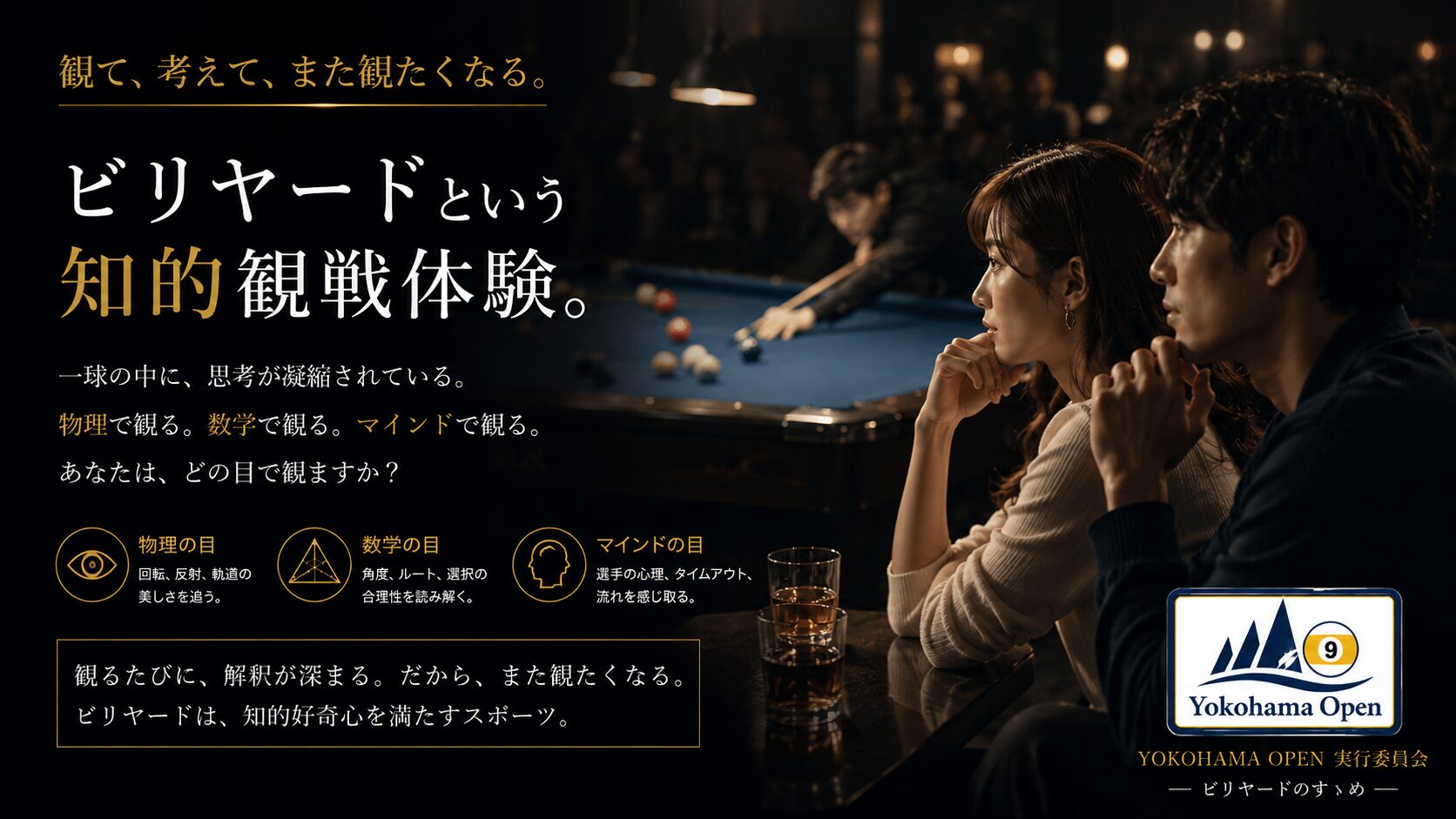
Watching one match with three eyes
There is more than one way into a pool match.
Watch with the eye of physics. How was the cue ball spinning, how did it come off the rail, where did it stop? Did the player get position with follow alone, or add a little English? The laws of physics are condensed into the path of a single shot.
Watch with the eye of mathematics. Angles, distances, speed — what the player calculates in an instant, the spectator traces in their head as well. There is pleasure in following, logically, why the player chose that ball from that layout.
👉 Numbers don’t diminish the thrill. — On watching sport.
Watch with the eye of the mind. A player’s face, their breathing, how they use their timeouts — reading a state of mind that never shows up in the numbers. You might call this the humanities way to enjoy it.
None of these is the right answer.
Watch the same match through these three lenses and you get three entirely different experiences — that is the nature of pool, a sport of stillness.
Because there is so little movement, each shot holds more, and there is more room for the watcher’s interpretation.
👉 The right answer is always being rewritten. — On pool as a pursuit.
The timeout, a mind game
Pool matches have timeouts.
Using time on the chess clock, a player can take one between racks.
Usually about five minutes.
But how players use them differs completely from one to the next.
The player who uses one every time, meticulously.
The player who hardly ever does.
The player who uses one only when they need the restroom (which is real life, in its own way).
And then — players who call it before the momentum turns against them, and players who call it after it has turned.
That difference shows a player’s character and nerve with startling clarity.
A player who can call it before things go wrong is reading their own state objectively.
A player who calls it after tends to ride the flow well, but their self-management tends to fall a step behind.
Neither is better. It is simply where a player’s individuality shows.
Watch the first rack after a timeout.
Have they reset?
Or are they still dragging it with them?
Their state of mind seeps into that one shot.
Tracing a player’s mind, imagining it, and getting it wrong again — that, too, is one way to enjoy watching pool.
“But I’ve never played pool myself…”
No need to worry about that.
Follow the movement of a shot with your eyes, and ask yourself, “Why did the cue ball go that way?”
Imagine what you would have done in place of the player who chose to play safe.
Try to read the intent behind where a player placed the cue ball with ball in hand.
That is a pure intellectual experience.
Playing experience has nothing to do with it.
In fact, it is precisely because you don’t know pool that the question “why?” comes so naturally.
Watching with that question in mind leads to the richest experience of all.
Each time you learn a little more, the game looks different.
Each time it looks different, you want to watch again.
That is the cycle of “watch, think, and want to watch again.”
👉 To witness a flash of inspiration. — In that moment, you hold your breath.
If, reading this, you felt even a little that you’d like to watch —
please hold on to that feeling.
The Yokohama Open Organizing Committee holds tournaments where you can enjoy matches with commentary by top professionals.
Watching with someone explaining the intent behind each shot is the shortest route into the depths of this game.
👉 Yokohama Open tournament information
And this weekend brings a perfect opportunity.
The 54th All Japan 14.1 Open Championship is being held in Tokyo today and tomorrow.
Japan’s only official open tournament in 14.1 (straight pool).
With Hayato Hijikata going for a third straight title, Lo Li-wen and top amateurs who have spent years polishing their 14.1 are gathering.
Watch with the eye of physics, if you like.
Or with the eye of the mind.
Or keep your attention on how the timeouts are used.
Admission is free. An intellectual weekend awaits.
- Qualifying: Saturday, May 16 / Billiard Rosa (Ikebukuro), Billiard Cue (Shibuya), Point Sanbiri Ogikubo West Exit
- Finals: Sunday, May 17 / Billiard Rosa (Ikebukuro)