
日本語 | 繁體中文 | English | 한국어 | Tiếng Việt
This weekend, an official open tournament in pool will be held in Tokyo.
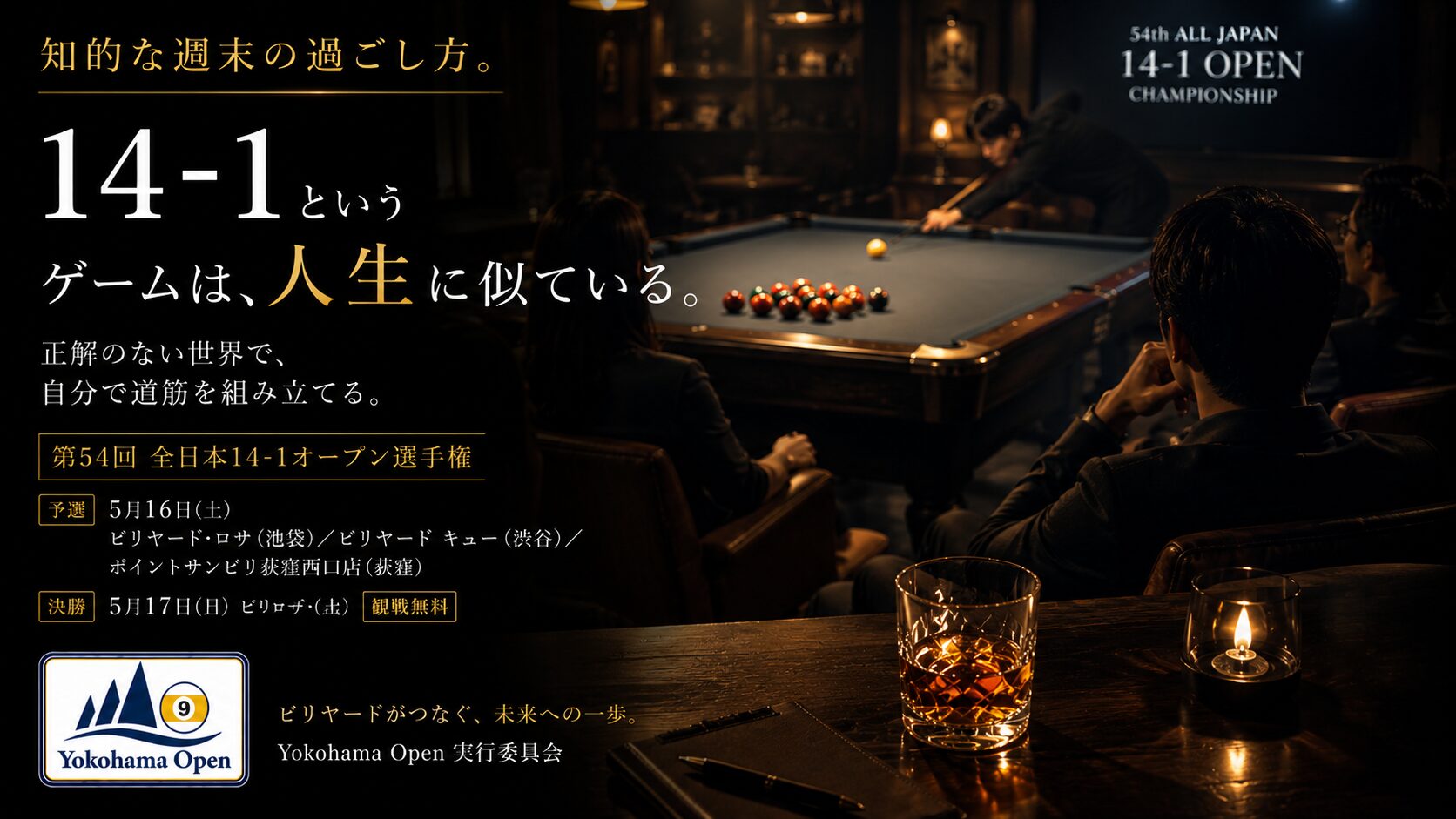
The 54th All Japan 14.1 Open Championship.
It is the only official 14.1 (straight pool) open tournament in Japan.
Qualifiers are on May 16 (Sat.), the finals on May 17 (Sun.) — and watching is free.
If you’re thinking “What is 14.1?”, please read to the end. This is a story about pool, and also about work and life.
First, get to know the game called 14.1
Many of you may know 9-ball.
14.1 is an entirely different game.
Fifteen balls are racked on the table.
You can shoot any ball you like (any-ball).
But on every shot, you must declare which ball goes into which pocket (call shot).
Make it as called, and you score a point.
The first to reach the target score wins.
In this tournament’s format, qualifying matches are races to 75 points, and from the last 16, races to 90.
And here is where it gets really interesting.
Once 14 balls are down, the rack is reset, with the last ball left where it lies.
Then you pocket that one ball while breaking open the next rack, and run it out again — repeating this until you reach the target score.
Because it is call shot, players don’t smash the break; a safety break is standard.
So from the very start, a battle of wits begins over how to deal with clusters (balls bunched together).
It doesn’t have the flash of 9-ball.
Instead, it is a quiet, deep game in which fine cue ball control and intelligent pattern play stand out.
The key ball and the break ball — the heart of 14.1
There is something we’d love you to know when you watch 14.1.
Break ball — the last ball pocketed in a rack. As it goes in, the cue ball breaks open the 14 newly racked balls. Whether you can open the rack at an ideal angle decides how the next rack will flow.
Key ball — the ball pocketed just before the break ball. After it drops, the cue ball needs to stop where it can play the break ball at the ideal angle.
What matters is that neither the key ball nor the break ball is set from the start.
As they run out, players read the layout and decide on the fly — “I’ll make this one my key ball,” “I’ll use that one as the break ball” — building as they go.
And when there is no ball that would make an ideal break ball, a player may, midway through the run, deliberately send the cue ball into another ball to move it into a good break-ball position.
This is what it means to “make a break ball.”
Not everything is set up perfectly.
Solving it with your own mind and skill — that is the depth of 14.1.
Watch with this chain of building and judgment in mind, and 14.1 looks like a completely different game.
14.1 is life in miniature
In 9-ball and 10-ball, the order of balls is fixed.
The rules tell you what to do next.
14.1 is different.
Because it is any-ball, you decide everything yourself — which ball to shoot first, where to send the cue ball.
No one tells you the right answer, and in fact there is no such thing.
Those choices, piled up, become a run, and if you miss, it’s all on you. No excuses.
Isn’t it the same with work, with study, with relationships?
You set your own goal.
You lay out the path to get there yourself, too.
When things go well, you can keep running, and it feels wonderful.
A player on a long run moves with rhythm and confidence.
But miss once, and the turn passes to your opponent.
In top-level 14.1, if your opponent keeps running, you never know when your next turn will come.
All you can do is wait.
That may be the most grueling time in this game.
Do they get anxious?
Do they reset their mind?
Do they quietly wait for their opponent’s miss?
Please watch the faces of the players waiting their turn.
It is in the moments when they are not playing that a player’s mind and true nature seep through.
Running, and waiting.
14.1 needs both — and so does life.
👉 The right answer is always being rewritten. — On pool as a pursuit.
That is why it is worth going to watch
People go to watch baseball or soccer, perhaps, for the thrill and the roar.
Going to watch 14.1 is a little different.
The intelligent strategy a player draws, and the delicate skill that brings it to life — witnessing that whole flow is close to appreciating a work of art.
Watching alone, predicting the next move in your head.
Sitting beside a friend or partner, talking it over: “Which ball will he pick there?”
Tilting a glass of whisky and talking in poetic words — time like that of a character in a novel is here.
Isn’t that rather stylish?
Having such intelligent, rich time makes life richer.
Sometimes it broadens your ideas at work.
Sometimes it deepens your conversations with people.
It is a kind of cultivation.
Going to watch 14.1 the way you would visit a museum or a concert.
Why not have that option for your weekend?
👉 Watch, think, and want to watch again. — Pool as a spectator’s art of thought.
This weekend, to Ikebukuro
The finals venue is Billiard Rosa in the Rosa Kaikan building, Ikebukuro.
It is one of the largest pool halls in Japan, with 33 tables, and the same building has bowling, a cinema, and a game arcade.
You can bowl or catch a movie before or after watching, and if the matches make you want to pick up a cue yourself, you can try it right there.
And the big story of this tournament is that Hayato Hijikata is going for a third straight title.
Against Hijikata, the two-time defending champion, comes Lo Li-wen, a five-time winner of the All Japan 14.1 Championship.
Hijikata chasing a third straight title, and Lo out to stop him — whether this showdown comes to pass is one of the great things to watch.
And there is one more pleasure unique to this tournament.
As the only official 14.1 open tournament in Japan, it also draws top amateurs who face the game of 14.1 day in, day out.
Since almost all official pro events are 9-ball or 10-ball, pros usually focus their practice there.
Meanwhile, many amateurs keep honing 14.1 as their specialty, so they may well knock out a pro or two.
Pros against amateurs, the summit clash of Hijikata and Lo, and the intellectual beauty of 14.1 itself — this weekend, you can enjoy 14.1 from many angles.
Even if you don’t know pool, you should feel the tension on your skin.
Watching is free.
An intelligent weekend, in Ikebukuro.
Something in you might change.
The 54th All Japan 14.1 Open Championship
- Qualifiers: May 16 (Sat.)
- Finals: May 17 (Sun.)Billiard Rosa (Ikebukuro)
- Free to watch