
日本語 | 繁體中文 | English | 한국어 | Tiếng Việt
I love pool.
The feel of the cue in my hand, the moment of taking aim, the quiet satisfaction when the cue ball moves just as I meant it to.
I love those things, and somehow I have stayed by pool’s side ever since.
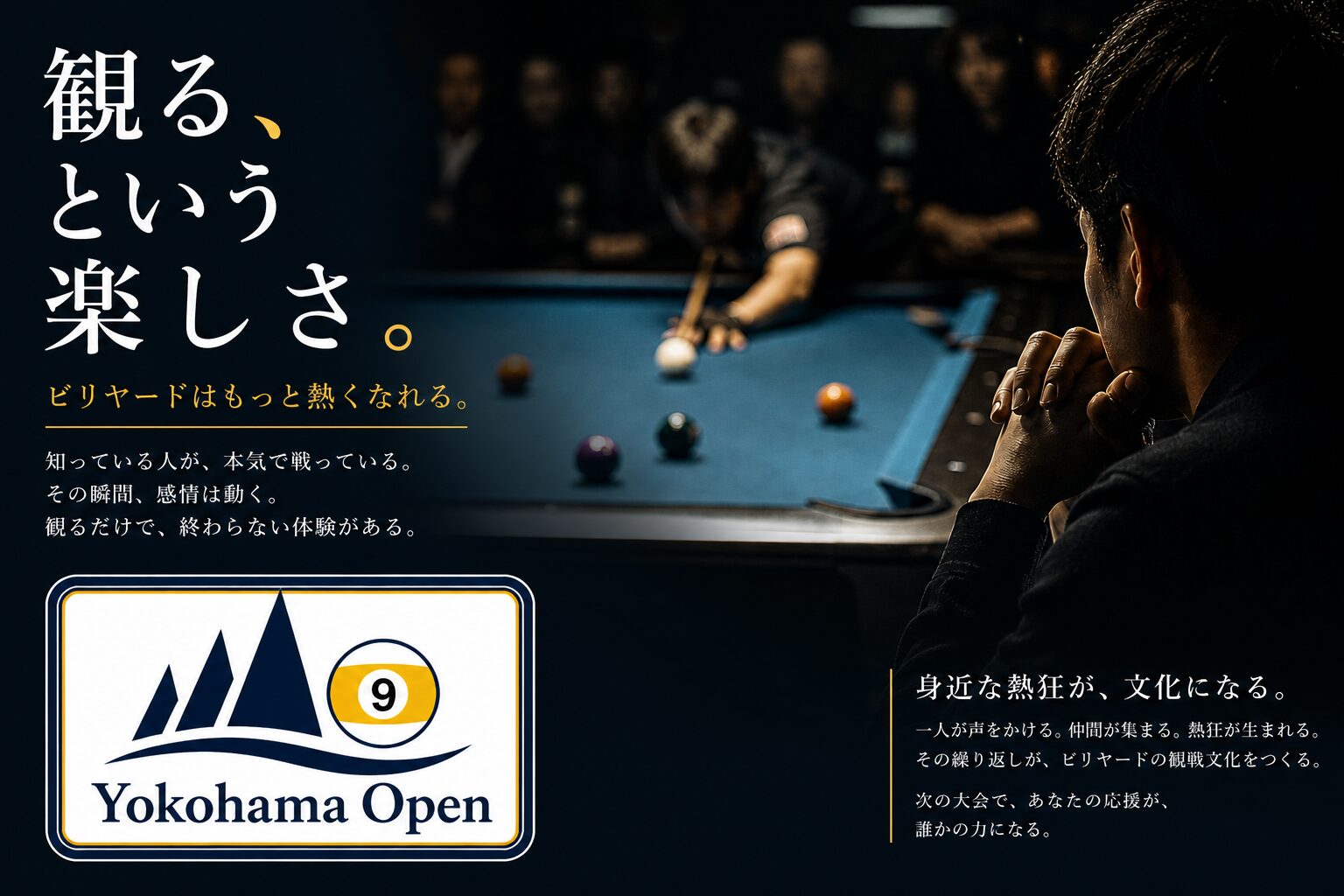
But today, I want to write not about the joy of playing, but about the joy of watching.
Someone you know, playing for real
Think back to a time you spotted a familiar face at a tournament.
A friend you always practice with.
An older player you often run into.
That person who plays at the same hall as you.
Someone you usually laugh with over a beer becomes another person the instant they get down on the cue.
The eyes change.
The breathing changes.
The air in the room changes.
In that moment, you will surely feel something.
Something the word “cheering” doesn’t quite reach.
“Holding your breath” may be closer.
Or perhaps it is the feeling of being as nervous as if it were you up there.
This isn’t only true of pool.
The eyes of a parent watching their child step onto the stage at a school recital.
The back of a colleague, the morning they walk in to give a big presentation.
An athlete from your hometown, sweating on the TV screen.
Someone you know, taking something on for real.
That feeling of being there when it happens.
Pool matches have it too.
The fever that only seriousness creates, and that “just for the memory” never will
There is one condition, though.
If the player isn’t serious, the people cheering can’t be serious either.
“I’m just here for the memory,” “it’s fine if I lose,” “as long as I have fun”: when a match is played in that spirit, little of it reaches those watching.
The hunger to win.
The sting of losing.
The regret of “why, in that moment—”
It is because a match is seeping with those things that the feelings of those watching are moved.
That is exactly why we want participants to play for real.
We want them to go for the win.
Not only for their own growth, but also for what the spectators get to live through.
Top pros aren’t the only ones worth watching
There is a fixed idea that watching pool means watching the pros.
And it’s true: top-pro matches are beautiful.
Precise, with few mistakes, and cue ball control that is an art.
But that doesn’t mean a match isn’t worth watching unless the players are brilliant.
Whatever the level, a match where someone you know is playing for real is reason enough to watch.
A match between intermediate players has a tension only intermediate players have.
A match where an amateur and a pro meet on the same table has a heat born of that setup alone.
A veteran being driven into a corner by a young challenger holds a drama beyond words.
Where someone places the ball in hand shows all of their knowledge, experience and nerve.
In the choice of a single shot, their whole life in pool seeps through.
And if you know the player, every ball carries a completely different weight.
What will they decide, here, in this moment?
Watching that with your breath held is a different kind of emotion entirely from “watching a well-played match.”
👉 Watch, think, and want to watch again. — Pool as a spectator’s art of thought.
Why can’t we bring even five people?
Let me ask a slightly unkind question.
Say 64 players enter a tournament. If each brought five people, that would be 320 spectators.
In reality, very few people come just to watch.
Why is that?
Some say, “It’s embarrassing if I lose,” or “If I lose, it’s only one match.”
But in high school club sports, too, a loss meant you were out.
Even so, the friends you always hung around with came to cheer for you.
And you went to cheer at someone else’s match.
Many of you must have memories like that.
So what is different about pool?
I have one hypothesis.
Perhaps many pool players don’t think of a match as something to be cheered for in the first place.
In club sports there was a context: you played for the team, for your friends.
So asking for support felt natural.
But pool has long been seen as “something I do for my own enjoyment,” and perhaps the very idea of drawing others in rarely comes up.
Asking for support is also a declaration: “I am playing for real.”
Perhaps the shyness of making that declaration, and being unused to that kind of culture, is what leads to the reality of so few spectators.
Yet there are places where friends, over drinks, say, “I’ve got a match coming up. If you’re off work, come cheer me on!”
There are places where people call out, “When’s your next match? I’ll come cheer!”
Even outside pool, when someone says, “We’re playing a gig!”, everyone buys tickets and goes. Those relationships are already there.
In other words, it isn’t that the culture doesn’t exist. It may simply be that we haven’t yet brought those relationships into pool matches.
More players who can say, “Come cheer me on.”
More friends who can say, “I’ll come cheer you on.”
I believe that is where a culture of watching begins.
The one who can change it is no one else. It’s you.
It is easy to blame the environment, or something outside, for pool not catching on.
But I am certain of this:
if each participant moves to liven it up as someone with a stake in it, it will change.
Even in niche events, there are cases where a sense of ownership gave rise to a culture of watching.
The Calligraphy Performance Koshien began with high school calligraphy club members in Ehime Prefecture, who wanted to bring some life to their hometown.
At first only a handful of schools took part. But the students brought their friends and families, the community was drawn in, and now more than 100 schools from across Japan take part. The latest event drew a record crowd of about 5,200.
A culture of “going to watch calligraphy” did not exist from the start.
It is the result of each student going on saying, “Come watch.”
Imagine yourself in front of a big crowd, trembling as you shoot the game ball.
Only you can take that first step.
👉 If you love it, root for it. — An invitation to pool.
Fever close to home, piled up, becomes culture
One person speaks up.
Friends gather.
A fever is born.
Repeated, that becomes, in time, a culture of watching sport.
The national fever of Koshien, and the J.League taking root in its towns, both began with someone saying, “Let’s go watch.”
A friend from your hall plays in a tournament.
Everyone goes to watch the match.
You celebrate together when they win.
You swallow the sting of a loss together.
At the next tournament, even more people come. At the end of that piling up, a culture of “going to watch pool” grows.
One person’s sense of ownership becomes a community’s fever, and in time, a culture.
Pool has more than enough openings for that to begin.
What we will work on, as the Organizing Committee
To grow a culture of watching, we need things that make people want to watch.
First, the players’ stories should be visible.
Famous player or close friend, you can feel for them because you can see where they come from.
How did they come to start playing pool?
How do they practice?
How far did they get at the last tournament? Only with that context does the weight of a single ball change.
As the Yokohama Open Organizing Committee, one of our goals for the future is to build up and publish participants’ records on the web.
Head-to-head histories linked to the brackets, results for each tournament, articles on the champions and runners-up. We believe that when each player’s story becomes visible, people will look forward to the next tournament.
There is still a way to go before it comes true, but we want to build that kind of environment, little by little.
And to make matches easier to watch.
A venue that makes people want to come in person.
A YouTube stream that makes people want to watch on screen.
A bracket where results appear in real time.
Content that commentary lets you enjoy more deeply. We will build these up, one at a time.
Finally
Playing, and watching. I believe both are the joy of pool.
Please do come to the venue for the next tournament.
Or watch on screen.
Just once, witness someone you know playing for real.
That experience will surely change the pool inside you, a little.
👉 Billiards resources from Japan and around the world, organized by purpose: Billiards in Depth (latest updated hourly)