
日本語 | 繁體中文 | English | 한국어 | Tiếng Việt
Van Gogh did not sell his paintings in his lifetime.
Living on help from his brother Theo, he kept painting pictures no one valued.
In his last years his mind fell ill, and he died at thirty-seven.
Measured by the yardstick of financial success, he would be “a failed painter.”
And yet no one thinks of him as a failure.
What does that tell us?
What does success mean?
Financial success is an easy yardstick to read.
Money earned, crowds drawn, titles won — the numbers are clear and easy to compare. That is exactly why they tend to become the only definition of “success.”
But is that really so?
Van Gogh’s paintings still move people all over the world, and not because they sold.
It is because the purity of the expression he chased with his whole life has reached people across the ages.
Financial success depends on “the timing of an era” and “the understanding of the public.”
But purity of expression outlives its era.
Perhaps what Van Gogh teaches us is that success itself has more than one definition.
There is more than one shape of a professional
Everyone has their own reason for turning pro.
Some became pros because they wanted to get better.
Some because they wanted the title.
Some out of admiration for someone, some to make a living — every one of these is a genuine motive, and none deserves to be dismissed.
In a tournament venue, pros of every shape step up to the same table.
A brilliant run-out.
A safety no one saw coming.
Control that seems to test the limits of physics — there are moments when one ball draws every eye in the room.
The venue falls quiet. All you hear is breath being held.
In that silence, all the time that person has spent holding a cue seeps through.
And someone who witnessed that moment is drawn, once more, toward pool.
Those who touched the truth by feel alone
This is also a continuation of our story about pursuit — that “the right answer is always being rewritten.”
High-speed cameras have revealed the physical truth of the follow-through.
Yet the great players of the past, knowing nothing of the science, had mastered “the right stroke” by feel alone.
When science caught up, they were already there.
Perhaps, in chasing the truth, they had arrived at the scientific answer naturally.
Each in their own shape, each with their own motive — but it is those who kept holding the cue who made this game’s history.
👉 The right answer is always being rewritten. — On pool as a pursuit.
What it means to be niche
Pool may still be a niche sport.
However brilliant the play, it does not lead straight to financial success. That is the reality.
We do not mean to take that lightly.
Financial success is an important condition for being able to keep going.
Still, you could also see it this way.
Being niche may simply mean that its value has not yet reached enough people.
Not being recognized and not having value are entirely different things.
What will spread into the future, no one in its own time can know.
The worth of holding the cue, day after day
Whatever the reason someone turned pro, there is the fact that they are holding a cue again today.
Each with their own motive, each in their own shape — but every ball moves the audience, draws the next person into this game, and widens the world of pool, little by little.
Of course, sport and art cannot simply be set side by side.
But if there is one question Van Gogh puts to us — isn’t it that success has more than one definition?
What will last into the future cannot be known in its own time.
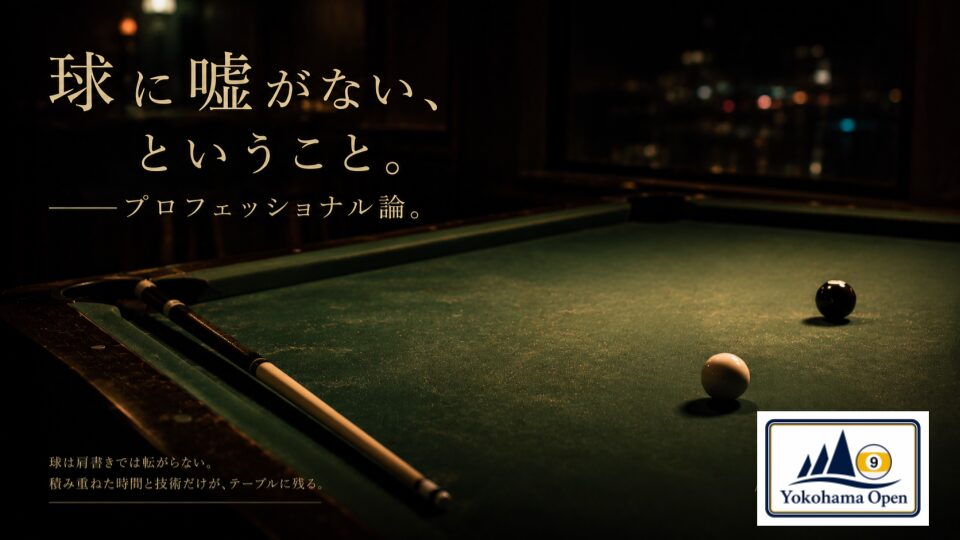
A ball does not roll on titles.
Only the time and the skill you have built up remain on the table.
In what form they will bear fruit — no one knows yet.
👉 What you love, you grow good at. — The heart of improvement, as science has shown.
👉 Billiards resources from Japan and around the world, organized by purpose: Billiards in Depth (latest updated hourly)