
日本語 | 繁體中文 | English | 한국어 | Tiếng Việt
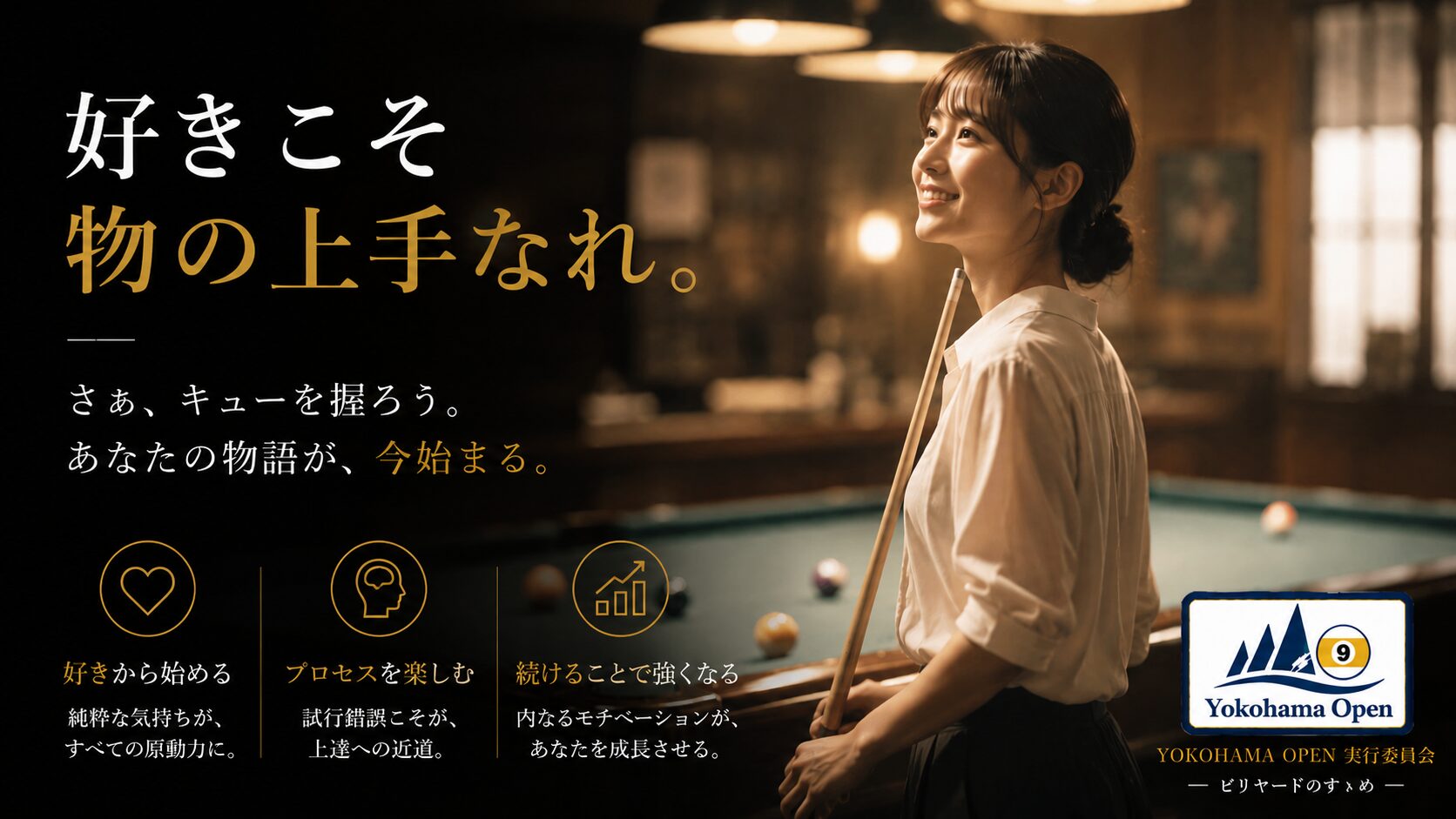
“What you love, you grow good at.”
Almost everyone has heard it at least once.
We throw ourselves into what we love, and so, without trying, we get better — that is what the saying has meant since long ago.
But it is more than an old proverb.
It is also something modern psychology has proven, scientifically.
Intrinsic and extrinsic motivation
The psychologists Edward Deci and Richard Ryan proposed an idea called “self-determination theory.”
Human motivation, broadly, comes in two kinds.
Extrinsic motivation — when we are moved to act by rewards from outside: prize money, praise, recognition.
Intrinsic motivation — when we are moved by a desire that wells up from within: because the thing itself is fun, interesting, because we want to get better at it.
According to research, compared with people moved by extrinsic motivation alone, people moved by intrinsic motivation:
- Are more resilient. They come through the hard stretches more easily.
- Can enjoy the process itself. Not only the results — the hours of practice, of trial and error, become richer too.
- Keep improving over the long run. Even when outside rewards disappear, the motivation holds.
Lean on extrinsic motivation alone, on the other hand, and motivation drops sharply the moment the reward stops coming.
This is called the “undermining effect.”
The day you first hold a cue
To anyone about to take up pool, there is just one thing I want to say.
You don’t have to make it complicated.
“It just looks cool.” “I want to try it.” “I want to play like that person.” — Reasons that simple are more than enough.
In fact, that pure feeling is the most important thing of all.
Imagine the first time you pick up a cue.
It is heavier than you expected.
You don’t even know how to hold it.
You settle into your stance, a little afraid, you take aim — and then the moment the ball you aimed at drops into the pocket for the first time.
Something inside you is bound to stir.
“Again.” “I want to get better.” — A moment your body feels it, even if you can’t put it into words.
That is intrinsic motivation.
Getting better is itself the joy.
The happiness of finally doing what you couldn’t do before.
Where those feelings pile up, one on another, real improvement lies.
Prize money, winning — at first, you need neither.
The feeling that made you want to hold a cue is enough.
Those who can enjoy the process are the ones who improve in the end
People who run on intrinsic motivation have one more great trait.
They can take failure as feedback. That, above all.
They look at a ball that didn’t go and ask, “Why did it miss?”
They try, and adjust.
They try again — and those who can enjoy that very process are, in the end, the ones who grow the most.
👉 The right answer is always being rewritten. — On pool as a pursuit.
It is the same as thinking backward.
When you work back from the goal to what you should do now, whether you find that thinking itself enjoyable — that is what decides how far you improve over the long run.
👉 Thinking back from the 9-ball can change your life.
Pool is a sport where this is especially true.
Every single shot is dense with thought, and inside the process lie endless discoveries.
For those who can enjoy that process, pool becomes a game they will never tire of, all their lives.
Outside motivation can be the spark
Think about it for a moment.
You don’t need prize money to enjoy baseball or soccer.
The pure joy of chasing a ball, the fullness of sweating alongside friends, the feel of getting better — that alone makes for a rich experience of sport.
Let me add something, so I’m not misunderstood.
This is not a rejection of extrinsic motivation.
Prize money and praise can be the spark that starts something new, or the push that takes you one step further.
It is only that relying on them alone carries a risk.
When there is a reward outside, we can push ourselves.
But when there is none, when things won’t go your way, the only thing that keeps you going is the energy that wells up from within.
Let outside motivation be the spark. Let inner motivation be the engine.
Hold on to the feeling of loving it
Do you remember how it felt the first time you held a cue?
Or, if you have never held one — in a film, in a shop window, on social media, was there a moment you saw someone playing pool and felt something?
“That’s cool.” “I want to try.” — That one flash is your first point of contact with pool.
That feeling is real. Not reason, but a moment of being drawn to something at the level of your DNA.
The essence of improvement, science agrees, lies in the feeling of loving something.
If you sense that feeling fading, pause for a moment.
And if you have never held a cue — please hold on to that sense of “That’s cool.”
Do you love pool, right now?
References
- Ryan, R. M. & Deci, E. L. (2000). Self-determination theory and the facilitation of intrinsic motivation, social development, and well-being. American Psychologist, 55(1), 68-78. doi:10.1037/0003-066X.55.1.68
- Deci, E. L., Koestner, R. & Ryan, R. M. (1999). A meta-analytic review of experiments examining the effects of extrinsic rewards on intrinsic motivation. Psychological Bulletin, 125(6), 627-668. doi:10.1037/0033-2909.125.6.627
- Cerasoli, C. P., Nicklin, J. M. & Ford, M. T. (2014). Intrinsic motivation and extrinsic incentives jointly predict performance: a 40-year meta-analysis. Psychological Bulletin, 140(4), 980-1008. doi:10.1037/a0035661
👉 Billiards resources from Japan and around the world, organized by purpose: Billiards in Depth (latest updated hourly)