
日本語 | 繁體中文 | English | 한국어 | Tiếng Việt
5–0.
September 27, Higashi-Omiya, Saitama.
At the 65th Meijin title playoff, the reigning Meijin, Yasuhiro Kijima, turned back the challenger, Yoshio Sakamoto.
A defense made by taking five sets in a row.
That makes nine terms in all as Meijin.
Look only at the numbers, and it reads like a one-sided day.
But the results hold another row of numbers.
Three hundred points, five times
The Meijin is an amateur title event that began in 1961.
This year was its 65th edition.
The game at the Meijin title playoff is Rotation.
You strike the balls in order from the 1, and the number on each ball you pocket is the score it gives you.
All fifteen added together make 120 points.
A set is a race to 300.
Only after piling up two and a half racks’ worth of points do you finally have one set.
The first to take five of them sits in the Meijin’s seat.
The numbers that remain
The results also keep the challenger’s points.
220. 264. 287. 200. 118.
The third set: 287 points.
13 points short of 300.
In Rotation, that is a single 13 ball.
In the first set, the live report that day tells us, the challenger was the first to build a score.
The Meijin ran 218 points without a break and closed out the set.
The 5–0 records neither of these.
Not letting them finish
Four days after the match, an interview appeared with the Meijin’s words set in its headline.
“I play so my opponent never gets to finish.”
In five sets, the challenger never once reached 300.
Kijima first took the Meijin title at the 54th edition, in 2014.
Four years later, at the 58th, came the return to that seat.
Since then, the Meijin title has passed into no one else’s hands.
The challenger came to this day’s table by winning through the Class A tournament held in Kyoto in August.
Only one player a year may take that seat.
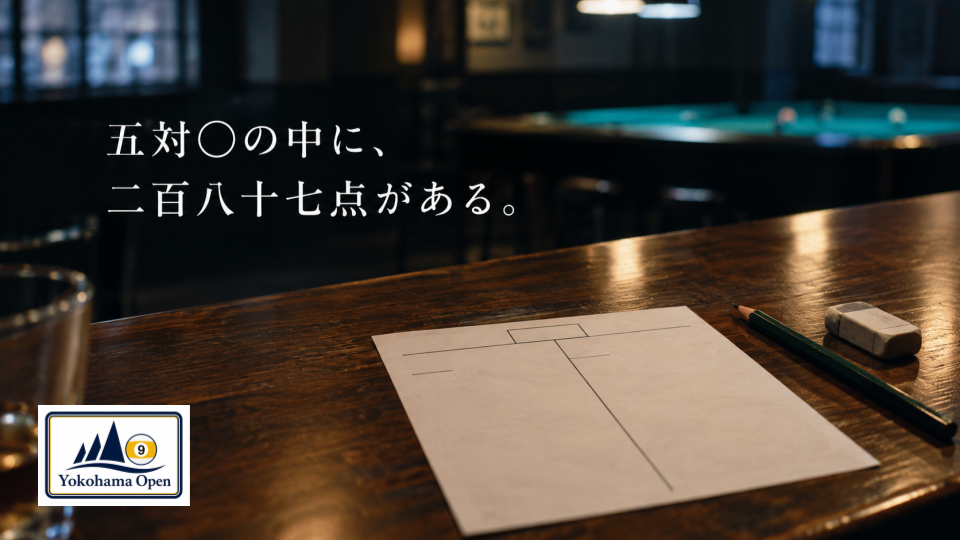
A score sheet, in pencil
More than a few of us, surely, have come within one rack in the final of a house tournament.
The score sheet is usually filled in by pencil.
In the winner’s column, a single circle.
In the loser’s, the number of racks taken up to that point.
Sometimes faint traces linger on the paper, where something was erased and written again.
When the match is over, the sheet goes back to the counter and, at some point, is thrown away.
And with it, the number that was one short.
Some, perhaps, keep one folded deep in their wallet.
Back to 5–0
Next year’s Meijin, too, will begin again with qualifiers around the country.
In the Meijin’s column, five W’s.
In the challenger’s column, five numbers.
Inside the 5–0, there are 287 points.
Sources for the results
- Japan Amateur Pocket Billiard Association (JAPA), “65th Meijin-sen Meijin title playoff: Yasuhiro Kijima successfully defends! Nine terms as Meijin!” (September 27, 2026) https://japa.ne.jp/?p=27302
- On the hill!, “The 65th Meijin title playoff” https://www.onthehill.jp/archives/108608
- Billiards Days, “65th Meijin title playoff (reigning Meijin Yasuhiro Kijima vs challenger Yoshio Sakamoto), under way!” (September 27, 2026) https://www.billiards-days.com/20260927-1/
- Billiards Days, “‘I play so my opponent never gets to finish’ — Yasuhiro Kijima, nine terms in all as Meijin: the long interview” (October 1, 2026) https://www.billiards-days.com/20261001-1/
- Japan Amateur Pocket Billiard Association, “Meijin-sen” (past Meijin) https://japa.ne.jp/?page_id=482