日本語 | 繁體中文 | English | 한국어 | Tiếng Việt
What is art?
No one has yet answered that question completely.
Philosophers, artists, critics—every time someone has tried to define it, a work has appeared that breaks the definition.
Even so, today I would like to sit with that question for a while.
Because I believe that somewhere beyond it, there is pool.
What Duchamp’s Fountain asked
In 1917, Marcel Duchamp signed a ready-made urinal “R. MUTT” and submitted it to an exhibition. He called it Fountain.
It was refused, as you might expect. And yet it is still spoken of as one of the most important works of twentieth-century art.
Why?
Because the question itself—“Is this art?”—became the art.
Not the maker’s skill. Not beauty.
A question put to the idea of art itself—that this, too, might be art. Duchamp showed the possibility with a single urinal.
The moment a viewer wonders, “What is this?”, art is born inside that thought.
A work is only finished in the one who receives it.
What Taro Okamoto embodied
Taro Okamoto came at art from somewhere else entirely.
Not reason, not concept, but the release of the energy kept inside.
A way of living, impulse, desire, anguish—hurled at the canvas, nothing hidden.
The viewer takes in that overwhelming energy, feels something, thinks something.
I still remember my visit to the Taro Okamoto Museum of Art in Kawasaki.
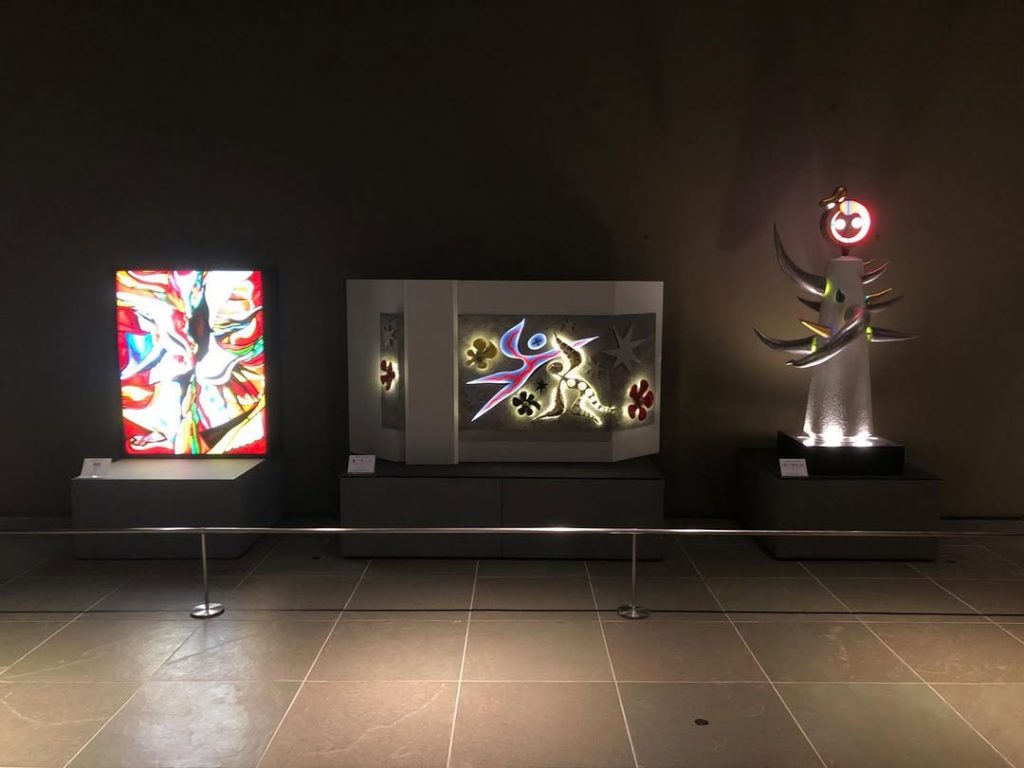
Standing before the works, I found I had no words.
Beautiful, difficult—judgments like these began to seem meaningless.
Only, something came through.
Whether it was something bright or something dark, I could not tell.
And I think that is as it should be.
If Duchamp made art out of asking, Okamoto made art out of making us feel.
Neither one gives an answer.
Both leave it to us.
The moment a work is finished, it leaves the artist’s hands.
How it is felt, how it is read—that belongs entirely to the one who receives it.
If someone feels joy in a work made of sorrow, then for that person, joy is the right answer.
Then is pool an art?
Let me ask the question here.
A professional pool player strikes a single ball.
Into that one shot, the player’s whole thinking has been distilled.
Why that ball.
Why the cue ball was sent there.
What run-out is being drawn in the mind—it is the moment when the judgment, skill and energy held within are released through the cue.
And the moment the ball begins to roll, it has already left the player’s hands.
Someone watching may find it beautiful.
Someone may wonder, “Why that choice?”
Someone may think, “I’d have played it differently.”
And if someone feels it was nothing special, that too is the right answer, for them.
A question asked through a single shot. Each person who receives it, with an answer of their own.
Isn’t this remarkably close to the essence of art that Duchamp revealed?
And there is one more thing at the heart of what makes pool an art.
In theory, every shot should be perfectly repeatable.
The laws of physics do not change.
Strike the same spot on the cue ball, with the same weight, the same spin, and the result should be the same—
But in reality, it never is.
The faintest tremor of a hand, how one feels that day, the state of the cloth, the humidity, the nerves—and the plain fact of a table on which the same layout will never appear twice.
Perfectly repeatable in principle, never perfectly repeated.
In that gap, which can never be closed, human existence itself resides.
And to watch that gap is to experience art.
Live music knows this too. Play exactly what is written and it should sound the same, yet no performance ever happens twice.
Even from the same score, the maker of an instrument, its age, how it has been kept—all of it plainly changes how the sound carries.
That is why we want to be there in person.
And pool resembles jazz.
The beauty of jazz lies in improvisation.
Over the “laws of physics” of a chord progression, players answer the feeling of the moment, the conversation with one another, the air in the room, and make music that will never be the same again.
Pool is the same. When the cue ball doesn’t go where you meant it to, you choose the best thing in the very next moment. One recovery after another—the beauty of that improvisation is like a jazz session.
Over a score written in physics, a human being improvises. That is the art called pool.
👉 The right answer is always being rewritten. — On pool as a pursuit.
Watching is an experience of art
There is one more thing I would like to add.
Sharing what you have received with someone else is also part of the experience of art.
Sitting beside a friend, watching a match, talking over why that ball was chosen.
Each of you brings what you felt, and a conversation begins.
Readings you would never have found watching alone are born in talking with someone else.
It is, at heart, the same as standing before a work in a museum and asking the person beside you, “What do you think it means?”
To think through a question that has no right answer, together with someone. That is the richest experience art can offer.
Watching pool offers exactly that.
👉 Watch, think, and want to watch again. — Pool as a spectator’s art of thought.
And so, we hope you’ll watch
A professional’s bearing, a professional’s shot, a professional’s thinking—we hope you will enjoy them as art.
If it seems like nothing special to you, that is quite all right.
That is your reading.
Moved, puzzled, even bored—every one of these is a right answer, and every one is a conversation with the art called pool.
There is no correct interpretation.
Which is exactly why you want to watch again, and again.
The Yokohama Open Executive Committee hopes to keep creating experiences like these.
👉 Yokohama Open tournament information
And today, the 54th All Japan 14-1 Open Championship is being played.
Admission is free. Spend your weekend with a little art.
- Final: Sunday, May 17 / Billiards Rosa (ビリヤードロサ), Ikebukuro
👉 Billiards resources from Japan and around the world, organized by purpose: Billiards in Depth (latest updated hourly)