
日本語 | 繁體中文 | English | 한국어 | Tiếng Việt
Count 9 is the game played at Sumai Agent presents Yokohama BC Count9 Battle 2026.
If you know 9-ball, you will feel at home right away.
But it is not quite ordinary 9-ball—and that is where the fun of Count 9 lies.
Here, we lay out the rules as plainly as we can.
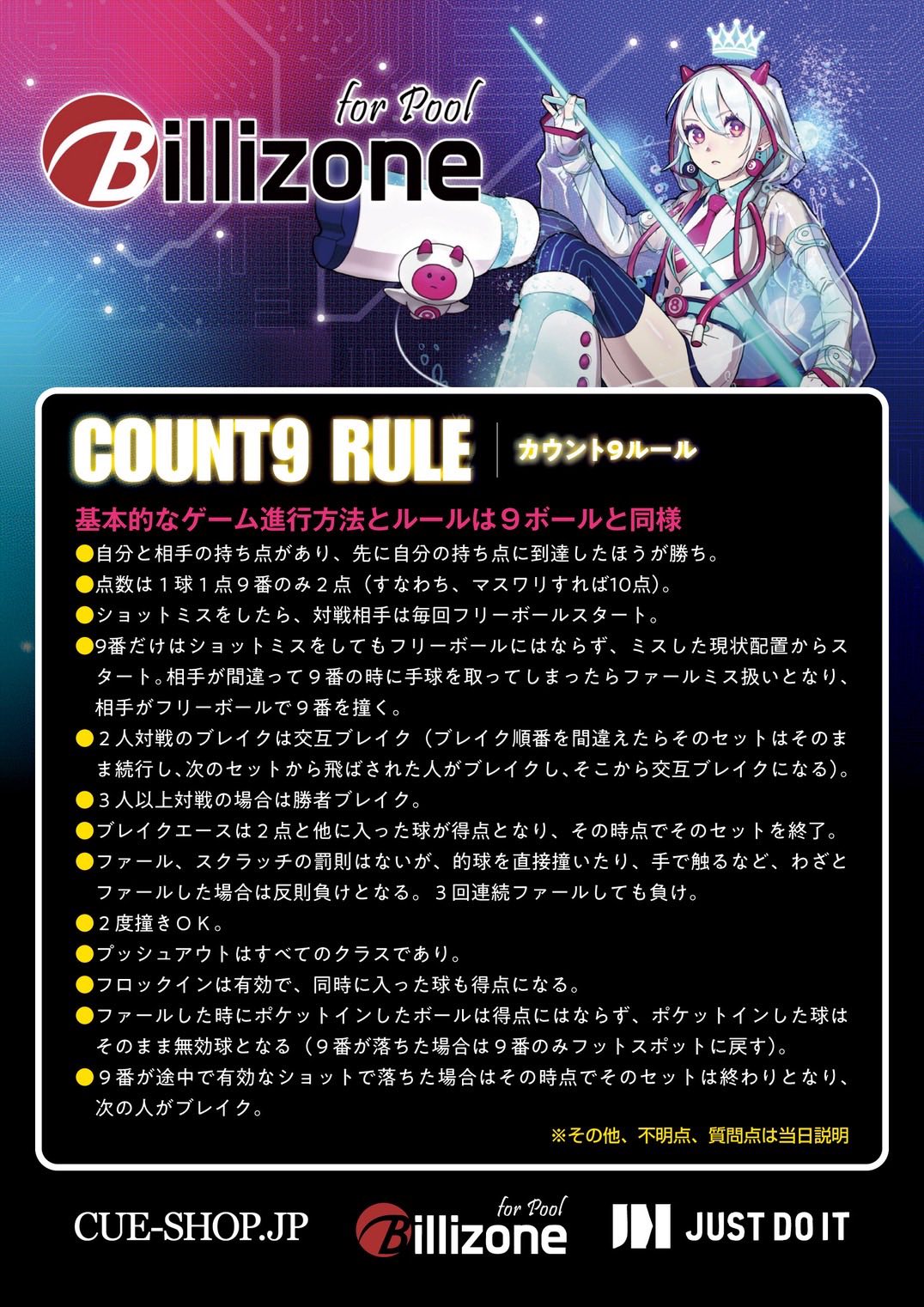
At heart, it is 9-ball
How a game proceeds, and the basics of the rules, are the same as in 9-ball.
If you already know 9-ball, all you need to learn are the rules unique to Count 9.
How to win
You and your opponent each have a target score, and whoever reaches their own target first wins.
The targets for this tournament:
- B class: 40 points
- C class: 30 points
Scoring
| Ball | Points |
|---|---|
| Balls 1–8 | 1 point each |
| The 9 ball | 2 points |
Run out an entire rack (pocket every ball) and you score the maximum: 10 points.
What makes Count 9 different
Ball in hand after every miss
Whenever a player misses, the opponent starts with ball in hand (anywhere on the table)—every single time.
You can place the cue ball wherever you like, so your own choice holds the key to everything.
The 9 is the exception
A miss on the 9 alone does not give ball in hand.
Play continues from the layout exactly as the miss left it.
However, if the opponent mistakenly picks up the cue ball when the 9 is the ball on, it is treated as a foul, and the 9 is then shot with ball in hand.
Breaking
Alternating break (If the break order is mistaken, that set continues as it is; from the next set, the player who was skipped breaks, and alternating breaks resume from there.)
Break ace
A break ace scores 2 points, plus points for any other balls that dropped, and the set ends right there.
Fouls and scratches
There is no penalty for a foul or a scratch.
However, in the following cases, the player loses by forfeit:
- Striking an object ball directly with the cue
- Fouling on purpose, such as touching a ball with your hand
- Three fouls in a row
Also, a ball pocketed on a foul does not score and is simply dead (if the 9 drops, only the 9 is returned to the foot spot).
Other rules
- Random rack
- Double hits are OK
- Push-outs allowed in all classes
- Flukes count, and any balls that drop on the same shot score too
- If the 9 is pocketed early on a legal shot (a carom, a combination, and so on), the rack ends there.
As with a break ace, the 9’s 2 points are added together with the points for any other balls that dropped.
The next player breaks.
The real pleasure of Count 9
Because of the ball-in-hand rule, which ordinary 9-ball does not have, the moment you miss, everything is handed over to your opponent.
Where to place it.
How to attack.
Every choice is yours—and that is exactly why skill and judgment show up in the score just as they are. That is both the joy of Count 9 and its severity.
“I got a bad leave”—in this game, that excuse does not hold.
With ball in hand, where the cue ball goes is always your own decision.
Not only your shot-making, but things like cue-ball movement and building a pattern—how far your knowledge really goes, all of it, is laid bare in Count 9.
On the other hand, thanks to ball in hand, even beginners can add points steadily, one ball at a time.
Since you are never handed a difficult layout, you can play at your own pace—that side of it is real, too.
Severe, and yet anyone has a chance. That is Count 9.
How will each of you fight within these rules? We are already looking forward to it.
How to think about the entry fee
The entry fee for this tournament is ¥5,000.
The B class target is 40 points—on simple arithmetic, about four racks.
Some of you may feel that ¥5,000 for four racks is a lot.
But think about it for a moment.
This ¥5,000 is not money paid by the rack.
A stream with live commentary by pros Hayato Hijikata and Lo Li-wen. If your match is on the stream table, your play will be talked through from a top professional’s point of view.
Even if you lose, there is always something to take away.
That ball in hand—why did you put it there?
That moment—how would a top pro think about it?
A view you could not see for yourself comes back to you in words.
An experience you will never get from ordinary lessons or practice—one born only in the extreme tension of a match.
What’s more, the two semifinals are planned to be played on the stream table one at a time.
If you make it to the final, you will play up to two matches—semifinal and final—on the stream table with commentary.
An intermediate tournament, and top pros commentating two of your matches.
That is a rare luxury.
*For operational reasons, matches running at the same time cannot be ruled out entirely, but we plan to stream them one at a time wherever possible.
And on the day itself: an exhibition match between Lo and Hijikata, free play on DUYA CLUB’s Chinese 8-ball tables, and free admission for spectators—all of it within this one day.
Caring about winning matters, of course.
But beyond the result of winning or losing, there is something here to take in.
Will you see ¥5,000 as an entry fee, or as an investment in a day that might change your billiards?
The answer is found in taking part.
Tournament overview
| Item | Details |
|---|---|
| Tournament | Sumai Agent presents Yokohama BC Count9 Battle 2026 |
| Date | Wednesday, April 29 (public holiday) |
| Venue | POOL LABO (Naka-ku, Yokohama) |
| Game | Count 9 |
| Format | Single elimination |
| Capacity | 64 players (32 meeting at 9:00 / 32 meeting at 9:30) |
| Entry fee | ¥5,000 |
| Target points | B class: 40 points / C class: 30 points |
| Spectators | Free |
From the last 32, streamed with live commentary by pros Hijikata and Lo
Prizes
🥇 Winner: playing cue (worth ¥140,000)
🥈 Runner-up: cue case
🥉 Joint 3rd: gift certificates
Joint 5th: billiards goods
*There is no prize money
Entries are still very much open!
On April 29, let’s spend a fun day full of discoveries together!!
👉 Tournament details and entry