
日本語 | 繁體中文 | English | 한국어 | Tiếng Việt
“Is pool actually fun to watch?”
If that is what you’re thinking, let us answer that first!
It’s ridiculously fun.
We are a people who know how to enjoy battles of the mind like shogi, so once you understand the rules and what to look for, you are bound to enjoy it!
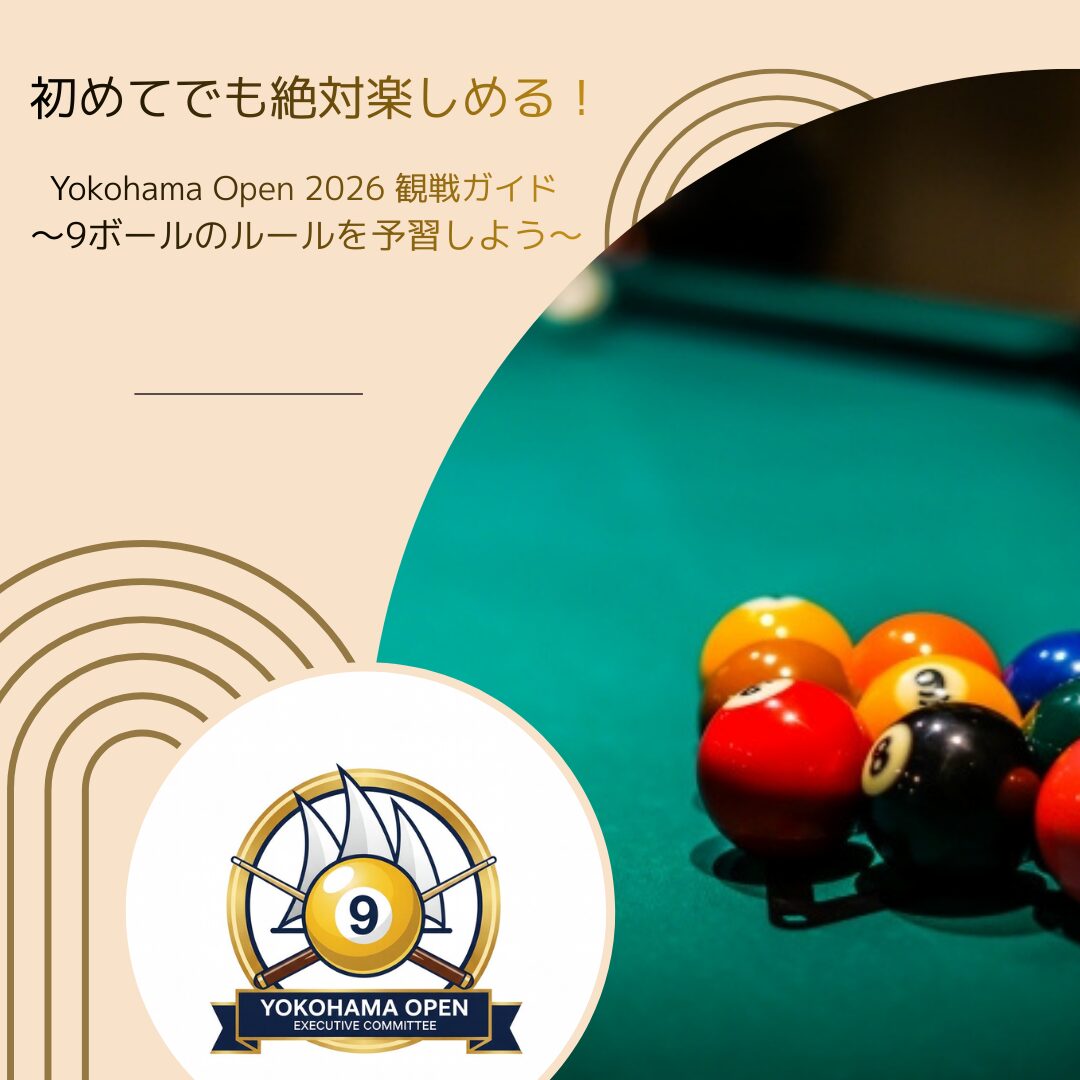
To help you enjoy watching in person, here are the 9-ball rules worth knowing, explained as simply as we can for first-timers!
So what kind of game is 9-ball?
Nine balls are used on the table, numbered 1 through 9.
The rules could hardly be simpler!
Using the cue ball (the white ball), you must hit the object balls in order, starting with the 1 (the lowest number on the table), and whoever pockets the 9 at the end wins.
But if the 9 happens to drop along the way, that counts too.
Whether it’s a shot that goes exactly as planned or a lucky bounce, both are “fair game”: that is what makes 9-ball fun.
Before the match: the “rack” matters too!
Before play begins, the balls are set in a diamond shape. This is called “racking.”
Yokohama Open 2026 uses “random self-racking.”
The player who breaks racks for themselves; only the positions of the 1 and the 9 are fixed, and the rest of the balls go in at random.
In fact, how the rack is set can shape the way a match unfolds.
Do watch the players’ faces as they rack.
What is “1 on the foot”?
When racking, the 1-ball is placed on a set position called the “foot spot.”
This is the “1 on the foot” rule.
With the 1-ball sitting on the foot spot, break strategy changes.
Top players calculate carefully, trying to gain the upper hand with a single break.
The battle of the break: the “3-point rule” and the “controlled break”
The break shot is subject to the “3-point rule.”
On the break, the balls pocketed, plus the balls that cross into the kitchen (the area within two diamonds of the short rail on the breaker’s side), must add up to three or more.
If not, the opponent resumes the game from that position.
What we’d love you to watch for here is the idea of the “controlled break.”
Top pros and top amateurs can break so that the ball at the side point of the diamond, in the spot known as the “wing,” goes into the corner pocket exactly as planned, while even the cue ball’s path stays under control, and they can do it again and again, with high consistency.
Not brute force, but a precisely calculated break.
But with the 3-point rule in place, a certain amount of power is needed as well.
Add power, and you risk losing control: caught in this dilemma, players chase the ideal break.
Do watch for just how hard a “strong, accurate break” really is.
Winner breaks: the streak that won’t stop
Yokohama Open 2026 plays “winner breaks”.
The player who won the previous game earns the right to break the next one as well.
The break is a huge advantage: the first move often decides it.
In other words, win one rack, and you get to play the next game on the front foot.
And the frightening part: lose the “lag” at the start of the match (a kind of rock-paper-scissors that decides who breaks first), and your turn may never come round again. There are even times when a match ends without a player ever getting to pick up the cue.
If you see a moment like “Wait, it’s over, and that player barely took a shot!?”, that is exactly how frightening winner breaks can be.
The tricky spot after the break: the “push out (shoot out)”
The break worked! No foul.
But sometimes the lowest-numbered ball, the one you must aim for next, is hidden, or the layout makes both a shot and a safety (a defensive shot) difficult.
At a time like that, a player can choose the “push out (shoot out).”
Declare a push, and you can send the cue ball anywhere you like, regardless of the lowest-numbered ball you would normally have to hit.
However, the turn passes to the opponent, and the opponent chooses whether to shoot or to pass it back.
Where the push leaves the balls, and how the opponent decides, can turn the whole flow of a match.
Know your fouls
Pool has several fouls.
Commit a foul, and the turn passes to your opponent, who gets “ball in hand”: the right to place the cue ball anywhere and shoot.
In a match between top players, this is a very big danger.
From a perfect position, the opponent goes on the attack.
Here are three common fouls.
Scratch
The cue ball (the white ball) falls into a pocket.
It happens at unexpected moments, such as when a shot takes on more topspin or backspin than intended.
No-rail foul
After the cue ball hits the object ball, neither the cue ball nor the object ball touches a cushion (the table’s rail) before coming to rest.
In a game that demands such delicate touch, it does happen.
Double hit
A foul in which the tip of the cue touches the cue ball more than once during a shot.
One way to judge it: the cue ball, right after hitting the object ball, moves forward past the tangent line to the object ball.
An unnatural, pushing contact is also treated as a double hit.
However, when the cue ball and the object ball are touching, “frozen,” it is, as an exception, not a foul.
What to watch for during a match!
Now that you know the rules, here are the moments that get the room going most.
Break ace
The 9 drops on the break shot itself.
Usually the 9 stays where it is, but all sorts of things can send it into a pocket.
The greatest miracle in pool: the match decided the instant it begins.
Break and run (runout)
After the break, pocketing every ball through to the 9 without ever handing the table to the opponent.
It only happens when a player keeps pocketing balls exactly as planned while steering the cue ball to just the right spot, again and again.
A feat that distills a top player’s concentration and skill.
The battle of safeties
There may be moments when you think, “Huh, why aren’t they even trying to pot it!?”
That is what is called the “safety”: a deliberate move to hand the opponent a difficult layout, a defensive shot.
How will the player on the receiving end reply? Go for the pot by force, answer with a safety, struggle just to make contact, or end up fouling?
Once you know that not potting can carry deep meaning, the scenes that look dull suddenly become fascinating.
On spectator manners
Lastly, one request for when you watch.
Please do applaud a good shot!
Your applause, answering the players’ fiery play, lifts the whole venue.
However, while a player is down on a shot, please keep your movement to a minimum.
Pool is a game of aiming to the millimeter.
In the moment of getting down on a shot, a player’s focus is at its absolute limit.
Too much movement within their line of sight can break that focus.
Let’s keep a clear rhythm of stillness and motion, and lift the venue together!
Free to watch, qualifiers and finals alike!
Even for first-timers, knowing just a little about the rules changes everything you see.
Even if you’ve never watched pool before, just keeping these points in mind should make watching fun!
On the day, watching is free for both the qualifiers and the finals.
Watch pool at a venue near you, a good beer in hand!!!
Please take this chance to experience pool as a spectator, in a way you never have before.
Yokohama Open 2026: we look forward to seeing you at the venue!