日本語 | 繁體中文 | English | 한국어 | Tiếng Việt
My hand had reached out again.
In front of the fridge in the middle of the night, a sigh.
I’d told myself, just today.
You watch what you eat, but your shape barely changes.
You exercise.
You’ve cut down on snacks.
Still, at night, your hand somehow reaches for sweets. Are the nights going on when you can’t sleep, carrying the guilt?
Nights like that are not as rare as you might think.
It isn’t that your will is weak, or that you aren’t trying hard enough.
Perhaps you just didn’t know how it works.
Why will gives way on tired nights
Have you noticed that on the nights after you’ve worked hardest, your appetite somehow won’t stop?
It isn’t your imagination.
It’s because your frontal lobe is worn out.
The frontal lobe is the part of the brain in charge of reason and holding back impulses.
When the brain is tired, that restraint works less well.
After a whole day of using your head for work or childcare, the frontal lobe is exhausted too.
That is why will gives way more easily at night.
There is no need to blame yourself. Your brain is simply, honestly tired.
Some days you can stop in front of the fridge; some days, before you know it, your hand has reached out.
Both of them are part of you.
👉 On the frontal lobe and anti-aging
What “just today” really is
“I’ll eat it just today.” “I’ll try hard from tomorrow.” When those words come out, a tug-of-war is going on in the brain between pleasure right now and long-term benefit.
You may have felt “I failed again” many times.
But perhaps that wasn’t because you are weak; perhaps it was because you were trying to go against the way the brain works.
It is known that the more our capacity to think is in good order, the more easily we choose our future selves over pleasure right now.
This is exactly the same as thinking backward in pool.
To pocket the 9, where do you send the cue ball on this shot?
Not the shot right in front of you, but a choice worked backward from the goal. That pattern of thought quietly carries over into everyday choices about food, too.
Rather than blaming yourself for failing, train your thinking.
That is a far gentler way to change.
👉 More on thinking backward and pool
The brain, at just 2% of body weight, uses 20% of all energy
During intellectual activity, the brain uses a surprising amount of energy.
Although it weighs only about 2% of the body, the human brain is the organ that uses about 20% of all the energy the body consumes.
When you are running backward thinking, spatial awareness and emotional control at full power in pool, your brain is using a great deal of energy.
And the wish to keep that brain healthy can, little by little, come to influence your choices about food.
Not out of duty, but changing from within. That kind of change may be the habit that lasts longest.
Brain and body shape are connected
And there is one more interesting thing.
Accumulated body fat dulls the workings of the brain.
Recent research has found that inflammatory substances released by visceral fat affect the brain, lower memory, and create a vicious circle that makes it harder to feel full.
Using the brain brings the body into shape, and a body in shape sharpens the brain.
It is never too late to start that cycle.
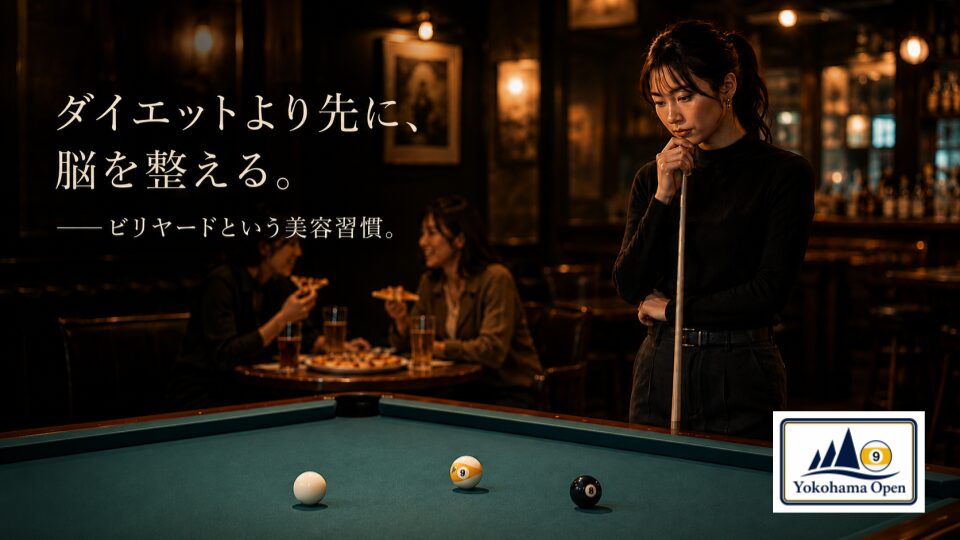
A night when you feel you haven’t moved enough, a night when your hand is about to reach for sweets again: what if, on nights like that, there were the choice of going to pick up a cue?
There is no need to blame yourself.
Just try choosing a slightly different night.
👉 On the mindfulness effects of pool
About a night with a cue in hand
One night, for no real reason, I turned my steps toward a pool hall.
I picked up a cue and went to the table.
One ball, then another.
Before I knew it, an hour had passed.
On the way home, somehow, I wasn’t hungry.
Nights like that slowly grew in number.
Enjoying it, little by little
You don’t have to try too hard. You don’t have to blame yourself.
Just, little by little, add to the time you spend with a cue in hand.
That might become a new beauty habit.
Why not make pool your next beauty habit?
👉 More on the beauty benefits of pool
👉 See the Yokohama Billiard Hall Guide
References
- Hofmann, W., Schmeichel, B. J. & Baddeley, A. D. (2012). Executive functions and self-regulation. Trends in Cognitive Sciences, 16(3), 174-180. doi:10.1016/j.tics.2012.01.006
- McClure, S. M. et al. (2004). Separate neural systems value immediate and delayed monetary rewards. Science, 306(5695), 503-507. doi:10.1126/science.1100907
- Raichle, M. E. & Gusnard, D. A. (2002). Appraising the brain’s energy budget. Proceedings of the National Academy of Sciences of the United States of America, 99(16), 10237-10239. doi:10.1073/pnas.172399499
- Miller, A. A. & Spencer, S. J. (2014). Obesity and neuroinflammation: a pathway to cognitive impairment. Brain, Behavior, and Immunity, 42, 10-21. doi:10.1016/j.bbi.2014.04.001
- Stranahan, A. M. (2022). Visceral adiposity, inflammation, and hippocampal function in obesity. Neuropharmacology, 205, 108920. doi:10.1016/j.neuropharm.2021.108920
- Dorfman, M. D. & Thaler, J. P. (2015). Hypothalamic inflammation and gliosis in obesity. Current Opinion in Endocrinology, Diabetes and Obesity, 22(5), 325-330. doi:10.1097/MED.0000000000000182