日本語 | 繁體中文 | English | 한국어 | Tiếng Việt
There is a technique called kintsugi.
It is a traditional Japanese way of mending: the shards of broken pottery are joined with gold or silver.
Rather than restoring the piece to perfection, it leaves the cracks as they are — and lets the gold make them shine.
The finished vessel holds the memory of when it was new, the moment it broke, and every piece of history that no longer exists in this instant.
All we can see is the surface of the vessel.
But when our thoughts reach toward what cannot be seen — the vessel is no longer just a tool.
Yohaku, the space left empty, is the room in which our thoughts can reach even the parts we cannot see.
There is a sense of beauty that the Japanese have nurtured over a very long time.
A sensibility that finds more beauty in petals as they fall than in cherry blossoms at full bloom.
An eye that feels the quiet grace of wabi more in a kintsugi bowl than in flawless pottery.
And a heart that senses depth in the words left unspoken.
One of the arts that embodies this sensibility most fully is rakugo.
The essence of rakugo
In rakugo, a single performer plays every character.
With nothing but a folding fan and a hand towel, he summons the tenement alleys of Edo, the pleasure quarter of Yoshiwara, even hell itself.
The audience looks at a bare stage and sees what is not there.
Danshi Tatekawa called this “illusion.”
The illusion Danshi meant is not stage trickery or fantasy.
The absurdity that lives inside human beings — that is what he meant.
Feelings that reason cannot explain, contradictory desires, the karma we cannot help — all of it comes vividly alive on the stage.
And Danshi left us one more phrase.
“Rakugo is the affirmation of human karma.”
Hopeless people, in hopeless situations, living on all the same.
Not laughing at their foolishness and sorrow, but affirming it. That, he said, is rakugo.
To affirm human karma is, in other words, the beauty of imperfection.
To accept human weakness, and to find beauty in the figure that still tries to move forward.
And the joy of classical rakugo is that the same story becomes something entirely different in the hands of each performer.
Shibahama, Daiku Shirabe, Sokotsu Nagaya — the same tales, handed down for a hundred years, take on wholly different faces through each performer’s reading and character.
In that “difference,” the performer’s own life seeps through.
The tirade in Daiku Shirabe
There is a classical rakugo story called Daiku Shirabe, “The Carpenter’s Inquest.”
Yotaro the carpenter falls behind on his rent, and the landlord seizes his toolbox.
His master, Masagoro, goes to the landlord to negotiate, but the landlord will not give it back.
Each has right on his side, and neither will back down.
Before long, it turns into an exchange of tirades.
Neither one is wrong.
And neither one will yield.
Pride, stubbornness and feeling tangle together, and being right is not enough to settle it — that is human karma.
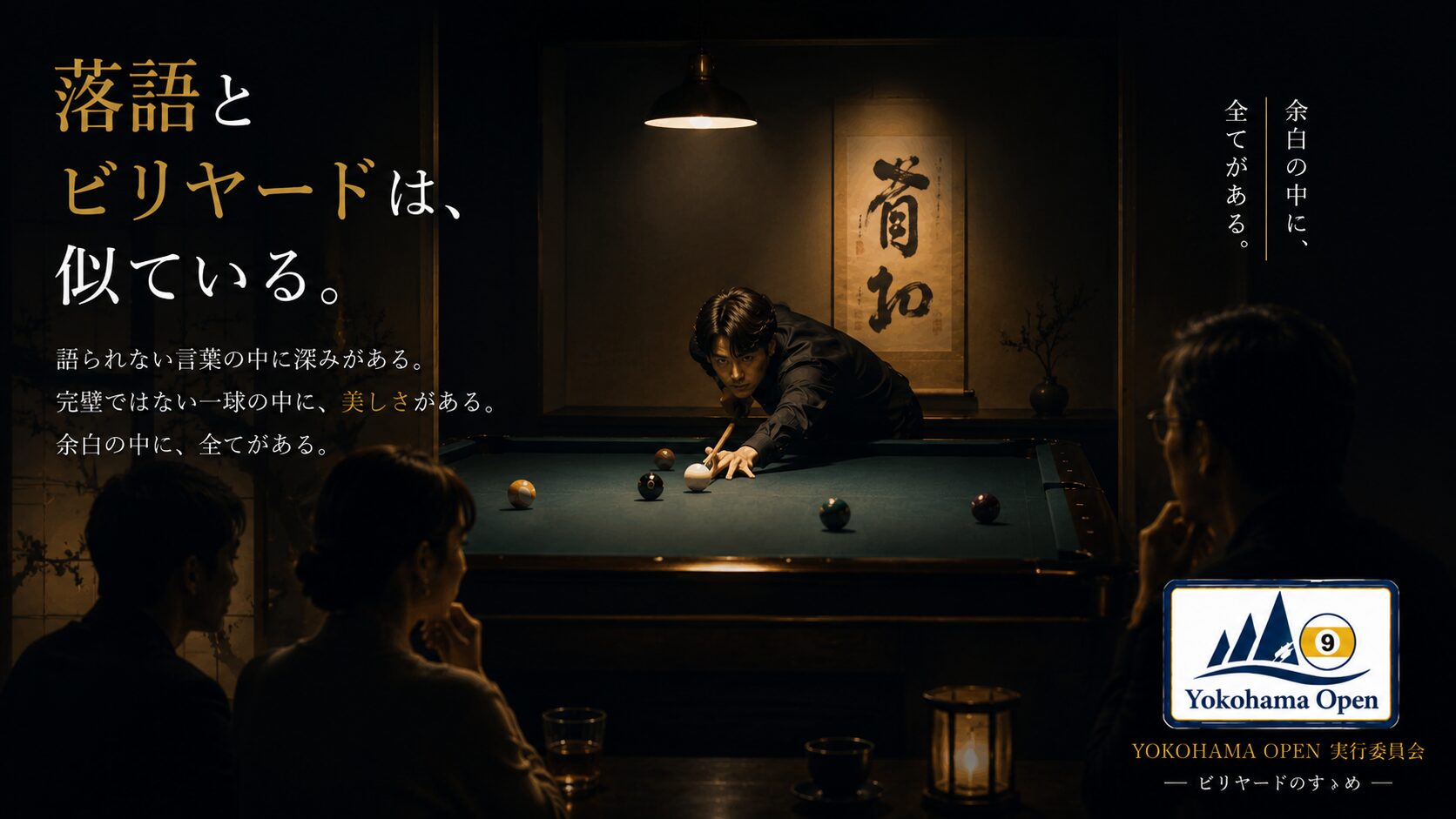
Picture a match on alternate breaks, where both players keep answering each other with run-outs.
There are no words.
But every ball becomes a question put to the opponent.
And the opponent’s every ball becomes a tirade aimed back at you.
Each gives everything they have, and the silent exchange goes on across the table.
A wordless Daiku Shirabe is unfolding on the cloth.
And the 9-ball break has been studied so closely that, with a controlled break, players can now reproduce fairly similar layouts.
So has the game become dull?
Not at all.
From the same break, each player builds the rest of the rack in an entirely different way.
In the choice of every ball, the player’s thinking, character and life seep through.
Just as in classical rakugo, the same “story” takes on a different face with each performer.
People are not strong
Here I have to be honest.
People are not strong.
However much you practice, however well you prepare, mistakes happen in places your effort cannot reach.
Aiming for perfection, and never quite reaching it.
That is what it is to be human.
Late in a match, at the moment that matters, your hand trembles.
A shot that should go in, misses.
Your body will not do what your heart wants.
Have you ever known a moment like that?
After a loss, you sometimes feel, “The rolls weren’t with me,” or “I got beaten by a fluke.”
Maybe that’s true. Maybe it isn’t.
But you can’t help feeling it — and is that really something to be ashamed of?
You feel it because you want to win. You feel it because you are human.
And within that absurdity, the players keep on shooting.
The recovery shot played after a miss.
From a ball that was not perfect, rebuilding the next best plan on the spot — don’t you think the beauty of that improvisation is like kintsugi?
As gold joins a broken vessel, the next ball joins the scar a mistake has left.
And it is in that seam that the player’s depth as a human being lives.
Just as rakugo affirms “hopeless people,” pool affirms the people who keep shooting amid “hopeless absurdity.”
Completed by the listener’s imagination
Rakugo is never complete with the performer alone.
There is nothing on the stage.
But the audience’s imagination summons the tenements, gives the characters life, and sets the story moving.
Rakugo is completed only by the listener’s imagination.
Pool is the same.
After a ball rolls, each person watching holds their own reading of it.
“Why that choice?” “What would I have done?” “Was that a fluke, or was it planned?” — the moment those questions arise, pool is completed inside the one who watches.
There is no correct reading. How it is received belongs to the one who watches.
👉 Pool is an art. — On the ball that asks a question.
In the empty space, there is everything.
To find beauty in empty space.
To taste something in imperfection.
To affirm human karma.
Just as rakugo is an art that embodies this sensibility, pool holds the very same within it.
In the silence before a shot, there is ma — the pause.
In a ball that can never be perfectly repeated, there is the beauty of imperfection.
In shooting on regardless, there is the affirmation of karma.
Whether or not you have ever seen rakugo.
Whether or not you have ever played pool.
Once, try placing yourself in that silence.
What you feel there — is up to you.
👉 Billiards resources from Japan and around the world, organized by purpose: Billiards in Depth (latest updated hourly)