
日本語 | 繁體中文 | English | 한국어 | Tiếng Việt
October 1, 1964.
The first Shinkansen ran between Tokyo and Shin-Osaka.
The opening ceremony of the Tokyo Olympics was nine days later.
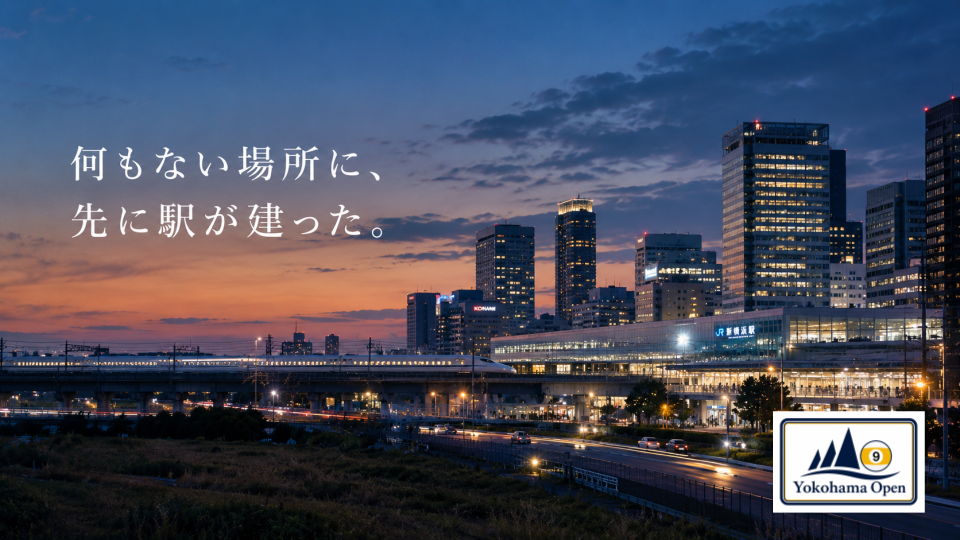
Along the way, one new station was built.
At the northern edge of Yokohama.
Where the old Yokohama Line met the new tracks.
Around the station, rice paddies spread out.
A station bearing Yokohama’s name, and yet from the platform you could not see the city of Yokohama.
Why there, I wonder.
The other Yokohama Station
Yokohama had one of the very first stations in Japan.
In 1872, the railway opened between here and Shimbashi.
The Yokohama Station of those days stood around today’s Sakuragicho.
There was the port, there was the foreign settlement — a place where people and cargo gathered.
The station was placed where the city was.
To Shimbashi, a little over fifty minutes.
From reclaimed land along the sea, the trains pulled out, trailing smoke.
Ninety-two years after that.
This time, a station was built where there was no city.
A platform among the rice fields
Only the Kodama, which stops at every station, stopped there.
The fast Hikari passed by in front of the platform.
A train stops.
The doors open, a few people get off, and they close again.
Outside the windows, perhaps the rice bent in the wind and rose again.
Land readjustment in front of the station began the same year it opened.
It was finished eleven years later.
It took nearly twelve years before the Hikari began to stop there.
All that while, the station was there.
Even on days when no one got off, on schedule.
The spring the subway arrived
In the spring of 1985, the municipal subway reached out from Yokohama Station.
Shin-Yokohama became its last stop.
Hotels went up; companies moved in.
In time, an arena was built, too.
On Saturday nights, waves of people coming home from concerts flow toward the ticket gates.
Not many people now know there were rice paddies in front of that station.
First came the station; the city came after.
The city does not know that the station was waiting.
On the way back from a business trip
The first night of October.
On my way back from Osaka, I get off at Shin-Yokohama.
Outside the ticket gates, many windows in the tall buildings are still lit.
Taxis circle quietly along the broad road in front of the station.
A little way on, a single sign glowed on a building.
A long time ago, I played there a few times.
Bag still in hand, I climb the stairs.
On a weeknight, about half the tables are empty.
At the next table, an older man was shooting alone.
The empty middle
The ball he struck sinks into a pocket.
The cue ball kept rolling after that.
It stops around the middle of the table, where there is not a single ball nearby.
He walks halfway around the table and stands behind the cue ball.
For a moment, he stays down, not moving.
He shoots.
A ball that had been far away vanished into a corner pocket.
The cue ball rolls off again, to where nothing is.
From there, the next ball looked dead straight.
I go back to my own table.
Each time one goes in, the cue ball sticks to the cushion, and the next ball is far away.
Just once, before potting, I look at where the cue ball will go.
A place where nothing is.
I shot, easing off just a little.
The ball didn’t go in.
The cue ball stopped shorter than I thought.
Even so, the next ball is closer than before.
At the next table, he is again sending the cue ball into the empty middle.
I look at the clock on the wall.
There is still an hour until closing.
Back to Shin-Yokohama
Leaving the hall, I hear from the station the sound of a Shinkansen, one of the last of the night.
Sixty-two years ago, there was nothing here but fields.
I head for the subway gates.
From the end of the platform, I look down the dark tracks.
In a place where nothing was, the station was built first.
👉 See the Yokohama Billiard Hall Guide
👉 Billiards resources from Japan and around the world, organized by purpose: Billiards in Depth (latest updated hourly)