
日本語 | 繁體中文 | English | 한국어 | Tiếng Việt
I heard someone’s story.
The result was off the charts.
I heard about the effort, too.
I thought it was amazing.
But on the way home, for some reason, my heart was heavy.
All of a sudden, I looked very small to myself.
Everything I had built up until now looked faded.
They are not a bad person.
If anything, I respect them.
But somehow, it felt hollow.
It’s your brain that makes you feel that way
All the way home, I kept thinking about it.
Not sure whether it was frustration or emptiness, I stood on the platform, waiting for the train.
There is a reason for what I felt that night.
Psychology calls it “social comparison”: without realizing it, people compare themselves with others to find out where they stand.
When the gap is too wide, the brain decides “I can’t catch up,” and can end up sizing us smaller than we are.
And feeling that “my worth has gone down,” when objectively nothing has been lost, is also because the human brain is built to react sharply to where we stand within a group.
It is only that the brain is built to feel that way.
What you have built up until now has not disappeared.
There are things you can’t see
I don’t know the time that person has walked through.
Chance meetings, timing, surroundings — none of it is visible.
What you see is only the tip of the iceberg called the result.
A sprinter needn’t watch an F1 driver’s speed and sink into thinking “my legs are slow and worthless.” In the same way, when the fields differ, the comparison itself is off from the start.
If you compare, compare with yesterday’s self.
Not the “sideways comparison” with others, but a comparison with your past self — try turning your attention there.
There should be something you have now that last year’s you did not.
Things you couldn’t do should be things you can do now.
More than the size of the result, the sense that you are choosing and moving forward on your own.
Confidence is born from that kind of accumulation.
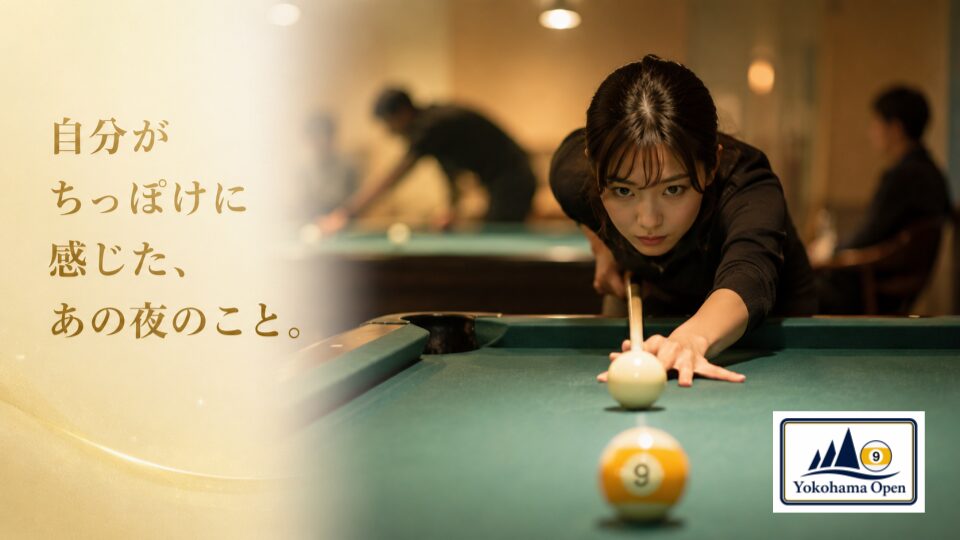
👉 Just not visible yet. — Pool, and what builds up.
What I noticed at the table
Pool has its gaps in skill, too.
Stand across from someone good, and your own inexperience becomes plain.
But strangely, at the table, it gets hard to measure yourself on someone else’s scale.
How you settle into your stance.
How to read this layout.
Whether your accuracy is a little better than yesterday.
Even with an opponent there, what you face in the end is your own shot.
At the table, before you know it, you are focused on your own shot.
👉 The true value of losing yourself in something.
There was that night I felt small
Frustrated, hollow — you don’t have to deny those feelings.
It means you are living your life that seriously.
But looking back now, I hadn’t become smaller.
I had only been measuring myself with someone else’s ruler.
Tomorrow, too, I need only strike my own shot.
👉 See the Yokohama Billiard Hall Guide
References
- Festinger, L. (1954). A theory of social comparison processes. Human Relations, 7(2), 117-140. doi:10.1177/001872675400700202
- Zink, C. F. et al. (2008). Know your place: neural processing of social hierarchy in humans. Neuron, 58(2), 273-283. doi:10.1016/j.neuron.2008.01.025
👉 Billiards resources from Japan and around the world, organized by purpose: Billiards in Depth (latest updated hourly)