
日本語 | 繁體中文 | English | 한국어 | Tiếng Việt
I remember, as a child, losing myself in something and forgetting the time.
Before I knew it, it was evening.
I didn’t even notice I was hungry.
Until my parents called, I didn’t want to leave that world.
Since growing up, that feeling seems to have drifted far away.
The urge to get better
Surely you have wanted to get better at something.
An instrument, a sport, cooking.
Those moments when the thought “If only I could get a little better” rises up out of nowhere.
There is no reward.
No one ordered you to.
Still, you want to try once more.
That urge may matter far more than we think.
When what you couldn’t do becomes what you can
What you couldn’t do, you become able to do.
What you didn’t understand, you come to understand.
That process itself is the brain’s greatest reward.
There was a layout I missed again and again.
Frustrated, I shot it again.
One day, it went in.
The feeling in that moment was not a score, not an evaluation.
It was a pure sense of something taking hold, welling up from within.
Psychology has a name for this curious urge: “intrinsic motivation.”
👉 What you love, you grow good at. — On intrinsic motivation.
Only while absorbed are you the lead in your own story
At work, you move within rules someone else set.
In meetings, you read the room.
On social media, you worry about how others react.
In much of modern life, we live as “parts of a larger system.”
But the time when you are absorbed in something is different.
You form a hypothesis, by your own will.
You carry it out with your own body.
You take on the result, directly, yourself.
Success and failure, all of it yours.
Not the sense of “being kept alive by someone else,” but of “walking on your own feet, deciding with your own hands.”
Time spent absorbed has the power to remind you of that.
👉 Time without judgment. — On a place where you can take off your titles.
The sense of deciding for yourself helps you grow
There are times it doesn’t work.
You think again, you try again.
Those small successes and failures, piling up, slowly grow your trust in yourself.
Psychology calls this sense “self-efficacy.”
It is trust in yourself that builds up inside you, regardless of scores or evaluation.
Being absorbed in something was not mere entertainment.
Perhaps it was a way of recovering “the sense that you can steer your own life.”
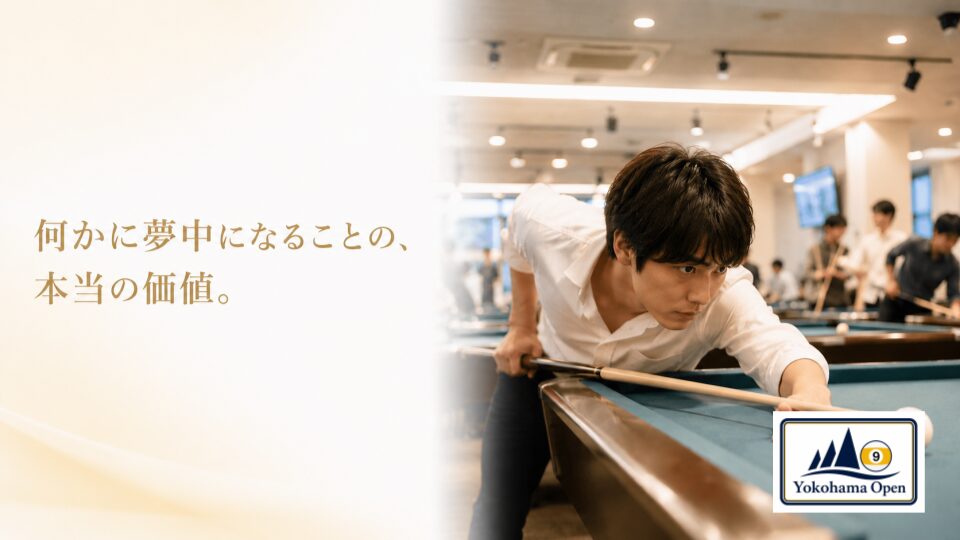
In pool, you can sometimes meet that feeling
Before each ball, there is thought.
Where to send the cue ball next.
The angle?
The speed?
It doesn’t work.
You think again.
You shoot again.
Before I knew it, I had forgotten the time.
That childhood feeling had not vanished anywhere.
It had only been waiting a while for its turn.
Being absorbed is not running away from reality.
If anything, it may be practice for taking on your own life yourself.
👉 See the Yokohama Billiard Hall Guide
👉 Just not visible yet. — Pool, and what builds up.
References
- Ryan, R. M. & Deci, E. L. (2000). Self-determination theory and the facilitation of intrinsic motivation, social development, and well-being. American Psychologist, 55(1), 68-78. doi:10.1037/0003-066X.55.1.68
- Bandura, A. (1977). Self-efficacy: toward a unifying theory of behavioral change. Psychological Review, 84(2), 191-215. doi:10.1037/0033-295X.84.2.191
👉 Billiards resources from Japan and around the world, organized by purpose: Billiards in Depth (latest updated hourly)