
日本語 | 繁體中文 | English | 한국어 | Tiếng Việt
July, 1853.
Yokohama’s landscape was on the verge of great change.
To a quiet peninsula village spread along a sandbar, the Black Ships suddenly came.
It was the beginning: a place where about 100 households, some 500 people, had lived quietly by farming and fishing began to open to the world.
Canals were dug, and a boundary called “Kannai” was born.
Japan’s first railway linked Shimbashi and Yokohama.
Gas lamps lit Bashamichi.
Ice cream spread from this town across Japan.
And beer, too, began in Yokohama.
Things that came from outside took root in this town, and in time became Japanese culture.
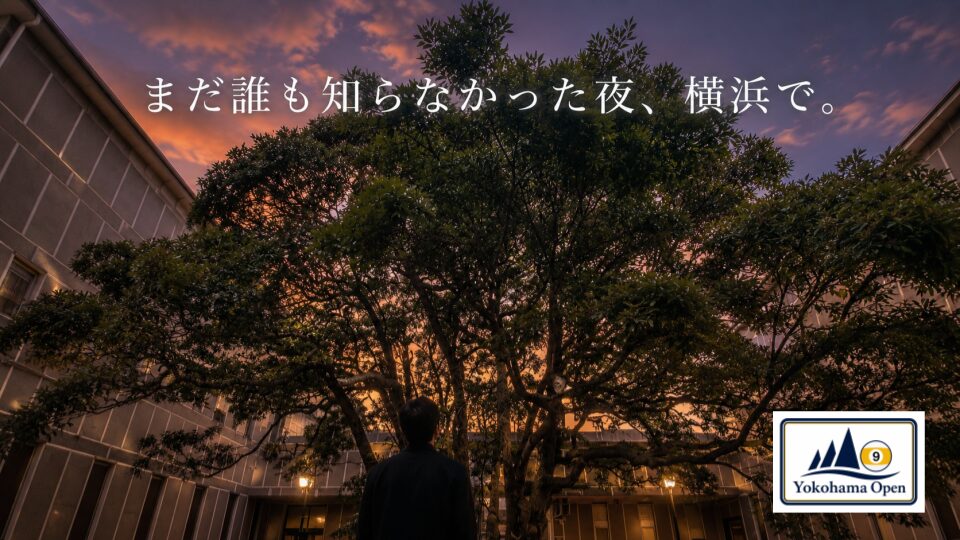
On the shore stood a single tabunoki, a Japanese bay tree.
Locally, it was called the “Tamakusu tree.”
It appears, just as it was, in paintings of Perry’s fleet.
Later, Kannai was struck twice by devastating fires.
The trunk was scorched.
Even so, the tree put out new shoots.
Today it still spreads its leaves, strong, in the courtyard of the Yokohama Archives of History.
Even now, 173 years on, Yokohama is a town where things begin.
A town that grew taking in the wind from outside, while putting down roots.
On a Yokohama night like that, a beer in one hand, I take hold of a cue.
Just as a culture from outside took root in this town and in time became part of daily life — pool, too, lives within Yokohama’s days.
Nights in Kannai are quiet and deep.
The lights of Bashamichi fall on the cobblestones.
From some bar, jazz drifts out.
At the end of that alley, there is a green table.
Holding the cue, a thought comes to me.
On this same night 173 years ago, something in this town may have been quietly beginning to stir.
And that night, no one knew it yet.
👉 See the Yokohama Billiard Hall Guide
👉 Billiards resources from Japan and around the world, organized by purpose: Billiards in Depth (latest updated hourly)