
日本語 | 繁體中文 | English | 한국어 | Tiếng Việt
At first, it was just play.
Shooting with friends, laughing at the misses, cheering when one went in.
That alone was plenty of fun.
But as I kept going, something started to change.
“I want to make a few more,” I thought.
On the way home, I started wondering, “Why did that ball miss?”
Before I knew it, the time for play had turned into something a little more serious.
But back then, I wasn’t thinking anything like “let’s enter a tournament.”
The hall becomes the tournament
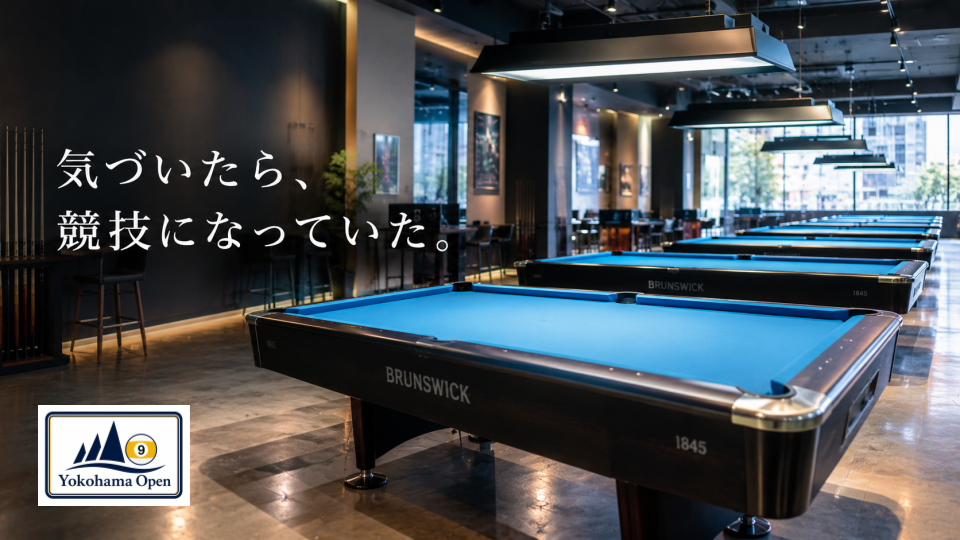
What’s interesting about pool is that the hall is both your practice ground and the tournament venue.
The match starts right on the table you come to every week.
No need to rent a gym.
No need to join a special club.
The usual hall.
The usual table.
The usual air.
The doorway to competition is right there, in the place you went for fun.
The practice ground and the venue are the same place.
That closeness is something only pool has.
The culture of house tournaments
One day, a poster was up on the hall’s notice board.
House tournament.
A small tournament the hall puts on.
Not as stiff as the word “tournament” sounds.
A day with the usual crowd, just a little nervous.
Regulars and beginners gather at the same hall and shoot on the same tables.
The entry fee is a few thousand yen.
There are hardly any requirements to enter.
At some halls, the owner or staff run tournaments, with matches nearly every month.
This culture has taken root in pool.
Darts has a very similar culture.
Each venue has its tournaments, ratings make your level visible, and some go on from there to league play.
The hall is both a clubroom and an arena.
The place you go to have fun becomes, just like that, the place you start competing.
That closeness is one of pool’s great charms.
Tournaments lie along the path of a hobby
There are many sports you can take up as a hobby once you are working.
Tennis, golf, running.
And of course there are plenty of tournaments.
But usually you move into a different place or community — a school, a club, a circle — to enter one.
Pool is a little different.
The place where you practiced becomes, just as it is, the place of the tournament.
At the hall you always go to, someone says, “Why don’t you give it a go?”
With those words, the tournament begins.
The line between hobby and competition is very low.
There are opponents at your level
“But won’t I just get crushed by the good players?”
That’s what I thought at first.
But pool has classes.
C class, B class, A class.
From people who have just started to people who have played for decades, players are divided by skill.
A beginner doesn’t suddenly face a top player.
There are tournaments you can enter as “who you are now.”
You can play opponents at your level, with the same level of nerves.
So you don’t have to think “it’s too soon.”
Age is a low wall
Pool has one more special thing.
The age you start at isn’t much of a handicap.
No running.
No collisions.
Build doesn’t matter.
It’s a game of skill and thought, so whether you start in your thirties or your forties, you can aim higher.
The view is a little different from sports like tennis or soccer, where physical ability decides results.
It isn’t rare for people who started as working adults to move up a class or make their mark in tournaments.
Sports where you can feel “it’s not too late, even now” are fewer than you might think.
Before I knew it
I never set out to compete.
I just wanted to get a little better.
I thought I’d try a tournament, just once.
That one step led to the next tournament.
In pool, there is no high wall between play and competition.
At the usual hall.
At the usual table.
I thought I was only shooting with the usual friends.
Before I knew it, I had entered.
And before I knew it, I was competing.
👉 See the Yokohama Billiard Hall Guide
👉 Billiards resources from Japan and around the world, organized by purpose: Billiards in Depth (latest updated hourly)