日本語 | 繁體中文 | English | 한국어 | Tiếng Việt
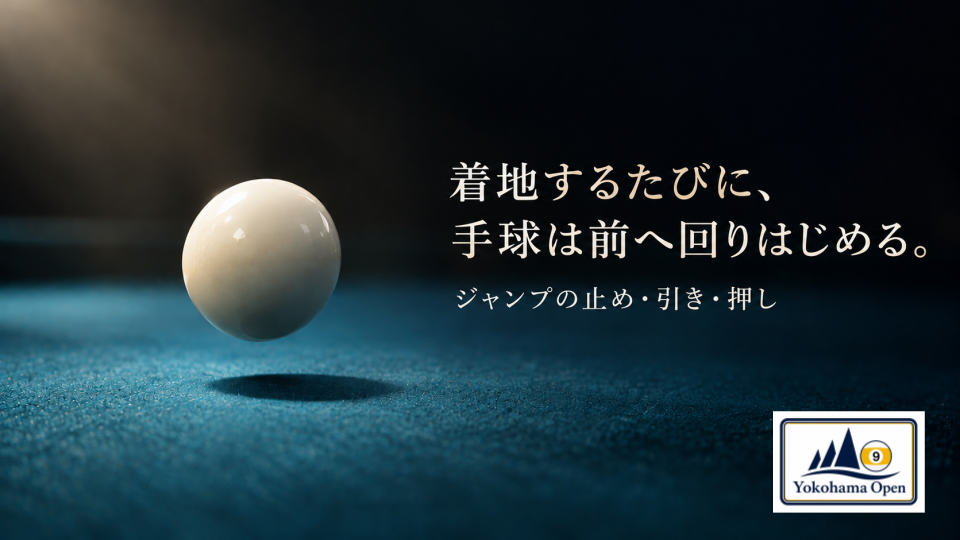
Jump the blocking ball, sink the object ball.
That much has been part of the game for a long time.
Today’s top pros take it further.
Over the obstacle, they stop the cue ball, draw it back, or follow through, and bring it to rest in position for the next ball.
The jump shot has long been thought of as the art of making a ball leave the table.
Yet for the cue ball’s spin, it seems, coming down matters more than going up.
Dr. Dave (David Alciatore, professor emeritus of mechanical engineering at Colorado State University), whose long-running column in the American magazine Billiards Digest looks at the game through physics, has filmed the cue ball after shot upon shot of jumps with Jeremiah Gage, using smartphone slow motion.
Drawing on his articles from the September 2015 and July 2009 issues, let us trace stun, draw, and follow on the jump.
In the Air, the Spin Holds
In a jump shot, the cue ball is first driven down into the table.
Pressed into the cloth, it bounces up into the air.
While it is airborne, the cue ball’s spin hardly decays.
There is nothing for it to rub against.
The spin changes only in the instants it touches the table:
when it is first driven down, and each time it lands after that.
Each Landing Turns It Forward
At the moment of landing, the bottom of the cue ball is sliding forward across the cloth.
The cloth resists, pulling back against it.
That force acts to turn the cue ball forward.
A cue ball carrying backspin has a little of it worn away with every landing.
Bounce it enough times, and the draw dies away and, in time, becomes topspin.
Once the spin catches up with a natural forward roll, it changes no further.
Dr. Dave writes that the cue ball “picks up” topspin with each bounce.
If it is carrying draw, whatever it picks up is taken from the draw.
Stun, Draw, Follow
That is why the tip contact point on a jump shot departs from your feel for a ball running along the cloth.
For stun.
Hit below center, enough to cancel the topspin the ball will pick up on landing.
The higher the cue elevation, the lower than you would expect.
The first blow, as the ball is driven down into the table, is said to take away most of the backspin.
For draw.
Hit well below center, and do not let the ball bounce many times before it reaches the object ball.
If you jump it high, one landing at most.
The most draw, it is said, comes when the cue ball never lands at all and meets the object ball while still in the air.
For follow.
On a low jump, hit center, or a little below.
Even when you want follow from a high, short jump, you still hit below center.
Strike high on the ball at a steep angle, and the cue ball gets pinched between the tip and the table and does not jump.
The landings will supply the topspin.
But when the cue ball hits the object ball in the air, the object ball goes off at a thinner cut than you aimed for.
An airborne cue ball travels a little farther than a ball running along the cloth would before it touches the upper part of the object ball.
The line joining the two centers tilts sideways by just that much.
So when you make contact in the air, aim a little fuller.
The contact that gives you the most draw is also the one most likely to throw off your aim.
The Sound of Landing
What is settled at the moment of the stroke goes no further than the height of the jump and the initial spin.
Everything after that depends on how many times the ball touches the table.
Next time you jump a ball, count the sounds of its landings.
Sources
- Dr. Dave Alciatore, “Jump Stun/Draw/Follow,” Billiards Digest, September 2015. https://drdavepoolinfo.com/bd_articles/2015/sept15.pdf
- Dr. Dave Alciatore, “Draw Shot Physics – Part IV: cue elevation effects,” Billiards Digest, July 2009. https://drdavepoolinfo.com/bd_articles/2009/july09.pdf
- Demonstration video NV F.3, “Pool stun/draw/follow jump shots at various cue elevations, with smartphone slo-mo” https://drdavepoolinfo.com/normal-video/nv-f-3/
- Dr. Dave Pool Info “Jump Shot Over-Cut” https://drdavepoolinfo.com/faq/jump/over-cut/
- Dr. Dave Pool Info “Jump Shot Cue Elevation Effects” https://drdavepoolinfo.com/faq/jump/cue-elevation/
👉 Billiards resources from Japan and around the world, organized by purpose: Billiards in Depth (latest updated hourly)