

For newcomers Billiards Guide
Step-Up 10 Game
Start with any ball you like, and improve a little at a time.
An “any ball” game, where you may aim at whichever ball you like, so that even first-timers can taste the pleasure of pocketing a ball. Two, three or four can play, and four steps, matched to your progress, bring you ever closer to real 10-Ball.
At a glance
Key points
- Balls
- 1 cue ball and 10 object balls, numbered 1 to 10 (1 to 15 with four or five players or more)
- Which ball to aim at
- Any ball you like (“any ball”). Only the 10 must come last
- Rack
- A triangle. The 1 on the foot spot, the 10 in the center. The rest are free
- On a change of turn
- Ball in hand (place the cue ball anywhere on the table and shoot)
- Winner
- Whoever pockets the 10
This is not a tournament game but a way to play and improve together with friends.
01Balls used
- 1 cue ball (white)
- 10 object balls, numbered 1 to 10
With four or five players or more, use 15 balls, the 1 through the 15, and put the 15 in the center (see 05).
02Object of the game
You are free to aim at whichever ball you like: it is an any ball game. Once the other nine are down, whoever pockets the 10 last wins.
We designed it so that newcomers could first discover the pleasure of pocketing a ball and get a feel for where the cue ball goes. How it came about, and how to enjoy it, are told in the article “A hit on any date or night out. — Your first pool? Start with the Step-Up 10 Game.“
03Racking
Rack the 10 balls in a triangle. Only two positions are fixed.
- The 1 goes on the foot spot
- The 10 goes in the center (the middle of the third row)
- The other eight may go in any order you like
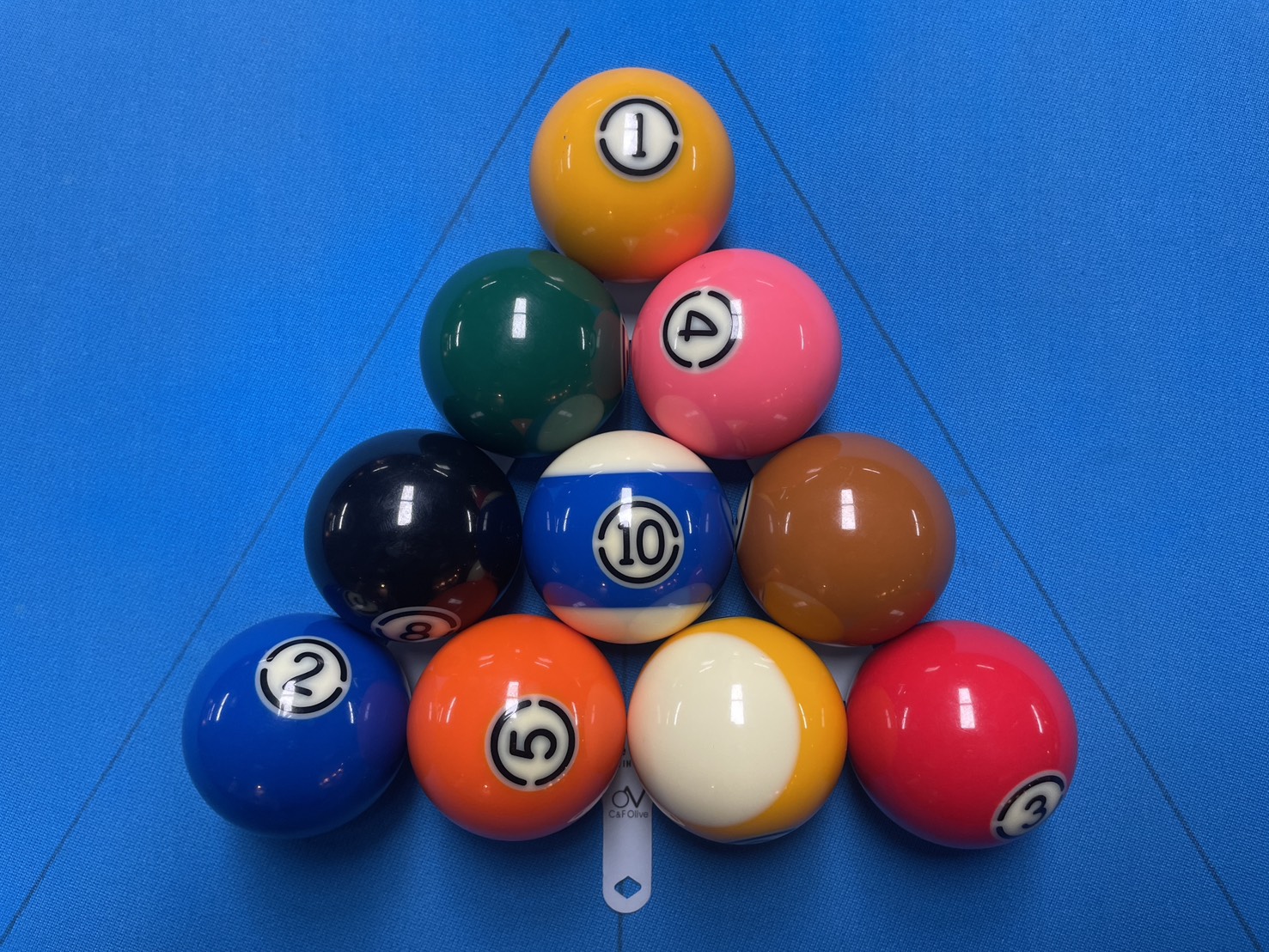
The point of the triangle (the 1) faces the breaking end (the head side), and the base lies toward the foot side (the end where pocketed balls collect).
04Basic rules
- On the break, aim at the 1
- If a ball goes in, keep shooting. If not, the turn passes to the next player
- On every change of turn, it is always ball in hand: place the cue ball anywhere on the table and shoot
- You may aim at any ball (“any ball”)
- But the 10 comes last: aim at it only once all the other nine are down
- Hitting the 10 first is a foul. The opponent (the next player) gets ball in hand
- Pocketing the cue ball (a scratch) or sending it off the table is also a foul. The opponent gets ball in hand
- Whoever pockets the 10 wins
05Any number can play
Not just two: three or four can play as well. Decide the shooting order, and take turns as you go.
With more players, ten balls can run out quickly. Once you have four or five players or more, rack 15 balls in a triangle and put the 15 in the center instead. The rules stay the same.
06Stepping up (four stages)
As you improve, add the rules a little at a time.
| Step | On a change of turn | Order of balls | Focus |
|---|---|---|---|
| Step 1 (Getting started) | ball in hand | Any order | First, learn the pleasure of pocketing a ball |
| Step 2 (Once you’re comfortable) | From where the cue ball stopped | Any order | Start thinking about position (leaving the cue ball well for the next ball) |
| Step 3 (As you improve further) | Back to ball in hand | Numerical order | Practice in planning your run |
| Step 4 (On to 10-Ball) | — | — | Step straight into 10-Ball proper |
Keep coming back with the same friends and climb one step at a time, and one day you will find yourselves playing real 10-Ball.
Playing by your own rules
The Step-Up 10 Game is not a tournament game. It is meant to be adjusted, so that you can enjoy it with the people you play with. Depending on skill and numbers, you might try rules like these.
- At the 10 only, the change of turn is played from where the cue ball stopped: for the last ball alone, you can’t place the cue ball wherever you like. Used from the very start, this rule can leave the 10 stubbornly on the table and the game at a standstill. Try it once you’re more at home with the game.
- If the 10 drops early: when the 10 happens to go in on a shot at another ball. If there was no foul, you may count it as a win, or spot the 10 on the foot spot and play on. Decide which before you start.
- A small handicap for the stronger player: for example, only the stronger player takes the change of turn at the 10 “from where the cue ball stopped.” Varying the rules from person to person is one way to play. Even with a gap in skill, the game stays close to the end.
07Frequently asked questions
How many people can play?
Two or more. Three or four is fine too. With four or five players or more, use 15 balls, numbered 1 to 15, with the 15 in the center.
On a change of turn, where do you shoot the cue ball from?
In Step 1, you place the cue ball anywhere on the table and shoot (ball in hand). In Step 2, you shoot from where the cue ball stopped. In Step 3, it’s back to ball in hand.
What if I hit the 10 first?
It’s a foul. The opponent (the next player) places the cue ball anywhere and shoots. The 10 is played only once all the other nine are down.
What if the cue ball goes in a pocket or leaves the table?
Both are fouls. The opponent (the next player) gets ball in hand.
About this game
This is an original game devised by the Yokohama Open Executive Committee. It is not part of any official rules of play. Before you begin, go over the rules with the people you’re playing.
For why we created it and how to enjoy it, see the article “A hit on any date or night out. — Your first pool? Start with the Step-Up 10 Game.“
👉 Once you know the rules: lessons and match streams in Billiards in Depth