
日本語 | 繁體中文 | English | 한국어 | Tiếng Việt
The city where billiards came into Japan—how many people know that it was Yokohama?
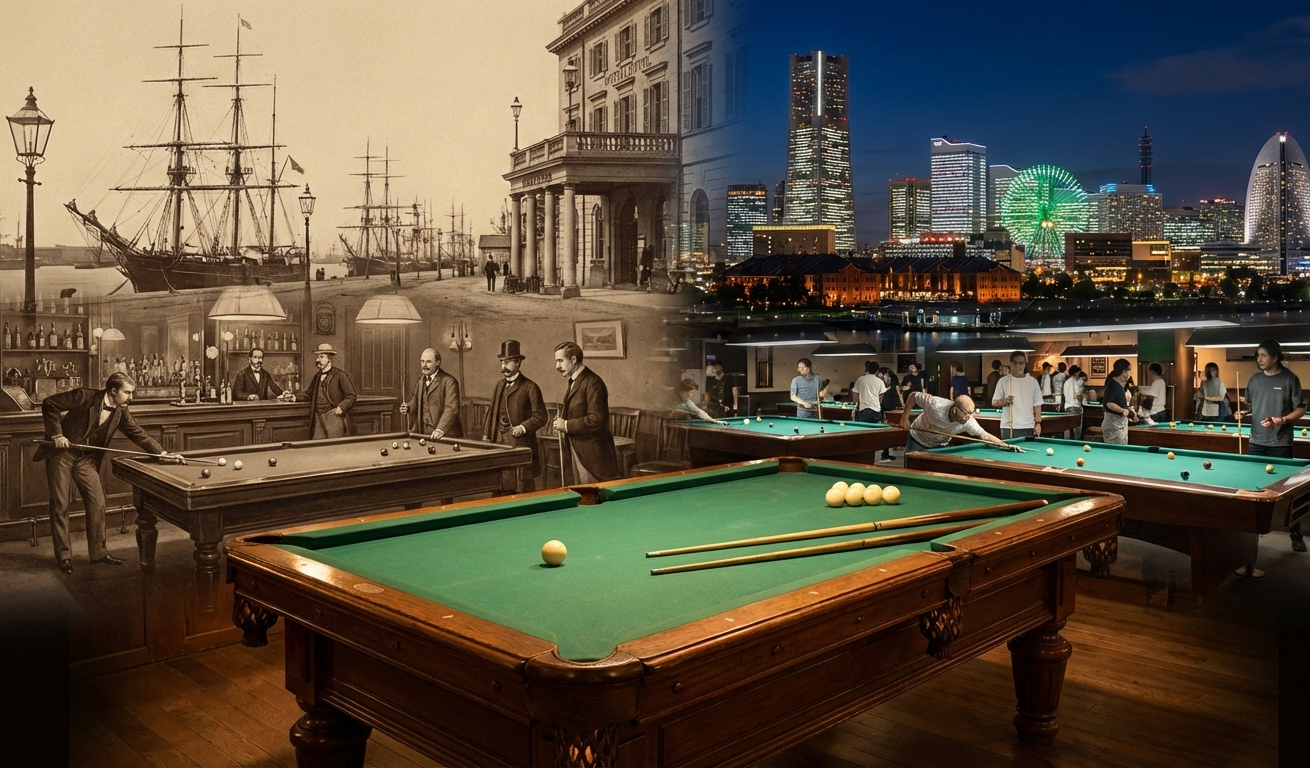
The harbor, the foreign settlement, the hotels, the bars.
In the air that belongs to this city alone, billiards took root—quietly, but surely.
Here, from a “Yokohama × Billiards” point of view, we would like to trace that history, at an easy pace.
Where did billiards come to Japan from?
Billiards is thought to have first reached Japan in the late Edo period, toward the end of the 1700s.
The place was Yokohama… no—it was Dejima, in Nagasaki.
Dejima: in a Japan closed to the world, the one place still connected to the West.
The Dutch who lived there, unable to come and go freely, are said to have enjoyed “ball-striking games” as a way to pass the time.
What is interesting is that records survive of a “set routine”: Japanese visitors to Dejima were served Dutch food, and then shown billiards.
It was probably here that Japanese eyes first fell on this curious game of table and balls.
At this point, billiards was still a rare “spectacle.”
The opening of Yokohama changed the fate of billiards
What truly set billiards spreading through Japan is said to have been the opening of the Port of Yokohama in 1859.
In 1860, the year after the port opened, Japan’s first hotel, the Yokohama Hotel, was born in Yamashitacho, then part of the foreign settlement.
It had not only guest rooms but a restaurant, a barbershop—and a bar.
And in that bar stood a billiard table.
In fact, this bar is said to have been the first Western-style bar in Japan, and Yokohama is also known as “the birthplace of the bar”.
Amid the sound of ice melting in a glass and the dry click of ball on ball, people drank, talked, and played billiards.
That Western culture of social life spread from Yokohama across Japan.
This is why Yokohama is called “the starting point of billiards culture in Japan.”
In the Meiji era, billiards was a salon for grown-ups
As the Meiji era began, billiard halls multiplied, above all in Tokyo and Yokohama.
Yet billiards in those days was not something just anyone could casually enjoy.
Nobility, senior military officers, high-ranking officials—a meeting place for what was called the upper class.
Billiards was treated as something close to a symbol of bunmei kaika, the Meiji drive toward “civilization and enlightenment.”
Like Western spirits, Western food and beer, it was “a grown-up pastime for those with a taste for Western culture.”
The port city of Yokohama was where such culture settled in most naturally.
Taisho and Showa: billiards spreads everywhere
It was from the Taisho era onward that billiards came to be widely loved by ordinary people.
At the height of the Showa era, there are said to have been more than 20,000 billiard halls across the country.
The war brought a temporary decline, but afterward, partly through the influence of the occupation forces, billiards came back.
In time it was released from the legal category of regulated amusement businesses, and settled in as a wholesome sport.
Along the way, many fine halls were born in Yokohama too.
“Highland,” which held up Yokohama’s billiards culture
Highland Billiards, which stood in Wakabacho, Yokohama, for some forty years from the 1970s.
There is no telling the history of billiards in Yokohama without this hall.
Players with their sights on going pro, office workers on their way home, beginners.
People of different generations and different walks of life held their cues in the same room.
“Just go to Highland. Someone’ll be there.”
That kind of reassurance, we are told, was something this place had.
Regulars who kept coming for more than twenty years were not unusual. It was not simply a place to play, but a “place to belong,” where people found one another.
In March 2016, it closed, to the sorrow of many.
But its spirit was handed on to “MECCA Yokohama”, which opened in May of the same year.
Yokohama now, and what comes next
Since the 2000s, billiards has slowly changed shape—from “a pastime for the young” to “a sport where skill is tested.”
In Yokohama today there is a wide range of billiard halls, from places where beginners can drop in and play to places where serious players gather.
That a billiard table still stands in a hotel bar looking out over the harbor is a scene that could only be Yokohama.
The ball-striking game that began long ago in the foreign settlement goes on in this city still, changing its form as it goes.
👉 A night with a cue in Yokohama—culture, worn with style.
Afterword
From Dejima to Yokohama.
From the hotel bar to the billiard halls of the city.
The history of Yokohama itself has been a history of taking in Western culture, digesting it, and making it its own.
Billiards, too, lives on within that current.
If, today, you pick up a cue somewhere in Yokohama—perhaps you are standing on a line that continues a story begun more than 160 years ago.
We take on the future of billiards. We create a legacy for Yokohama.
So that this history is never broken, and a new page can be written.
The Yokohama Open Organizing Committee hopes to treasure the history of billiards and the culture of Yokohama, and to bring billiards to life together with all of you.
👉 Billiards resources from Japan and around the world, organized by purpose: Billiards in Depth (latest updated hourly)