
日本語 | 繁體中文 | English | 한국어 | Tiếng Việt
I can solve it.
At home, I can solve it.
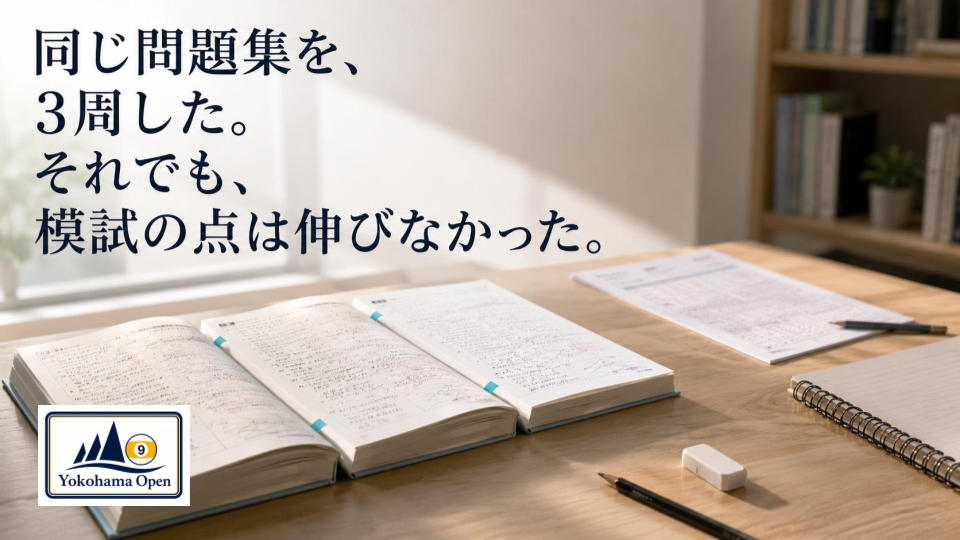
I went through the same workbook three times.
My accuracy went up.
With every page I turned, there were more problems where I thought, “Oh, I know this one.”
It felt like progress.
But the moment I opened the mock exam, my hand stopped.
Problems I had never seen.
Questions asked from a slightly different angle.
Layouts that weren’t on that page of that workbook.
My accuracy hadn’t climbed as much as I’d thought.
The same thing happened in the meeting room.
I rehearsed the presentation again and again.
I had the order of the slides down perfectly.
I had prepared for three kinds of likely questions, too.
But on the day, the client threw a question from an angle I never expected.
For a moment, my mind went blank.
It wasn’t that I couldn’t answer.
But that pause stayed with me.
On the train home, looking out the window, I thought.
I practiced.
I prepared, too.
So why do I freeze when it counts?
What lies between “I can do it” and “I can handle it”
Solve the same problem over and over, and you can solve that problem.
Rehearse the same presentation over and over, and that presentation gets better.
But the real thing is different every time.
The angle is different.
The order is different.
The conditions are different.
Between “I can do it” and “I can handle any situation” lies a greater distance than you think.
Research in cognitive psychology offers one hypothesis about what that distance really is.
Practicing the same thing repeatedly (blocked practice) gives a strong short-term sense of improvement.
It’s easy to feel “I’ve got it now.”
By contrast, there is practice that mixes different but related kinds of tasks and makes you judge each time, starting from “which way of thinking does this one need?” — this is called “interleaved learning.”
In 1979, in a motor learning experiment, Shea & Morgan showed that a group that practiced different tasks under an interleaved condition (mixing different tasks), though at a disadvantage in performance right after practice, came out ahead on delayed retention tests and on transfer tests of application.
This finding has since been replicated in mathematics education as well.
Studies by Rohrer and colleagues have reported a tendency for a group that solved shuffled math problems of different kinds to score higher on a later test than a group that solved problems of one kind in blocks.
What is interesting is that people doing repetitive practice are more likely to feel “I’m improving.”
The feeling of progress, and actual skill.
In the gap between them, perhaps, lies the truth of a plateau.
On that table, a different question every time
In pool, there is a discipline called 14.1 (straight pool).
Fifteen balls are set on the table and pocketed one at a time.
When 14 have been pocketed, the last ball stays where it lies, and 14 new balls are racked.
Then you break the rack with that remaining ball and keep shooting.
Over and over.
Except the layout is never the same.
The remaining ball is somewhere different.
The cue ball is somewhere different.
The rack breaks open differently.
In 14.1, where a wooden rack is used and the rack is broken a different way each time, the same layout is almost never reproduced.
Every time, you are handed a blank problem.
Which ball to start with.
Where the clusters have formed.
When to break them up.
How to break them up.
Attack, or defend.
If you defend, where to leave the cue ball.
Every shot asks for a different judgment.
Chalk again.
Walk around the table and take in the layout.
Steady your breath, and settle into your stance.
The answer from a moment ago won’t work.
The weight of reading the table
Of course, in 9-ball and 10-ball too, you deal with a different layout each time.
How the balls scatter after the break, where the remaining balls sit in relation to each other, the back-and-forth with the opponent — there is no moment that doesn’t call for reading the situation.
But in 14.1, that weight grows larger still.
In 9-ball and 10-ball, the spread of template racks has brought a degree of reproducibility to the layout after the break.
In 14.1, by contrast, the layout after the break is hardly reproducible at all.
Each time you break the rack, a new problem appears in front of you.
And clearing 14 balls and racking again — that structure repeats many times within a single match.
In other words, the number of times you face a problem you have never seen is far higher than in other disciplines.
The adaptability that 9-ball also asks for is demanded in 14.1 more continuously, and far more often.
That is the structure of this game.
The pros were saying the same thing
Lo Li-wen called 14.1 “a game that builds the fundamentals.”
Tomoya Iima called it “all of pocket billiards.”
Their words likely come from what long years at the table have taught them.
But seen through the lens of interleaved learning, that feeling seems to have a structural basis.
By responding again and again to a different layout each time, cue ball control, shot sequencing, judging risk — every element pool requires is trained at once.
Now and then you hear of players stuck at 9-ball or 10-ball who found a breakthrough by taking up 14.1.
Perhaps that is no accident, but what happens when the structure of practice changes.
👉 Lo Li-wen — For 313 balls, the view he had drawn in his mind went on.
👉 Tomoya Iima — All of pocket billiards.
Back to that mock exam
I went through the same workbook three times.
The problems I could solve grew in number. But I couldn’t handle the ones I had never seen.
If, back then.
If, instead of repeating the same problems, I had mixed different kinds together and practiced judging each time, starting from “which way of thinking does this one need?”
And with the presentation, if instead of polishing the script to perfection, I had practiced changing the conditions a little each time and thinking about how to respond.
Would that mock exam, that presentation, have turned out a little differently?
The strength to face a blank problem
On a 14.1 table, the same problem never comes up.
So you think, every time.
Shot by shot, you build the answer.
Perhaps what 14.1 trains is not only the skill of pocketing balls.
Perhaps it is the strength of “how to face a problem you are seeing for the first time.”
References
- Shea, J. B. & Morgan, R. L. (1979). Contextual interference effects on the acquisition, retention, and transfer of a motor skill. Journal of Experimental Psychology: Human Learning and Memory, 5(2), 179-187.
- Rohrer, D. & Taylor, K. (2007). The shuffling of mathematics problems improves learning. Instructional Science, 35(6), 481-498.
👉 14.1 communities and study groups across Japan
👉 Player stats
👉 Billiards resources from Japan and around the world, organized by purpose: Billiards in Depth (latest updated hourly)