日本語 | 繁體中文 | English | 한국어 | Tiếng Việt
It was a small peach.
Small enough to sit whole in the palm of my hand.
I bought it in mid-June, at a farm stand in Tsunashima.
A good month ahead of the summer peaches.
When I peeled it, the juice ran down toward my wrist.
After the sweetness, a little sourness lingered.
I was told it is written 日月桃, sun and moon and peach, and read jitsugetsutō.
In the bag, a few more of about the same size.
All the way home, a sweet smell rose from the bag in my hand.
Since the Edo period, this area had been troubled by the waters of the Tsurumi River.
At the end of the Meiji era, a man named Michitarō Ikenoya made a peach of his own on this land.
An early peach, hardy against disease, that ripened before the typhoon season.
Pick the fruit before the water comes.
The saplings were shared with nearby farms, and Tsunashima became peach country.
But in the thirteenth year of Showa, a great flood came.
The peach orchards went under.
Through the war years and after, the fields gave way to rice paddies.
The jitsugetsutō disappeared from the town.
Sixty years went by.
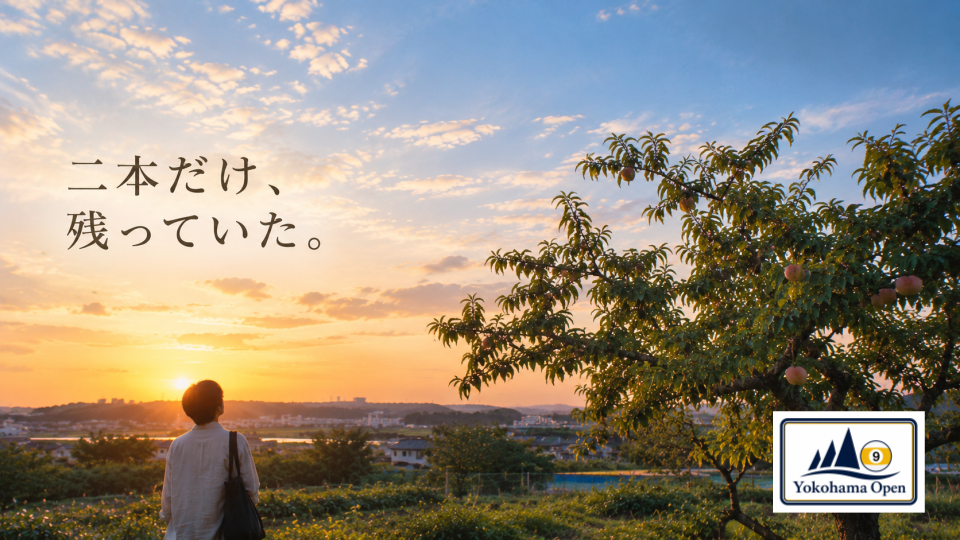
At a research station in Tsukuba, Ibaraki, only two jitsugetsutō trees were left, they say.
From those two, the peach came to be grown in Tsunashima once more.
These days, when June comes, those small peaches are lined up on the farm stand’s table.
There is a game called 14.1, or straight pool.
You pocket fifteen balls, one at a time.
When the fourteenth goes down, you stop.
You leave the last one where it is, and gather up the fourteen.
You rack them in a triangle again.
Leaving only the apex empty.
You pocket the ball you kept, and with that same stroke, break open the new triangle.
Another fourteen begins.
Which one to keep, you have been weighing all along.
Because that ball becomes the way into the next triangle.
After work, I played 14.1 alone.
I broke the first triangle and pocketed them one by one.
Somewhere past the tenth ball, my hands slowed.
Before the next ball to pocket, I was already looking for the last one to leave.
A little to the side of where the triangle would sit.
A blue 2, by itself.
That one, I decided, would stay.
I pocketed the others, one by one.
I sent the cue ball the long way round, so it would not touch the 2.
One ball all but stopped on the lip of the pocket, then fell.
The fourteenth sank.
Only two were left on the table.
The white cue ball, and the blue 2.
I gather the balls from the pockets and set them in the rack.
Leaving the apex empty.
When I lift the rack away, the triangle, one short, sits quietly at the far end of the table.
I chalk the tip.
I walk around behind the 2.
I take my stance.
👉 See the Yokohama Billiard Hall Guide
👉 Billiards resources from Japan and around the world, organized by purpose: Billiards in Depth (latest updated hourly)