
日本語 | 繁體中文 | English | 한국어 | Tiếng Việt
The city of Yokohama owns a forest in Yamanashi.
A village among the mountains, called Doshi Village.
A little over a third of the village is Yokohama’s water-source forest.
The city acquired it from Yamanashi Prefecture in 1916, the fifth year of Taisho.
For a little more than a century since, Yokohama has gone on tending the hills of another village.
The port city was never blessed with water.
On land widened by filling in marshes and sea, it is said, you could dig a well and still rarely find water fit to drink.
In October 1887, the twentieth year of Meiji, water was drawn from the upper reaches of the Sagami River all the way to Nogeyama.
It was the first modern waterworks in Japan.
Some ten years later, the intake moved a little farther into the mountains, to the Doshi River.
Sailors, it is said, called it the water that did not spoil even across the equator.
The water of the Doshi River still flows to Yokohama today.
A forest holds water, they say, because of its soil.
Beneath the fallen leaves, the soil drinks in the rain and lets it seep, slowly, down into the depths of the earth.
A planted stand of cedar and cypress, left untended, seems to lose its power to hold water.
So they fell trees.
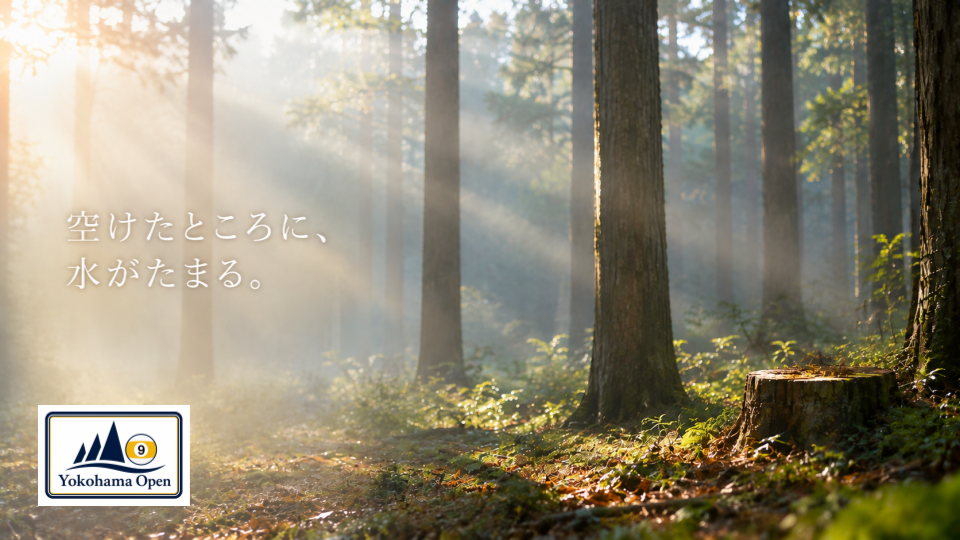
From the grown woods, they choose a few, and open up the space between.
When the gaps open between tree and tree, light begins to reach the forest floor.
To keep the water, fewer trees.
A hundred years of tending.
Most people who turn on a tap may never have seen that forest.
On Friday night, I played 9-ball with a coworker.
After the break, the balls scattered across the table.
Even so, a few stayed close together and would not part.
In front of the 1 sits the 5.
Beyond the 3 lies the 7, and the pocket is out of sight.
Wherever you shoot, it feels as though you will hit something.
One drops.
On the table, a space opens, the size of one ball.
Another drops.
A pocket that was hidden a moment ago comes into view.
While my coworker was at the table, I sat in a chair and watched.
With each ball that goes, more of the cloth shows.
The cue ball rolls a long way, touching nothing.
In the end, only the 9 was left.
On the wide table, the white cue ball, and a single ball with a yellow stripe.
Between the two, nothing remains.
The stroke.
Home again, I fill a glass with water.
I drink it down in one breath.
And hold the empty glass under the tap once more.
👉 See the Yokohama Billiard Hall Guide
👉 Billiards resources from Japan and around the world, organized by purpose: Billiards in Depth (latest updated hourly)