
日本語 | 繁體中文 | English | 한국어 | Tiếng Việt
“I’ve asked them to come again this year.”
That was all my mother said on the phone.
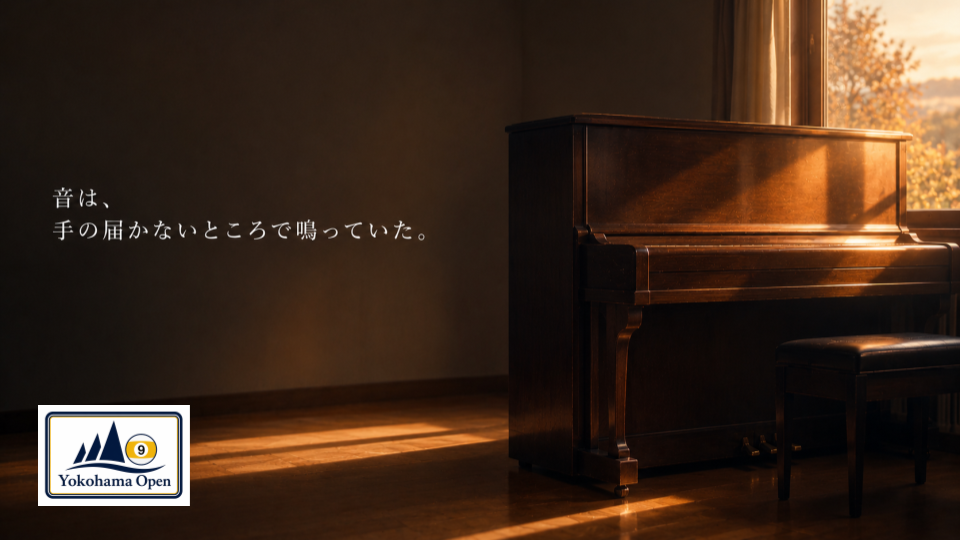
In the living room of the house I grew up in, there is an old upright piano.
I took lessons from the fourth grade until I finished middle school.
Since I left home, no one has played it.
Even so, once a year, my mother calls the tuner.
Early on a Sunday afternoon, I stopped by the house.
The tuner arrived carrying a single small bag.
With barely a greeting, the tuner opened the fallboard and deftly lifted away the panel above it.
Behind the Panel
Behind the panel, felt heads stood packed in a close row.
Small hammers, each about the size of a thumb.
Beyond them, silver strings were stretched taut.
The bass strings were thick, wound with copper-colored wire.
The tuner presses a single key.
A hammer leaps forward and strikes the string.
The instant after it strikes, it has already left the string.
Even with the key held down, the hammer does not stay on the string.
Only the sound remains in the string.
The same key, struck again and again.
A small tool turns the pin that holds the string, just slightly, and the key is struck again.
The sound that had been wavering, wah, wah, grows thinner and thinner until it becomes a single line.
Six years, I played.
Every night, beside the metronome, I went over the same passage again and again.
In the week before a recital, my fingertips ached a little.
And yet this was the first time I had seen what lay behind that panel.
All my fingers had ever touched were the white keys and the black.
The strings, not once.
I quit the year of the high school entrance exams.
I can no longer remember the last piece I played.
Near the right end of the keyboard, there is a single small scratch.
It came from a ruler I dropped in the middle of practice.
My mother is in the kitchen, boiling water.
The tuner moves from low to high, one key at a time.
Not once is a piece of music played.
After about two hours, the panel went back, the lid closed, and the tuner left.
In the evening, my younger brother came home.
He had gone to the same music school too, but quit after a year.
Looking at the piano in the living room, he said, “Oh. It’s still here.”
Only the White One
After dinner, my brother dragged me out to the area by the station.
Apparently he had started playing this spring, with people from work.
We walk the road I used to take to lessons as a child.
The corner where the music school stood had become a coin parking lot.
At the far end of the shopping street, the second floor of a building.
Balls lie scattered across the table.
My brother hands me a cue.
“I don’t know the rules, though.”
“You only hit the white one.”
After that, he says nothing more.
I rest my hand on the edge of the table. The cloth is rougher than I expected.
I pick up a nearby ball between my fingers.
So small, and yet heavy.
My brother raises his eyebrows, just slightly.
Gently, I put it back where it was.
A red ball sits near the pocket in the far corner.
Close enough, it seems, to reach out and push in with a finger.
But the tip of the cue points at the white ball in front of me.
I take my stance, and stroke.
The white ball grazes past the red, strikes the cushion, and comes back.
Once more.
This time it catches the edge of the red ball.
The red ball bounces once in the jaws of the pocket, and stops.
Then it is my brother’s turn.
He aims at a different ball.
After the stroke, the hand holding the cue does not move.
The white ball rolls and touches the ball he aimed at.
Only that ball rolls away, into the distance.
My brother simply follows it with his eyes.
A few tries later, the white ball struck the red one full in the center.
Only the red ball rolls, straight across the table.
Over the edge of the pocket, to a place no longer within reach.
In the far corner, a short sound.
The sound rang out beyond the reach of my hand.
All that remains in the hand gripping the cue is the small feel of striking the white ball.
My brother picks the red ball out of the pocket and sets it back where it was.
“Again.”
When we got home, the living room light was off.
The lid of the piano is closed.
My brother passes in front of it and starts up the stairs.
Halfway, he comes back, and taps the closed lid, just once, with a finger.
A dry sound, of wood.
👉 See the Yokohama Billiards Hall Guide
👉 Billiards resources from Japan and around the world, organized by purpose: Billiards in Depth (latest updated hourly)