
日本語 | 繁體中文 | English | 한국어 | Tiếng Việt
Picasso painted a face seen from the front and a face seen from the side in a single picture.
Until then, painting had cut the world out from a single point of view.
Picasso broke that rule.
He layered onto one canvas several viewpoints that could never exist at the same time.
That was Cubism.
Take it apart, put it back together
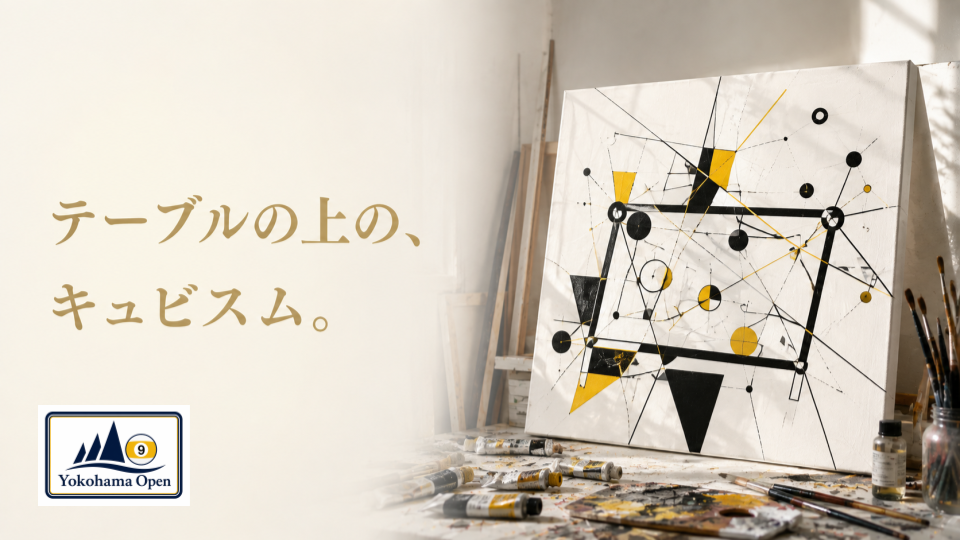
Cubism breaks its subject into geometric fragments and rebuilds it.
A guitar is split into strings, body and neck, and rearranged as planes at different angles.
In a figure, an eye seen from the front and a nose seen in profile share the same face.
It looks broken.
But it isn’t breaking things.
It is trying to see, from several viewpoints at once, what could not be seen from just one.
To the viewer, it looks like confusion.
But to the painter, it was the most real.
Pool is a little like that.
It’s on the table, too
Look down at a pool table from above.
Balls are scattered across the cloth.
One layout.
One moment.
But in that moment, many futures that haven’t happened yet are layered on top of one another.
The layout after one shot.
The layout after that.
The layout after breaking up the cluster.
The layout after breaking the rack.
The player is seeing those futures now.
Seeing from many sides
A player is walking around the table.
That isn’t a stroll.
They are looking at the same layout from different angles.
The line seen from the front is not the line seen from the side.
The fullness of the hit changes.
The sense of distance to the rail changes.
The layout is the same, yet even the view of the next shot changes.
It’s one table, yet depending on where you stand, you see a completely different scene.
Just as Picasso layered front and profile into a single picture, the player layers several viewpoints in their head.
And then plays one shot that holds them all.
Breaking it down into geometry
Thinking in pool begins with breaking down the reality on the table.
The distance between balls.
The angle to the pocket.
The angle off the rail.
The curve made by the spin put on the cue ball.
A layout that looks complicated is broken down, one piece at a time, into geometric elements.
Lines, angles and curves.
Just as Cubism broke its subjects into geometric fragments, the player breaks the reality on the table down into geometry and rebuilds it in their head.
And with the tool we call a cue, turns that rebuilt image into a single shot.
Cubism on film
In 2005, Takeshi Kitano made a strange film.
“TAKESHIS’”.
Beat Takeshi the director.
Beat Takeshi the actor.
Beat Takeshi the comedian.
All of them exist at once inside a single film.
Dream or reality, which “Takeshi” is the real one — the boundaries melt away.
Depending on who watches it, it looks like an entirely different film.
It was probably Cubism on film.
It layered the many faces within one human being into a single work, all at once.
What Picasso did by painting front and profile on the same canvas, Takeshi Kitano was doing on film.
And pool players do the same thing on the table.
Cubism in the mind
A player is chalking the cue.
In those few seconds, the table is being rebuilt again and again in their head.
If I hit this ball, at this angle, with this much force.
The cue ball goes here.
Next, that ball, at that angle.
Beyond it, there’s a cluster.
If I’m going to break it, it has to be here.
Not a single shot has been played, yet in their head they are already several balls ahead.
Present and future exist at once within a single thought.
Maybe that is Cubism in the mind.
And then the cue comes through.
A ball rolls.
In that one shot, many viewpoints overlap.
Even time that hasn’t yet arrived overlaps there.
What the player is striking isn’t a single ball.
They are painting a single Cubist work on the table.
👉 Pool is an art. — On the ball that asks a question.
👉 See the Yokohama Billiard Hall Guide
👉 Billiards resources from Japan and around the world, organized by purpose: Billiards in Depth (latest updated hourly)