日本語 | 繁體中文 | English | 한국어 | Tiếng Việt
In my draft for the company newsletter, one box is still empty.
“Hobbies.”
I open the previous issue.
Golf, camping, baking bread.
Someone has written that they broke ninety.
I type: billiards.
After a moment, I add something in parentheses.
(All love, no skill.)
It has been three years.
Once a week, after work, I play alone.
I can’t say I feel I’ve gotten any better.
When I mentioned the newsletter in the office kitchen, someone from the next section asked,
“Three years, huh. Have you gotten good?”
They started running this spring, they told me, and log their times in a notebook.
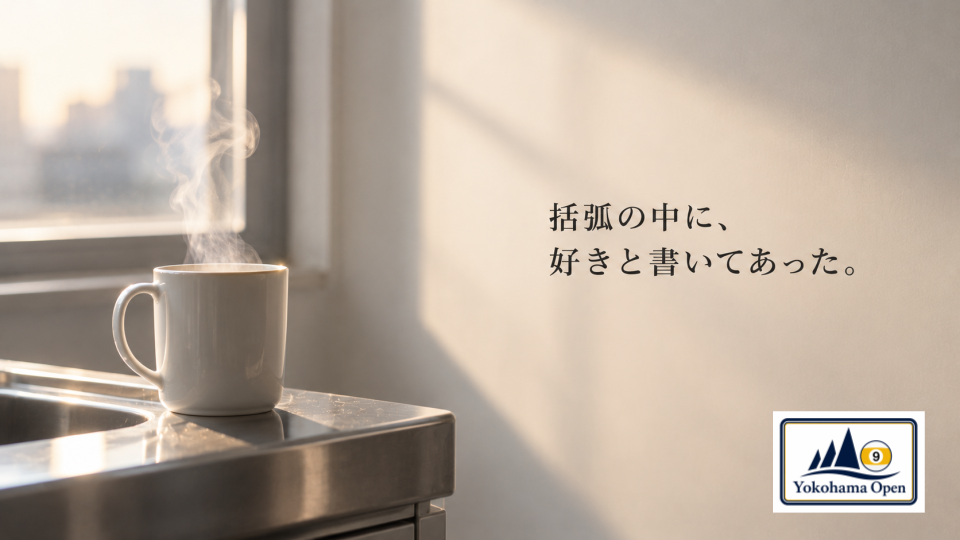
Holding my mug in both hands, I laughed, and tilted my head.
The conversation ended with the sound of the kettle coming to a boil.
All love, no skill. It is my father’s line, too.
He has been going to a go parlor for nearly thirty years.
Whenever someone asks his rank, that is what he says.
He hardly ever talks about winning, or about losing.
He leaves a little after noon on Sundays and comes home in the evening.
Once, as a child, I asked him if he had won.
“Hm, I wonder,” he said, and went to wash his hands.
I have never once seen my father sitting at a go board.
There is a study of some ninety thousand people over sixty-five, in sixteen countries.
Those who had hobbies, it reports, tended to have fewer depressive symptoms and greater satisfaction with life.
What they were asked was whether they had a hobby.
Not whether they were any good at it.
When we think of leisure as wasted time, we find it harder to enjoy.
There is a report of that, too.
The pattern apparently showed up in time enjoyed for its own sake, like a party.
In time spent for some other purpose, like taking the kids out somewhere, the same pattern did not appear.
When I tilted my head in the kitchen, I didn’t know what to divide three years by.
Maybe I didn’t need to divide it at all.
My father, I suspect, never has.
Thursday night, I play alone.
At the front desk, they tell me my table number.
I hang my jacket over the back of a chair.
I scatter three balls across the table and shoot them in turn.
The first one drops.
The second rattles in the jaws of the pocket and comes back out.
About the same as three years ago, I’d guess.
After the stroke, until the balls stop, there is nothing to do.
I stand there, cue in hand.
The ball meets the cushion, comes back, slows little by little.
The last roll, just before it stops, is the longest.
It can’t be corrected, and it can’t be hurried.
Make or miss, those few seconds come.
The player at the next table is far better than me.
Shot after shot, the balls sink, sweet and clean.
Even so, after each stroke, they stand there, cue in hand.
They, too, watch the cue ball until it stops.
I shoot the third.
A miss.
I watch until the balls stop.
The next morning, I open the draft again.
It’s due at noon today.
Billiards.
(All love, no skill.)
It will run in the same issue as the one who broke ninety.
I leave the parentheses in.
I read it over.
Inside the parentheses, it said love.
I hit send.
👉 See the Yokohama Billiard Hall Guide
References
- Tonietto, G. N., Malkoc, S. A., Reczek, R. W. & Norton, M. I. (2021). Viewing leisure as wasteful undermines enjoyment. Journal of Experimental Social Psychology, 97, 104198. doi:10.1016/j.jesp.2021.104198
- Mak, H. W., Noguchi, T., Bone, J. K., Wels, J., Gao, Q., Kondo, K., Saito, T. & Fancourt, D. (2023). Hobby engagement and mental wellbeing among people aged 65 years and older in 16 countries. Nature Medicine, 29(9), 2233-2240. doi:10.1038/s41591-023-02506-1
👉 Billiards resources from Japan and around the world, organized by purpose: Billiards in Depth (latest updated hourly)